


Earthquakes | Earthquake Research Report


- Grades
- Grades 4–6
- Pages
- 34
- File type
- Preparation
- Print ready


- Subject
- Science, Earth Sciences, Research
- Topic
- Earthquake research, Research report
- Resource types
- Worksheets
- Preparation
- Print ready
- Standards
- W.5.7
Product description
From the author
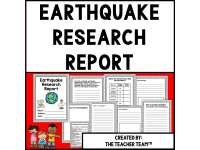
Engage your students with this fun and comprehensive, 34-page Earthquakes Research Report resource. It helps make report writing easy! It contains worksheets, questions, organizers, tools, forms, and academic vocabulary for your students to create, develop, write, edit, illustrate, present, and assess your students’ Earthquakes Research Report.
This report is also designed to help students explain new information and apply it through higher-level questions. You can use this report template in its entirety, or “pick and choose” the questions that you wish to use and tailor it to your students’ needs. This package contains the following earthquake report elements:
1. Title Page- Templates Provided-Topic, student’s name, and teacher’s name - We
created gray-scale version if you can’t copy in color.
2. What is an earthquake?
3. There are three different types of faults; strike-slip, normal, and reverse (thrust)
faults. Research them, describe them, and illustrate them.
4. Where do earthquakes occur and what are the relationships between plates,
faults and earthquakes?
5. What is the Ring of Fire? Describe and illustrate.
6. What is liquefaction?
7. What are “P” waves and “S” waves?
8. What are aftershocks and foreshocks?
9. Can they currently be predicted? What current technology or research being
done on this endeavor?
10. How are earthquakes measured and what is the Mercalli Scale of earthquake
intensity?
11. How are tsunamis and earthquakes related?
12. Seismologists in California often discuss the probabilities of when “The Big
One” will occur. Describe what they mean and why is it important?
13. The website “The United States Geological Survey” or usgs.gov, has real- time
information about earthquakes. With permission from an adult, go onto this
website and write about the information that can be found there.
14. Choose two major historical earthquakes that you are interested in and
compare and contrast them. What are their similarities and differences?
15. If an 8.0 magnitude earthquake occurred in a major United States city
tomorrow, what possible events could occur? Describe what you think the first
day after the earthquake would be like.
16. How can people prepare for future earthquakes?
17. Make a poster to encourage people to be prepared for earthquakes and list the
major things that people can do to prepare their homes and classrooms.
18. Blank paper to add to any of the questions if more room is needed.
19. Additional Information page for any other facts not discussed in other areas of
the report if needed.
20. How to research your report
21. Note taking bullet form template
22. Note taking lined form template
23. Resource pages and Bibliography Template
24. Student Checklist for editing and revising
25. Rubric for Performance Task Assessment
26. Common Core ELA Standard
27. Teacher Notes
Related resources
More resources teachers may find useful
24 related resources were found using this product's title, contributor, categories and tags.


In the classroom
Teaching tips & learning objectives

Learning objectives
Explain what an earthquake is and how tectonic plates, faults and earthquakes relate to one another
Describe and illustrate strike-slip, normal and reverse faults as three distinct fracture types
Compare and contrast two historical earthquakes, identifying similarities and differences

Teaching tips
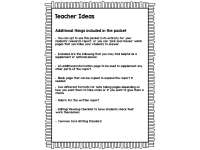
Pick and choose rather than assigning all seventeen pages - the teacher pages say the packet works either way, and the questions are self-contained enough to be split across a group
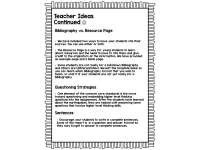
Remind students to answer in complete sentences: the teacher notes warn that the question-and-answer layout makes it easy for them to reply in fragments
Set the USGS page as a supervised task - the file's own research page tells students to get a teacher or parent's approval before searching online

Skills covered
Science research writing - students investigate and write about seventeen earthquake topics, from fault mechanics to the Mercalli intensity scale, one topic to a page.
Comparison writing - one page asks students to choose two major historical earthquakes and write about their similarities and differences.
Self-editing - a nine-item checklist walks students through rereading, spelling, capitalisation, punctuation and peer proofreading before the report is handed in.
Good to know
Questions teachers ask about this resource
Can I assign only part of the packet?
Yes. The teacher notes allow selecting pages to suit the project. You can also choose between note-taking formats and use optional blank or additional-information pages.
How can I introduce source citation?
Start with the resource page and its examples if students are new to recording sources. Use the bibliography template when they are ready for a fuller citation format.

No reviews yet
Downloaded this resource? Tell other teachers how it went.
Curriculum
Standards, concepts & topics
Standards
 Standards
- W.5.7
Core concepts
 Core concepts
Earthquakes
Faults and tectonic plates
Seismic waves
Earthquake measurement
Research report writing
 Topics
Explore related searches
More to explore
You may also like