



2,661 products added recently
History Lesson Plans
Transport your students through time with history lesson plans that vividly illustrate past events and societies. These resources include primary sources, discussions, and projects. Implement them to foster critical thinking and a deeper understanding of our world's history.

 Show filters


Baseball Reading Comprehension Passage - Cored Ed Encyclopedia
ELA, Language Development, Reading Comprehension, Reading, Social Studies, Writing, Vocabulary, History, Geography, Pre-Reading, Grade 2, 3, 4, 5, Worksheets & Printables, Worksheets, Teacher Tools, Centers, Activities, Writing Prompts, Assessments, Quizzes and Tests, Quizzes, Lesson Plans
This baseball reading comprehension with lesson plan includes: Visualization (on the front cover) Start your lesson by taking a minute to think and share something about the topic. Read the script aloud (slowly), perhaps prepare some music or sound effects. Student close their eyes and let their imaginations wander. Students open their eyes, read the question aloud and give them a few minutes to complete. Ask a few students to share or keep answers until the end to compare with what they learn in the passage. COMPANION VIDEO NOW AVAILABLE (EMBEDDED AFTER PREVIEW PICTURES IN PRODUCT DESCRIPTION) Quick pause—thousands of Cored Education products are included with your TeachSimple membership. Download links and encyclopedia index available here. Pre-Reading Trivia Students will write down one thing they already know about the subject and then read five more facts and discuss. These facts are fun, and the students will enjoy learning about the subject before reading more. Give 1 minute for students to write what they already know (no pressure—best guess is fine). Read the five facts together. After each fact, do ask a student for their opinion, was it surprising? Set a purpose by asking students to highlight/underline one fact they want to learn more about during the reading. Reading Passage The text is a high-interest reading passage with set paragraphs, roughly three to four paragraphs long. It contains a variety of themes about the topic, anywhere from history to technology. The passage is between 250 and 350 words in length. First, ask students to look at the headings and see what they’ll learn about today. What do they know about the topic/heading? First read options: Teacher read-aloud (best for support). Partner reading (paragraph by paragraph). While reading, students underline important details, and vocabulary words they think may come up in the questions section. Mixed Questions The first question page contains four multiple-choice questions, each with a choice of four answers, and three written response questions that require a sentence or two from the student. Students complete the mcqs first independently, then review quickly as a class. For the 3 written responses, try to get students giving the answer with some form of evidence: “I think ___ because the text says ___.” If students get stuck, send them back to check the passage. Vocabulary Questions Practice seven key words from the text in this section across two activities. First section is scrambled words where students will unscramble three words given a clue for each. The second section is a word to meaning matching activity. Before starting, have some students read out words they underlined in the passage. Ask students to say the word and read aloud the sentence(s) around each word. Ask students to do scrambled words and the matching exercise in pairs then go through answers as a class. For the scrambled spelling task, get four pairs to come up to the board and write the words for extra practice with the other student reading out the clue. For the matching task, prompt students to give full sentences: “I matched ___ with ___ because ___.” Creative Writing In this question, the student will be required to write a five to eight sentence paragraph on a question related to the topic. Before starting, ask students write down 3 key ideas they are going to include in their piece. Ask students for ideas to share around the class to help those struggling. Pro writing expectations: 5–8 sentences At least 2 facts or details from the passage At least 2 vocabulary words from the previous page Students read their paragraphs while classmates listen for facts and vocabulary words. Extension Activities This page is optional for fast finishers or to take home. There are several activities, each one requiring a different skill. Do some, do none, do all, completely optional - but you will feel reassured knowing every possibility is planned for. Includes summary writting question and additional facts. Answer Key There are answers for the multiple-choice questions, written response questions have sample answers, vocabulary answers and if there is a summary question then a sample summary will be provided as well. Lesson Plan Included Customized lesson plan for this lesson is included. Lesson Snapshot Title: Baseball Genre: Nonfiction (informational passage) Subject: Physical Education / Social Studies (Sports history) / Reading (Informational Text) Primary Topic: How baseball works and how it spread Estimated Guided Reading Level (A–Z): S What This Lesson Teaches Best Clear explanation of how a baseball game works (bases in a diamond, two teams, innings, outs, extra innings). How shared written rules helped organize the modern game (clubs writing rules; later standards like nine innings and a 90-foot base path). A brief timeline of key turning points using dates and evidence (1845 rules, 1869 first all-professional team, 1903 World Series, 1872 introduction in Japan). How baseball changed as it grew (teams traveling, paid players, big leagues forming, some leagues using timing rules). How baseball spread beyond its early American home (popularity across parts of the Americas and East Asia). Learning Goals Identify key parts of a baseball game described in the passage (bases, teams, innings, outs, extra innings). Explain how keeping shared rules helped baseball become more organized. Describe the “safer idea” included in the 1845 rules. Describe what it meant for baseball to turn “professional,” using details from the text. Retell the passage’s key dates in order and explain what happened at each date. Describe how the passage shows baseball spreading to new places and continuing to change. Key Vocabulary From the Text inning — part of the game when teams take turns playing. outs — times when a player is put out. standards — agreed-upon rules that many people follow. professional — paid to play as a job. leagues — organized groups of teams that play each other. FULL CATALOG OF DOWNLOAD LINKS AND ENCYCLOPEDIA INDEX HERE
Author Cored Education
Rating
Tags Vocabulary, Reading Comprehension, Reading Passages, Lesson Plans, Ela Lesson Plans, Reading Comprehension Lesson Plans, Pre-reading, History, History Lesson Plans, Social Studies Lesson Plans

Ancient Civilizations: Rome Unit Study
Social Studies, History, History: Ancient, Grade 3, 4, 5, 6, Lesson Plans, Teacher Tools
Reawaken the wonders of ancient Roman civilization with this expansive teaching toolkit. Through vivid posters, interactive maps and crafts, pupils uncover facets of daily life alongside major events that shaped Western history. Introduce figures like Julius Caesar and Caligula while tracing Rome’s rise and fall on an illustrated timeline. Articles adapted to two reading levels unpack triumphs in infrastructure along with gladiatorial spectacles. Extend comprehension via coloring pages, coin templates and hands-on activities /projects/projects-by-subject/math-projects/3d-projects">3D projects building chariots, wreaths and architectural marvels like the Colosseum. Interdisciplinary writing prompts, artifact analysis activities and video links encourage connections between past and present. Worksheets allow learners to outline their own Roman city informed by geography concepts. Assess retention with a competitive Jeopardy-style game addressing everything from Latin derivations to deities. This Roman Empire package contains plentiful teacher support outlining connections to social studies standards across grades 3-8. Easily incorporate engaging elements into existing units or facilitate an entire stand-alone study on the grandeur that was Rome. Through multi-sensory materials, tap into the visual, auditory and kinesthetic channels vital for concept retention. Rediscover what shaped Europe and the Mediterranean two millennia ago! Check out other resources from my store: Simply Schoolgirl! I can be contacted for questions and concerns at simplyschoolgirl1@gmail.com
Author Simply Schoolgirl
Tags Ancient Rome, Social Studies, Nonfiction Book, Artifacts, Landmarks, Italy, Romans, Aquaducts, Gladiators, Chariots, Rome Ancient Civilizations
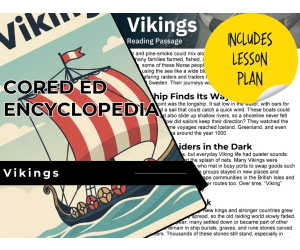
Vikings Reading Comprehension Passage - Cored Ed Encyclopedia
ELA, Language Development, Reading Comprehension, Reading, Pre-Reading, History, Social Studies, History: Europe, History: British, Vocabulary, Grade 2, 3, 4, 5, Worksheets & Printables, Worksheets, Teacher Tools, Centers, Activities, Writing Prompts, Assessments, Quizzes and Tests, Quizzes, Lesson Plans
This Vikings reading comprehension with lesson plan includes: Visualization (on the front cover) Start your lesson by taking a minute to think and share something about the topic. Read the script aloud (slowly), perhaps prepare some music or sound effects. Student close their eyes and let their imaginations wander. Students open their eyes, read the question aloud and give them a few minutes to complete. Ask a few students to share or keep answers until the end to compare with what they learn in the passage. Quick pause—thousands of Cored Education products are included with your TeachSimple membership. Download links and encyclopedia index available here. Pre-Reading Trivia Students will write down one thing they already know about the subject and then read five more facts and discuss. These facts are fun, and the students will enjoy learning about the subject before reading more. Give 1 minute for students to write what they already know (no pressure—best guess is fine). Read the five facts together. After each fact, do ask a student for their opinion, was it surprising? Set a purpose by asking students to highlight/underline one fact they want to learn more about during the reading. Reading Passage The text is a high-interest reading passage with set paragraphs, roughly three to four paragraphs long. It contains a variety of themes about the topic, anywhere from history to technology. The passage is between 250 and 350 words in length. First, ask students to look at the headings and see what they’ll learn about today. What do they know about the topic/heading? First read options: Teacher read-aloud (best for support). Partner reading (paragraph by paragraph). While reading, students underline important details, and vocabulary words they think may come up in the questions section. Mixed Questions The first question page contains four multiple-choice questions, each with a choice of four answers, and three written response questions that require a sentence or two from the student. Students complete the mcqs first independently, then review quickly as a class. For the 3 written responses, try to get students giving the answer with some form of evidence: “I think ___ because the text says ___.” If students get stuck, send them back to check the passage. Vocabulary Questions Practice seven key words from the text in this section across two activities. First section is scrambled words where students will unscramble three words given a clue for each. The second section is a word to meaning matching activity. Before starting, have some students read out words they underlined in the passage. Ask students to say the word and read aloud the sentence(s) around each word. Ask students to do scrambled words and the matching exercise in pairs then go through answers as a class. For the scrambled spelling task, get four pairs to come up to the board and write the words for extra practice with the other student reading out the clue. For the matching task, prompt students to give full sentences: “I matched ___ with ___ because ___.” Creative Writing In this question, the student will be required to write a five to eight sentence paragraph on a question related to the topic. Before starting, ask students write down 3 key ideas they are going to include in their piece. Ask students for ideas to share around the class to help those struggling. Pro writing expectations: 5–8 sentences At least 2 facts or details from the passage At least 2 vocabulary words from the previous page Students read their paragraphs while classmates listen for facts and vocabulary words. Extension Activities This page is optional for fast finishers or to take home. There are several activities, each one requiring a different skill. Do some, do none, do all, completely optional - but you will feel reassured knowing every possibility is planned for. Includes summary writting question. Answer Key There are answers for the multiple-choice questions, written response questions have sample answers, vocabulary answers and if there is a summary question then a sample summary will be provided as well. Lesson Plan Included Customized lesson plan for this lesson is included. Lesson Snapshot Title: Vikings Genre: Nonfiction (Informational text) Subject: Social Studies (History/Culture) Primary Topic: Viking travel, daily life, and lasting clues Estimated Guided Reading Level (A–Z): Q Support pages included: Visualization prompt, pre-reading trivia, mixed questions, vocabulary activities, creative writing, extension activities, and an answer key. QA check on support pages: The questions/vocabulary generally match the passage; the visualization prompt includes extra sensory details (e.g., “carved dragons,” a “small market”) that are not stated in the reading passage. What This Lesson Teaches Best Geography and origins of Viking-age people: Describes rocky coasts of Scandinavia and connects Vikings to places now Denmark, Norway, and Sweden. Why longships mattered for travel: Explains how longships used oars and a sail, crossed open seas, and moved up shallow rivers. Navigation using nature: States that sailors watched the Sun and stars to keep direction. A fuller view of Viking life: Notes that Vikings farmed, crafted, and traded goods (furs, metalwork, silver), and some blended with local people and helped shape communities. How history leaves evidence: Identifies lasting clues such as ship burials, graves, rune stones, and written sagas. Learning Goals Students will describe where Vikings lived and what the passage says the coasts were like. Students will explain how the longship’s design helped Vikings travel to many places. Students will identify how Viking sailors kept direction while traveling. Students will summarize everyday Viking jobs and trade goods named in the text. Students will list evidence the passage says still helps us learn about Vikings today. Key Vocabulary From the Text Scandinavia — a northern European region where many Vikings lived. Norse — people from Scandinavia in the passage. longship — a Viking boat with oars and a sail. Christianity — a religion that spread as times changed. sagas — stories written down from spoken memories. Discussion Prompts Pre-reading question: What details in the passage describe the coasts of Scandinavia? Comprehension questions: When did some Norse people begin traveling farther than neighbors expected? Comprehension questions: How did the longship help Vikings cross seas and travel up rivers? Comprehension questions: What clues does the passage say still remain today to help us learn about Vikings? FULL CATALOG OF DOWNLOAD LINKS AND ENCYCLOPEDIA INDEX HERE
Author Cored Education
Rating
Tags Vocabulary, Reading Comprehension, Reading Passages, Lesson Plans, Ela Lesson Plans, Reading Comprehension Lesson Plans, Pre-reading, History Lesson Plans, European History, British History

Hiking Reading Comprehension Passage - Cored Ed Encyclopedia
ELA, Reading Comprehension, Reading, Pre-Reading, Language Development, History, Social Studies, Geography, P.E. & Health, Physical Education, Grade 2, 3, 4, 5, Worksheets & Printables, Worksheets, Teacher Tools, Centers, Activities, Writing Prompts, Assessments, Quizzes and Tests, Quizzes, Lesson Plans
This hiking reading comprehension with lesson plan includes: Visualization (on the front cover) Start your lesson by taking a minute to think and share something about the topic. Read the script aloud (slowly), perhaps prepare some music or sound effects. Student close their eyes and let their imaginations wander. Students open their eyes, read the question aloud and give them a few minutes to complete. Ask a few students to share or keep answers until the end to compare with what they learn in the passage. Quick pause—thousands of Cored Education products are included with your TeachSimple membership. Download links and encyclopedia index available here. Pre-Reading Trivia Students will write down one thing they already know about the subject and then read five more facts and discuss. These facts are fun, and the students will enjoy learning about the subject before reading more. Give 1 minute for students to write what they already know (no pressure—best guess is fine). Read the five facts together. After each fact, do ask a student for their opinion, was it surprising? Set a purpose by asking students to highlight/underline one fact they want to learn more about during the reading. Reading Passage The text is a high-interest reading passage with set paragraphs, roughly three to four paragraphs long. It contains a variety of themes about the topic, anywhere from history to technology. The passage is between 250 and 350 words in length. First, ask students to look at the headings and see what they’ll learn about today. What do they know about the topic/heading? First read options: Teacher read-aloud (best for support). Partner reading (paragraph by paragraph). While reading, students underline important details, and vocabulary words they think may come up in the questions section. Mixed Questions The first question page contains four multiple-choice questions, each with a choice of four answers, and three written response questions that require a sentence or two from the student. Students complete the mcqs first independently, then review quickly as a class. For the 3 written responses, try to get students giving the answer with some form of evidence: “I think ___ because the text says ___.” If students get stuck, send them back to check the passage. Vocabulary Questions Practice seven key words from the text in this section across two activities. First section is scrambled words where students will unscramble three words given a clue for each. The second section is a word to meaning matching activity. Before starting, have some students read out words they underlined in the passage. Ask students to say the word and read aloud the sentence(s) around each word. Ask students to do scrambled words and the matching exercise in pairs then go through answers as a class. For the scrambled spelling task, get four pairs to come up to the board and write the words for extra practice with the other student reading out the clue. For the matching task, prompt students to give full sentences: “I matched ___ with ___ because ___.” Creative Writing In this question, the student will be required to write a five to eight sentence paragraph on a question related to the topic. Before starting, ask students write down 3 key ideas they are going to include in their piece. Ask students for ideas to share around the class to help those struggling. Pro writing expectations: 5–8 sentences At least 2 facts or details from the passage At least 2 vocabulary words from the previous page Students read their paragraphs while classmates listen for facts and vocabulary words. Extension Activities This page is optional for fast finishers or to take home. There are several activities, each one requiring a different skill. Do some, do none, do all, completely optional - but you will feel reassured knowing every possibility is planned for. Includes summary writting question and additional facts. Answer Key There are answers for the multiple-choice questions, written response questions have sample answers, vocabulary answers and if there is a summary question then a sample summary will be provided as well. Lesson Plan Included Customized lesson plan for this lesson is included. Lesson Snapshot Title: Hiking Genre: Nonfiction (informational text) Subject: Health / Physical Education Primary Topic: What hiking is, its history, and staying safe Estimated Guided Reading Level (A–Z): Q What This Lesson Teaches Best Defines hiking as “more than a stroll” and describes what hiking feels like on a trail or footpath. Explains how walking shifted from serious reasons (like religious pilgrimages) to walking for pleasure and adventure. Describes how trails needed signs, maps, and protection as hiking grew, including work to build and maintain the Appalachian Trail. Teaches basic hiking safety and preparedness (boots/shoes, backpack supplies, and the “Ten Essentials” such as a compass and first-aid kit). Names risks hikers can face when weather shifts or routes disappear, including dehydration and hypothermia. Learning Goals Students will describe what hiking is using details from the passage. Students will explain why people walked long ago and how walking for pleasure grew later. Students will identify why trails needed signs, maps, and protection as more people hiked. Students will describe what the passage says about the Appalachian Trail (where it stretches and how long it is). Students will list items hikers pack to “stay alert” and connect them to safety. Students will name risks mentioned in the text that can affect hikers’ bodies. Key Vocabulary From the Text pilgrimages — long journeys taken for religious reasons. destinations — places people want to go or visit. organizations — groups that work together for a purpose. dehydration — not enough water in the body. hypothermia — when the body gets too cold. FULL CATALOG OF DOWNLOAD LINKS AND ENCYCLOPEDIA INDEX HERE
Author Cored Education
Rating
Tags Vocabulary, Reading Comprehension, Reading Passages, Lesson Plans, Ela Lesson Plans, Reading Comprehension Lesson Plans, Pre-reading, Health Lesson Plans, Social Studies Lesson Plans, P.e.
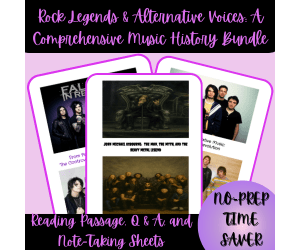
High School Rock Legends and Alternative Voices Reading Passage Bundle
ELA, Reading, Writing, Research, Resources for Teachers, Social Studies, History, High School, Homeschool Resources, Worksheets & Printables, Writing Prompts, Teacher Tools, Assessments, Lesson Plans, Quizzes and Tests
As a homeschool mom navigating high school literature and history with my 9th grader, I know firsthand how tough it can be to find materials that actually grab our kids' attention. That is exactly why I created this High School Rock Legends & Alternative Music Reading Passages Bundle - because music has this amazing way of connecting with teenagers that dusty textbooks just can't touch. This three-resource collection takes students on a real journey through influential musical movements and artists, diving way deeper than basic biographical facts to explore the cultural significance, artistic evolution, and social commentary that made these musicians legendary. Whether you are a fellow homeschool parent wanting to energize your curriculum or you are just looking for something that will genuinely engage your teenager, this High School Rock Legends & Alternative Music Reading Passages Bundle delivers content that sparks actual discussions, gets them thinking critically, and connects historical events to issues that matter to them today - all while challenging them to explore themes of identity, authenticity, and overcoming obstacles that really resonate with their own experiences. INCLUDED IN THIS RESOURCE: British Alternative Music John Michael Osbourne Falling in Reverse All answer keys include detailed explanations and sample responses for guided discussion TOPICS COVERED: British alternative music movement and cultural impact (The Smiths, Radiohead, Arctic Monkeys, The Cure) Heavy metal origins and artistic evolution through pioneering musicians Contemporary rock themes of redemption, authenticity, and second chances Cultural movements, industry evolution, and the intersection of art and controversy This comprehensive High School Rock Legends & Alternative Music Reading Passages Bundle represents more than just music history—it is a tool for developing the kind of critical thinking, analytical writing, and cultural literacy that will serve students/homeschoolers throughout their academic careers and beyond. By connecting academic skills to topics that genuinely interest teenagers, these resources create learning experiences that feel meaningful and relevant rather than simply assigned. The combination of engaging content, rigorous questioning, and thorough support materials makes this collection an invaluable addition to any high school curriculum seeking to bridge the gap between academic excellence and student/homeschooler engagement. If you and your students/homeschoolers enjoyed this resource, please leave a review. Thank you for your support! Tina - Big Easy Homeschooling Mom
Author Homeschool with Big Easy Homeschooling Mom
Rating
Tags British Alternative Music Cultural Revolution Reading Passage, John Michael Osbourne Heavy Metal Legend Biography Study, Falling In Reverse Contemporary Rock Critical Analysis, British Alternative Music Smiths Radiohead Educational Materials, Heavy Metal Origins Cultural Impact Lesson Plans, Contemporary Rock Redemption Themes Analytical Questions, High School English Resources, Homeschool Music Resources, Homeschool Music Curriculum
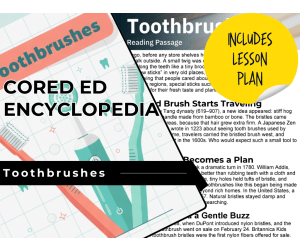
Toothbrushes Reading Comprehension Passage - Cored Ed Encyclopedia
ELA, Language Development, Reading Comprehension, Reading, Science, Technology, Engineering, History, Social Studies, Life Sciences, Grade 2, 3, 4, 5, Worksheets & Printables, Worksheets, Teacher Tools, Centers, Activities, Writing Prompts, Assessments, Quizzes and Tests, Quizzes, Lesson Plans
This toothbrushes reading comprehension includes: Visualization (on the front cover) Start your lesson by taking a minute to think and share something about the topic. Read the script aloud (slowly), perhaps prepare some music or sound effects. Student close their eyes and let their imaginations wander. Students open their eyes, read the question aloud and give them a few minutes to complete. Ask a few students to share or keep answers until the end to compare with what they learn in the passage. Quick pause—thousands of Cored Education products are included with your TeachSimple membership. Download links and encyclopedia index available here. Pre-Reading Trivia Students will write down one thing they already know about the subject and then read five more facts and discuss. These facts are fun, and the students will enjoy learning about the subject before reading more. Give 1 minute for students to write what they already know (no pressure—best guess is fine). Read the five facts together. After each fact, do ask a student for their opinion, was it surprising? Set a purpose by asking students to highlight/underline one fact they want to learn more about during the reading. Reading Passage The text is a high-interest reading passage with set paragraphs, roughly three to four paragraphs long. It contains a variety of themes about the topic, anywhere from history to technology. The passage is between 250 and 350 words in length. First, ask students to look at the headings and see what they’ll learn about today. What do they know about the topic/heading? First read options: Teacher read-aloud (best for support). Partner reading (paragraph by paragraph). While reading, students underline important details, and vocabulary words they think may come up in the questions section. Mixed Questions The first question page contains four multiple-choice questions, each with a choice of four answers, and three written response questions that require a sentence or two from the student. Students complete the mcqs first independently, then review quickly as a class. For the 3 written responses, try to get students giving the answer with some form of evidence: “I think ___ because the text says ___.” If students get stuck, send them back to check the passage. Vocabulary Questions Practice seven key words from the text in this section across two activities. First section is scrambled words where students will unscramble three words given a clue for each. The second section is a word to meaning matching activity. Before starting, have some students read out words they underlined in the passage. Ask students to say the word and read aloud the sentence(s) around each word. Ask students to do scrambled words and the matching exercise in pairs then go through answers as a class. For the scrambled spelling task, get four pairs to come up to the board and write the words for extra practice with the other student reading out the clue. For the matching task, prompt students to give full sentences: “I matched ___ with ___ because ___.” Creative Writing In this question, the student will be required to write a five to eight sentence paragraph on a question related to the topic. Before starting, ask students write down 3 key ideas they are going to include in their piece. Ask students for ideas to share around the class to help those struggling. Pro writing expectations: 5–8 sentences At least 2 facts or details from the passage At least 2 vocabulary words from the previous page Students read their paragraphs while classmates listen for facts and vocabulary words. Extension Activities This page is optional for fast finishers or to take home. There are several activities, each one requiring a different skill. Do some, do none, do all, completely optional - but you will feel reassured knowing every possibility is planned for. Includes summary writting question. Answer Key There are answers for the multiple-choice questions, written response questions have sample answers, vocabulary answers and if there is a summary question then a sample summary will be provided as well. Lesson Plan Included Customized lesson plan for this lesson is included. Lesson Snapshot Title: Toothbrushes Genre: Nonfiction (informational text) Subject: Science (Health & Technology) Primary Topic: How toothbrushes changed over time Estimated Guided Reading Level (A–Z): R What This Lesson Teaches Best Explains how people cleaned teeth before store-bought toothbrushes by chewing a twig until it turned “fuzzy” and rubbing it on teeth. Shows how evidence from the past (archaeologists finding signs in places like Mesopotamia and Egypt) can tell us about tooth care long ago. Traces the history of the bristled brush from China’s Tang dynasty to Europe in the 1600s, highlighting how inventions travel. Describes how toothbrush designs changed to solve problems (for example, natural bristles staying damp and trapping bacteria). Summarizes key innovations—nylon bristles (1938) and the electric toothbrush (1954)—and connects them to the ongoing goal of protecting teeth. Learning Goals Students will describe how a “chew stick” was used to clean teeth long ago. Students will identify evidence in the text that people cared about clean mouths thousands of years ago. Students will explain how the bristled brush began in China and later spread to Europe. Students will summarize how toothbrush-making changed after 1780 using details about materials and design. Students will explain why inventors searched for new bristle materials and what nylon changed. Students will describe how an electric toothbrush helped brushing by adding steady motion. Key Vocabulary From the Text archaeologists — scientists who study the past using old remains. Mesopotamia — an ancient region where people lived long ago. miswak — a special stick used for cleaning teeth. patent — legal rights that protect an invention. bacteria — tiny germs that can cause problems. FULL CATALOG OF DOWNLOAD LINKS AND ENCYCLOPEDIA INDEX HERE
Author Cored Education
Rating
Tags Vocabulary, Reading Comprehension, Reading Passages, Lesson Plans, Ela Lesson Plans, Reading Comprehension Lesson Plans, Pre-reading, History, History Lesson Plans, Toothbrushes
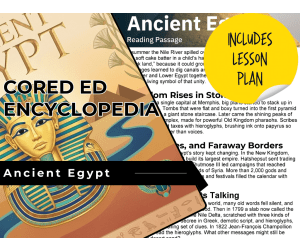
Ancient Egypt Reading Comprehension Passage - Cored Ed Encyclopedia
ELA, Language Development, Reading Comprehension, Reading, Social Studies, History, History: Ancient, Writing, Pre-Reading, Vocabulary, Grade 2, 3, 4, 5, Worksheets & Printables, Worksheets, Teacher Tools, Centers, Activities, Writing Prompts, Assessments, Quizzes and Tests, Quizzes, Lesson Plans
This ancient Egypt reading comprehension with lesson plan includes: Visualization (on the front cover) Start your lesson by taking a minute to think and share something about the topic. Read the script aloud (slowly), perhaps prepare some music or sound effects. Student close their eyes and let their imaginations wander. Students open their eyes, read the question aloud and give them a few minutes to complete. Ask a few students to share or keep answers until the end to compare with what they learn in the passage. Quick pause—thousands of Cored Education products are included with your TeachSimple membership. Download links and encyclopedia index available here. Pre-Reading Trivia Students will write down one thing they already know about the subject and then read five more facts and discuss. These facts are fun, and the students will enjoy learning about the subject before reading more. Give 1 minute for students to write what they already know (no pressure—best guess is fine). Read the five facts together. After each fact, do ask a student for their opinion, was it surprising? Set a purpose by asking students to highlight/underline one fact they want to learn more about during the reading. Reading Passage The text is a high-interest reading passage with set paragraphs, roughly three to four paragraphs long. It contains a variety of themes about the topic, anywhere from history to technology. The passage is between 250 and 350 words in length. First, ask students to look at the headings and see what they’ll learn about today. What do they know about the topic/heading? First read options: Teacher read-aloud (best for support). Partner reading (paragraph by paragraph). While reading, students underline important details, and vocabulary words they think may come up in the questions section. Mixed Questions The first question page contains four multiple-choice questions, each with a choice of four answers, and three written response questions that require a sentence or two from the student. Students complete the mcqs first independently, then review quickly as a class. For the 3 written responses, try to get students giving the answer with some form of evidence: “I think ___ because the text says ___.” If students get stuck, send them back to check the passage. Vocabulary Questions Practice seven key words from the text in this section across two activities. First section is scrambled words where students will unscramble three words given a clue for each. The second section is a word to meaning matching activity. Before starting, have some students read out words they underlined in the passage. Ask students to say the word and read aloud the sentence(s) around each word. Ask students to do scrambled words and the matching exercise in pairs then go through answers as a class. For the scrambled spelling task, get four pairs to come up to the board and write the words for extra practice with the other student reading out the clue. For the matching task, prompt students to give full sentences: “I matched ___ with ___ because ___.” Creative Writing In this question, the student will be required to write a five to eight sentence paragraph on a question related to the topic. Before starting, ask students write down 3 key ideas they are going to include in their piece. Ask students for ideas to share around the class to help those struggling. Pro writing expectations: 5–8 sentences At least 2 facts or details from the passage At least 2 vocabulary words from the previous page Students read their paragraphs while classmates listen for facts and vocabulary words. Extension Activities This page is optional for fast finishers or to take home. There are several activities, each one requiring a different skill. Do some, do none, do all, completely optional - but you will feel reassured knowing every possibility is planned for. Includes summary writting question and additional facts. Answer Key There are answers for the multiple-choice questions, written response questions have sample answers, vocabulary answers and if there is a summary question then a sample summary will be provided as well. Lesson Plan Included Customized lesson plan for this lesson is included. Lesson Snapshot Title: Ancient Egypt Genre: Nonfiction (informational passage) Subject: Social Studies Primary Topic: Nile flooding, kingdoms, pyramids, and writing Estimated Guided Reading Level (A–Z): T What This Lesson Teaches Best How the Nile River flooding left dark mud that helped farming and food growth. The meaning of Kemet (“black land”) and why it described the fertile farming strip. How leaders joined Upper Egypt and Lower Egypt into one kingdom, with the pharaoh as a symbol of unity. Key achievements in building and record-keeping (pyramids, scribes, hieroglyphs, papyrus, grain and taxes). How the Rosetta Stone helped scholars decode hieroglyphs by showing the same text in three kinds of writing. Learning Goals Explain how the Nile River’s yearly flooding helped people grow food. Describe why people called the fertile farm area Kemet, or “black land.” Identify ways ancient Egyptians organized and strengthened their kingdom (sharing water, one ruler, a capital). Describe how pyramids changed over time (step pyramid for Djoser and later pyramids at Giza). Explain how scribes used hieroglyphs and papyrus to keep records of grain and taxes. Describe how the Rosetta Stone led to reading hieroglyphs again. Key Vocabulary From the Text fertile — able to grow lots of plants. pharaoh — ruler of ancient Egypt. hieroglyphs — picture symbols used for writing. papyrus — plant paper used for writing. decree — an official order from leaders. FULL CATALOG OF DOWNLOAD LINKS AND ENCYCLOPEDIA INDEX HERE
Author Cored Education
Rating
Tags Vocabulary, Reading Comprehension, Reading Passages, Lesson Plans, Ela Lesson Plans, Reading Comprehension Lesson Plans, Pre-reading, History, Ancient History Lesson Plans, History Lesson Plans
Chess Reading Comprehension Passage - Cored Ed Encyclopedia
ELA, Language Development, Reading Comprehension, Reading, Pre-Reading, Science, Social Studies, Geography, History, Technology, Grade 2, 3, 4, 5, Worksheets & Printables, Worksheets, Teacher Tools, Centers, Activities, Writing Prompts, Assessments, Quizzes and Tests, Quizzes, Lesson Plans
This chess reading comprehension with lesson plan includes: Visualization (on the front cover) Start your lesson by taking a minute to think and share something about the topic. Read the script aloud (slowly), perhaps prepare some music or sound effects. Student close their eyes and let their imaginations wander. Students open their eyes, read the question aloud and give them a few minutes to complete. Ask a few students to share or keep answers until the end to compare with what they learn in the passage. COMPANION VIDEO NOW AVAILABLE (EMBEDDED AFTER PREVIEW PICTURES IN PRODUCT DESCRIPTION) Quick pause—thousands of Cored Education products are included with your TeachSimple membership. Download links and encyclopedia index available here. Pre-Reading Trivia Students will write down one thing they already know about the subject and then read five more facts and discuss. These facts are fun, and the students will enjoy learning about the subject before reading more. Give 1 minute for students to write what they already know (no pressure—best guess is fine). Read the five facts together. After each fact, do ask a student for their opinion, was it surprising? Set a purpose by asking students to highlight/underline one fact they want to learn more about during the reading. Reading Passage The text is a high-interest reading passage with set paragraphs, roughly three to four paragraphs long. It contains a variety of themes about the topic, anywhere from history to technology. The passage is between 250 and 350 words in length. First, ask students to look at the headings and see what they’ll learn about today. What do they know about the topic/heading? First read options: Teacher read-aloud (best for support). Partner reading (paragraph by paragraph). While reading, students underline important details, and vocabulary words they think may come up in the questions section. Mixed Questions The first question page contains four multiple-choice questions, each with a choice of four answers, and three written response questions that require a sentence or two from the student. Students complete the mcqs first independently, then review quickly as a class. For the 3 written responses, try to get students giving the answer with some form of evidence: “I think ___ because the text says ___.” If students get stuck, send them back to check the passage. Vocabulary Questions Practice seven key words from the text in this section across two activities. First section is scrambled words where students will unscramble three words given a clue for each. The second section is a word to meaning matching activity. Before starting, have some students read out words they underlined in the passage. Ask students to say the word and read aloud the sentence(s) around each word. Ask students to do scrambled words and the matching exercise in pairs then go through answers as a class. For the scrambled spelling task, get four pairs to come up to the board and write the words for extra practice with the other student reading out the clue. For the matching task, prompt students to give full sentences: “I matched ___ with ___ because ___.” Creative Writing In this question, the student will be required to write a five to eight sentence paragraph on a question related to the topic. Before starting, ask students write down 3 key ideas they are going to include in their piece. Ask students for ideas to share around the class to help those struggling. Pro writing expectations: 5–8 sentences At least 2 facts or details from the passage At least 2 vocabulary words from the previous page Students read their paragraphs while classmates listen for facts and vocabulary words. Extension Activities This page is optional for fast finishers or to take home. There are several activities, each one requiring a different skill. Do some, do none, do all, completely optional - but you will feel reassured knowing every possibility is planned for. Includes summary writting question and additional facts. Answer Key There are answers for the multiple-choice questions, written response questions have sample answers, vocabulary answers and if there is a summary question then a sample summary will be provided as well. Lesson Plan Included Customized lesson plan for this lesson is included. Lesson Snapshot Title: Chess Genre: Nonfiction (informational passage with headings) Subject: Reading (Informational Text) / Social Studies (history & culture) Primary Topic: How chess works and how it changed over time Estimated Guided Reading Level (A–Z): Q What This Lesson Teaches Best Introduces key basics of the game (64 squares, 16 pieces, and the goal of checkmate). Traces chess’s spread across places and cultures (India → Persia → Muslim world → Europe). Explains how rules changed over time (the queen and bishop gaining powerful moves in the late 1400s). Uses a chronological, heading-based structure to show history in clear sections (early origins, Europe, tournaments, computers). Connects chess to modern competition and technology (international tournaments, FIDE, computers like Deep Blue). Learning Goals Students will describe the chessboard and starting pieces using details from the passage. Students will explain what “checkmate” means in the passage. Students will identify where the passage says chess traveled and what it was called in different places. Students will describe the late-1400s rule change mentioned and how it affected games. Students will summarize how chess moved into public life and became an international sport. Students will explain one way computers affected chess, based on the passage. Key Vocabulary From the Text checkmate — the king is trapped with no safe move. ancestor — something that came earlier than something else. chaturanga — an early India game linked to chess. tournament — a contest with many games. calculating — working things out by thinking ahead. FULL CATALOG OF DOWNLOAD LINKS AND ENCYCLOPEDIA INDEX HERE
Author Cored Education
Rating
Tags Vocabulary, Reading Comprehension, Reading Passages, Lesson Plans, Ela Lesson Plans, Reading Comprehension Lesson Plans, Pre-reading, Geography, Social Studies Lesson Plans, History

Jeeps Reading Comprehension Passage - Cored Ed Encyclopedia
ELA, Reading Comprehension, Reading, Language Development, Vocabulary, History, Social Studies, Technology, Science, Pre-Reading, Grade 2, 3, 4, 5, Worksheets & Printables, Worksheets, Teacher Tools, Centers, Activities, Writing Prompts, Assessments, Quizzes and Tests, Quizzes, Lesson Plans
This Jeeps reading comprehension with lesson plan includes: Visualization (on the front cover) Start your lesson by taking a minute to think and share something about the topic. Read the script aloud (slowly), perhaps prepare some music or sound effects. Student close their eyes and let their imaginations wander. Students open their eyes, read the question aloud and give them a few minutes to complete. Ask a few students to share or keep answers until the end to compare with what they learn in the passage. Quick pause—thousands of Cored Education products are included with your TeachSimple membership. Download links and encyclopedia index available here. Pre-Reading Trivia Students will write down one thing they already know about the subject and then read five more facts and discuss. These facts are fun, and the students will enjoy learning about the subject before reading more. Give 1 minute for students to write what they already know (no pressure—best guess is fine). Read the five facts together. After each fact, do ask a student for their opinion, was it surprising? Set a purpose by asking students to highlight/underline one fact they want to learn more about during the reading. Reading Passage The text is a high-interest reading passage with set paragraphs, roughly three to four paragraphs long. It contains a variety of themes about the topic, anywhere from history to technology. The passage is between 250 and 350 words in length. First, ask students to look at the headings and see what they’ll learn about today. What do they know about the topic/heading? First read options: Teacher read-aloud (best for support). Partner reading (paragraph by paragraph). While reading, students underline important details, and vocabulary words they think may come up in the questions section. Mixed Questions The first question page contains four multiple-choice questions, each with a choice of four answers, and three written response questions that require a sentence or two from the student. Students complete the mcqs first independently, then review quickly as a class. For the 3 written responses, try to get students giving the answer with some form of evidence: “I think ___ because the text says ___.” If students get stuck, send them back to check the passage. Vocabulary Questions Practice seven key words from the text in this section across two activities. First section is scrambled words where students will unscramble three words given a clue for each. The second section is a word to meaning matching activity. Before starting, have some students read out words they underlined in the passage. Ask students to say the word and read aloud the sentence(s) around each word. Ask students to do scrambled words and the matching exercise in pairs then go through answers as a class. For the scrambled spelling task, get four pairs to come up to the board and write the words for extra practice with the other student reading out the clue. For the matching task, prompt students to give full sentences: “I matched ___ with ___ because ___.” Creative Writing In this question, the student will be required to write a five to eight sentence paragraph on a question related to the topic. Before starting, ask students write down 3 key ideas they are going to include in their piece. Ask students for ideas to share around the class to help those struggling. Pro writing expectations: 5–8 sentences At least 2 facts or details from the passage At least 2 vocabulary words from the previous page Students read their paragraphs while classmates listen for facts and vocabulary words. Extension Activities This page is optional for fast finishers or to take home. There are several activities, each one requiring a different skill. Do some, do none, do all, completely optional - but you will feel reassured knowing every possibility is planned for. Includes summary writting question and additional facts. Answer Key There are answers for the multiple-choice questions, written response questions have sample answers, vocabulary answers and if there is a summary question then a sample summary will be provided as well. Lesson Plan Included Customized lesson plan for this lesson is included. Lesson Snapshot Title: Jeeps Genre: Nonfiction (informational text) Subject: Social Studies (History) / Reading (Informational Text) Primary Topic: WWII jeep origins and how the Jeep line evolved Estimated Guided Reading Level (A–Z): S What This Lesson Teaches Best Explains why the U.S. Army wanted a small, tough 4-wheel-drive truck in 1940 and how designs led to the World War II jeep (Willys MB and Ford GPW). Uses concrete facts and numbers (more than 600,000 built; held 3 to 6 people; carried scouts, messengers, and heavy gear). Explores multiple possible origins of a word/nickname (“g.p.”, soldier slang, and Eugene the Jeep) and shows that history can have more than one source. Traces change over time: military jeep → civilian CJs (starting 1945) → a family of vehicles including SUVs and the Wrangler as a descendant of the CJ line. Supports comprehension with clear section headings that organize the timeline and ideas. Learning Goals Identify the problem armies faced in 1940 and what kind of truck the U.S. Army wanted. Describe two details about World War II jeeps (names, number built, what they carried, or how many people fit). Explain why the passage says the nickname “jeep” is “not that simple,” using text evidence. Describe how jeeps changed after the war when Willys began selling CJs. Summarize how the Jeep line continued and changed “over the years,” including the Wrangler and one feature it kept. Key Vocabulary From the Text 4-wheel-drive — power can go to all four wheels. nickname — a fun or short name. civilian — not in the military. surplus — extra items left over after use. descendant — a newer vehicle from the same family line. FULL CATALOG OF DOWNLOAD LINKS AND ENCYCLOPEDIA INDEX HERE
Author Cored Education
Rating
Tags Vocabulary, Reading Comprehension, Reading Passages, Lesson Plans, Ela Lesson Plans, Reading Comprehension Lesson Plans, Pre-reading, Social Studies Lesson Plans, History, Technology
Tanks Reading Comprehension Passage - Cored Ed Encyclopedia
ELA, Language Development, Reading Comprehension, Reading, Pre-Reading, Science, Technology, Engineering, History, Social Studies, Grade 2, 3, 4, 5, Worksheets & Printables, Worksheets, Teacher Tools, Centers, Activities, Writing Prompts, Assessments, Quizzes and Tests, Quizzes, Lesson Plans
This tanks reading comprehension includes: Visualization (on the front cover) Start your lesson by taking a minute to think and share something about the topic. Read the script aloud (slowly), perhaps prepare some music or sound effects. Student close their eyes and let their imaginations wander. Students open their eyes, read the question aloud and give them a few minutes to complete. Ask a few students to share or keep answers until the end to compare with what they learn in the passage. Quick pause—thousands of Cored Education products are included with your TeachSimple membership. Download links and encyclopedia index available here. Pre-Reading Trivia Students will write down one thing they already know about the subject and then read five more facts and discuss. These facts are fun, and the students will enjoy learning about the subject before reading more. Give 1 minute for students to write what they already know (no pressure—best guess is fine). Read the five facts together. After each fact, do ask a student for their opinion, was it surprising? Set a purpose by asking students to highlight/underline one fact they want to learn more about during the reading. Reading Passage The text is a high-interest reading passage with set paragraphs, roughly three to four paragraphs long. It contains a variety of themes about the topic, anywhere from history to technology. The passage is between 250 and 350 words in length. First, ask students to look at the headings and see what they’ll learn about today. What do they know about the topic/heading? First read options: Teacher read-aloud (best for support). Partner reading (paragraph by paragraph). While reading, students underline important details, and vocabulary words they think may come up in the questions section. Mixed Questions The first question page contains four multiple-choice questions, each with a choice of four answers, and three written response questions that require a sentence or two from the student. Students complete the mcqs first independently, then review quickly as a class. For the 3 written responses, try to get students giving the answer with some form of evidence: “I think ___ because the text says ___.” If students get stuck, send them back to check the passage. Vocabulary Questions Practice seven key words from the text in this section across two activities. First section is scrambled words where students will unscramble three words given a clue for each. The second section is a word to meaning matching activity. Before starting, have some students read out words they underlined in the passage. Ask students to say the word and read aloud the sentence(s) around each word. Ask students to do scrambled words and the matching exercise in pairs then go through answers as a class. For the scrambled spelling task, get four pairs to come up to the board and write the words for extra practice with the other student reading out the clue. For the matching task, prompt students to give full sentences: “I matched ___ with ___ because ___.” Creative Writing In this question, the student will be required to write a five to eight sentence paragraph on a question related to the topic. Before starting, ask students write down 3 key ideas they are going to include in their piece. Ask students for ideas to share around the class to help those struggling. Pro writing expectations: 5–8 sentences At least 2 facts or details from the passage At least 2 vocabulary words from the previous page Students read their paragraphs while classmates listen for facts and vocabulary words. Extension Activities This page is optional for fast finishers or to take home. There are several activities, each one requiring a different skill. Do some, do none, do all, completely optional - but you will feel reassured knowing every possibility is planned for. Includes summary writting question. Answer Key There are answers for the multiple-choice questions, written response questions have sample answers, vocabulary answers and if there is a summary question then a sample summary will be provided as well. Lesson Plan Included Customized lesson plan for this lesson is included. Lesson Snapshot Title: Tanks Genre: Nonfiction (informational text) Subject: Social Studies (History & Technology) Primary Topic: Why tanks were created and how they changed Estimated Guided Reading Level (A–Z): R What This Lesson Teaches Best Explains a real-world problem from World War I (trenches, barbed wire, muddy ground) and why a new machine was needed. Describes how tracks work by spreading a tank’s heavy weight so it doesn’t sink as easily and can cross rough land and trenches. Introduces key tank parts and purposes, including armor plates for protection and a rotating turret that helps the tank aim. Shows how designs changed over time (stronger engines, tougher armor, radios, better sights) and how tanks became part of teams with special jobs. Reinforces the idea that inventions are problem-solving —how to protect people inside a moving machine and travel over hard-to-cross land. Learning Goals Students will identify the main problems soldiers faced on the Western Front that led to tanks being developed. Students will explain how tracks helped early tanks move over muddy ground and cross trenches. Students will describe what a rotating turret does and why it was an important design change. Students will summarize how tanks changed from World War I to the end of World War II using key details from the text. Students will use text evidence to explain how new tools (like radios) helped crews work together. Key Vocabulary From the Text trenches — long ditches where soldiers sheltered during war. barbed — having sharp points that make crossing dangerous. tracks — looped bands that help vehicles grip the ground. turret — a rotating top part that carries the main weapon. armored — protected with strong metal on the outside. FULL CATALOG OF DOWNLOAD LINKS AND ENCYCLOPEDIA INDEX HERE
Author Cored Education
Rating
Tags Vocabulary, Reading Comprehension, Reading Passages, Lesson Plans, Ela Lesson Plans, Reading Comprehension Lesson Plans, Pre-reading, History, Social Studies, Social Studies Lesson Plans

High School The History of St. Patrick's Day Reading Passage
Social Studies, Reading, ELA, Reading Comprehension, Research, Resources for Teachers, History, Writing, High School, Homeschool Resources, Worksheets & Printables, Teacher Tools, Assessments, Lesson Plans, Quizzes and Tests, Writing Prompts
I will be the first to admit that finding "holiday" stuff for high schoolers is a total nightmare because it usually feels like it's meant for a second grader. My 9th-grade daughter is at that stage where if I hand her a "fun" worksheet with a cartoon leprechaun, she just gives me that look—you know the one. I really wanted to create something that respected her intelligence and actually challenged her to write more than just a single sentence. This revamped resource is my answer to that; it has more meat, it is historical, and it actually treats our teens like the capable young adults they are becoming. I poured my heart into making this a "grab-and-go" lesson so you can actually enjoy your coffee while your student/homeschooler dives into some serious history. INCLUDED IN THIS RESOURCE: I have expanded this reading [assage to really dive into Patrick’s life and how this day turned into a worldwide celebration. These 20 deep-dive passage questionsare meant to get them thinking; they require full paragraph answers.I included some structured sheets to help your student catch the big themes and historical changes without feeling totally overwhelmed I have included some note-taking sheets to help your student/homeschooler catch the big themes. I compose full paragraph samples for you, so grading is a breeze and you have a solid starting point for those dinner-table discussions. TOPICS COVERED: Students/Homeschoolers will dive into his kidnapping and the grit it took to survive years of captivity before returning as a leader We look at how the 1840s famine actually turned a religious day into a massive statement of Irish-American pride. Your teen will explore the "why" behind the shamrock and the surprising shift from "St. Patrick's Blue" to green. We analyze how cities from Tokyo to Sydney have reimagined the day, making it a bridge between cultures. I am truly honored to be a small part of your homeschooling journey, and I hope this resource makes your St. Patrick’s Day both educational and stress-free. There is something so special about the moment a student realizes that a holiday they have celebrated their whole life has a much deeper, more significant meaning than they ever imagined. My goal is for this reading passage and the accompanying activities to be the spark for those "lightbulb moments" in your home or classroom. Please know that I am always here to support you, and I am constantly working on new materials that help our high schoolers grow into thoughtful, articulate adults. Thank you so much for trusting my work and for all the incredible effort you put into educating the next generation! If you and your students/homeschoolers enjoyed this resource, please leave a review. Tina - Big Easy Homeschooling Mom
Author Homeschool with Big Easy Homeschooling Mom
Rating
Tags St. Patrick's Day For High School, History Of Saint Patrick Reading Passage, Irish History Curriculum, Saint Patrick Life Story, St. Patrick's Blue History, Corned Beef And Cabbage Origins, Roman Britain Saint Patrick, High School Irish Heritage, History Of St. Patrick For Teens, Saint Patrick Captivity Story
Discovering United Kingdom: Guided Reading Level Q with Lesson Plan
ELA, Resources for Teachers, Reading Comprehension, Reading, Science, Geography, Social Studies, History, Life Sciences, Earth and Environmental Sciences, Grade 3, 4, 5, Worksheets & Printables, Worksheets, Teacher Tools, Centers, Activities, Literacy Readers, Quizzes, Quizzes and Tests, Assessments, Lesson Plans
This Discovering the United Kingdom (level q) guided reading book with lesson plan includes: Guided Reading Color Label (front cover x1) This is a quick way to match the book’s demands to what students can generally handle.. The overall goal is to use the level/color to pick books for several smaller groups. To qualify for a certain level, a student is expected to read a book from that level with about 90–94% accuracy. If a student is consistently accurate and understands, move up a level. If the student is struggling at that level, drop down and add more support. Each student will improve at completely different rates, but it is generally one of the best ways to check progress across the class. DOWNLOAD THE CATALOG TO VIEW ALL GUIDED READING BOOKS AVAILABLE (SORTED LEVELS A-Z) Pre-Reading Question (x1) Teacher asks the prompt aloud, can be while showing the cover or first page. Students share what they already know, or make educated guesses from the cover. Prompt them to use the target vocabulary. Write some of their responses on the board to look back at during the reading. Vocabulary Words (x5) Introduce the five words, best doing it one at a time. Start by saying it, while students repeat and then see if anyone knows what it means before reading further. Read through the meaning and try to briefly connect each word to a picture or gesture so it’s meaningful. Ask students to flip through the book pages and point to where they see each of the vocabulary words. While reading the book pause upon coming across one of the vocab words or read the sentence twice to make sure students understand the word has appeared. Optional: Ask students to raise hands whenever they see/hear one of the new words. Guided Reading Pages (x10) Check the book snapshot (below) for: primary topic - do you need to prep extra reading or intro materials on this? what is taught best - decide on 1-2 bullets to focus on, use the prompt or words provided here for best results. learning goals - what you are checking for students to be able to do after the session, elicit answers using prompts or words provided. key vocabulary (see section above). questions overview - so you know what is coming up and if you need to prep extra materials to assist understanding. Run the lesson You may have already looked at a few of the pages together, but you can show them some of the pictures again first to set meaning. Depending on how much time you have and how familiar your students are with guided reading class, you may want to read the book aloud first with the group first. Students whisper or partner read, while you listen in. If time, do it as a group, one student reading a page each. Use the guided page’s prompts to coach: “Check the picture / does it make sense?” “Point under the words / try the first sound” “Reread the sentence smoothly”. Try to focus more on one student per session (rotating every time), so you can work out if they are ready to move up or need to move down a level. Comprehension Questions (back cover x3) This is your way to check that students didn’t just say the words, but actually understood the text. First, let students answer by pointing to the page/picture and saying a short sentence. After any answer, follow with: “Show me where you found that in the text.” In bigger groups, have partners answer first (10–20 seconds), then call on 2–3 students to share. Differentiation tips: Emerging speakers/struggling readers: oral + pointing On-level: oral in a full sentence Higher: one written sentence or draw + label Book Snapshot Title: Discovering the United Kingdom Genre: Nonfiction Subject: Social Studies (Geography, Government, Culture) Primary Topic: The UK’s nations, landmarks, climate, and culture Estimated Guided Reading Level (A–Z): Q What This Book Teaches Best Introduces the United Kingdom as a union of four countries and explains that each has its own traditions and landscapes. Builds geography knowledge by describing where the UK is located and by highlighting regional features in Scotland, Wales, and Northern Ireland. Teaches civics basics by explaining the UK’s constitutional monarchy and that the elected Parliament makes laws. Connects history and landmarks through examples like Stonehenge and major places in London along the River Thames. Explains how climate supports wildlife and gives an example of conservation connected to the red squirrel. Learning Goals Students will identify the four countries that make up the United Kingdom using details from the text. Students will describe why London is important in the United Kingdom and name one detail about the River Thames from the text. Students will describe key physical features of Scotland and explain what “lochs” are using the text’s description. Students will describe two details the text gives about Wales, such as its landscape, castles, or language. Students will explain how the text describes the UK’s government and who makes laws. Students will explain how the UK’s temperate climate is described and name one effect it has on wildlife. Key Vocabulary From the Text sovereign — able to govern itself. distinct — clearly different. interspersed — spread in between other things. constitutional — based on rules for how a country is run. prehistoric — from before written records. Discussion Prompts Pre-reading question: When you hear “United Kingdom,” what places or facts do you expect to learn about? Comprehension questions: What four countries does the text say make up the United Kingdom? Comprehension questions: What does the text say about who makes laws in the United Kingdom? Comprehension questions: What are two details the text gives about Scotland or Wales? Printing Tips 1. Best Printing Method (Recommended) “Booklet” Printing (Best if Available) If your printer or PDF viewer supports Booklet Printing , use this. Settings to use: Print mode: Booklet Paper size: Letter or A4 (either works) Orientation: Landscape Print on both sides: Yes Flip on: Short edge Scaling: Fit to printable area Booklet subset: First test: Front sides only Then: Back sides only This will automatically: Pair pages correctly Put the cover on the outside Align everything for folding After printing, fold in half and staple along the spine . 2. If “Booklet” Printing Is NOT Available You can still print this correctly with manual duplex printing . Step-by-step: Open the PDF. Choose Print . Set: Orientation: Landscape Pages per sheet: 1 Print on both sides: Yes Flip on: Short edge Print all pages . Because each PDF page already contains two facing book pages, the result will still fold cleanly into a book. Thousands of Cored Education products are included with your TeachSimple membership. Download links and encyclopedia index available here.
Author Cored Education
Rating
Tags Reading Comprehension, Reading Passages, Reading, Guided Reading, Guided Reading Lesson Plan, Guided Reading Activity, Pre-reading, Social Studies, Geography, History
Video Games Reading Comprehension Passage - Cored Ed Encyclopedia
ELA, Language Development, Reading Comprehension, Reading, Pre-Reading, Science, Technology, Engineering, History, Social Studies, Grade 2, 3, 4, 5, Worksheets & Printables, Worksheets, Teacher Tools, Centers, Activities, Writing Prompts, Assessments, Quizzes and Tests, Quizzes, Lesson Plans
This video games reading comprehension with lesson plan includes: Visualization (on the front cover) Start your lesson by taking a minute to think and share something about the topic. Read the script aloud (slowly), perhaps prepare some music or sound effects. Student close their eyes and let their imaginations wander. Students open their eyes, read the question aloud and give them a few minutes to complete. Ask a few students to share or keep answers until the end to compare with what they learn in the passage. Quick pause—thousands of Cored Education products are included with your TeachSimple membership. Download links and encyclopedia index available here. Pre-Reading Trivia Students will write down one thing they already know about the subject and then read five more facts and discuss. These facts are fun, and the students will enjoy learning about the subject before reading more. Give 1 minute for students to write what they already know (no pressure—best guess is fine). Read the five facts together. After each fact, do ask a student for their opinion, was it surprising? Set a purpose by asking students to highlight/underline one fact they want to learn more about during the reading. Reading Passage The text is a high-interest reading passage with set paragraphs, roughly three to four paragraphs long. It contains a variety of themes about the topic, anywhere from history to technology. The passage is between 250 and 350 words in length. First, ask students to look at the headings and see what they’ll learn about today. What do they know about the topic/heading? First read options: Teacher read-aloud (best for support). Partner reading (paragraph by paragraph). While reading, students underline important details, and vocabulary words they think may come up in the questions section. Mixed Questions The first question page contains four multiple-choice questions, each with a choice of four answers, and three written response questions that require a sentence or two from the student. Students complete the mcqs first independently, then review quickly as a class. For the 3 written responses, try to get students giving the answer with some form of evidence: “I think ___ because the text says ___.” If students get stuck, send them back to check the passage. Vocabulary Questions Practice seven key words from the text in this section across two activities. First section is scrambled words where students will unscramble three words given a clue for each. The second section is a word to meaning matching activity. Before starting, have some students read out words they underlined in the passage. Ask students to say the word and read aloud the sentence(s) around each word. Ask students to do scrambled words and the matching exercise in pairs then go through answers as a class. For the scrambled spelling task, get four pairs to come up to the board and write the words for extra practice with the other student reading out the clue. For the matching task, prompt students to give full sentences: “I matched ___ with ___ because ___.” Creative Writing In this question, the student will be required to write a five to eight sentence paragraph on a question related to the topic. Before starting, ask students write down 3 key ideas they are going to include in their piece. Ask students for ideas to share around the class to help those struggling. Pro writing expectations: 5–8 sentences At least 2 facts or details from the passage At least 2 vocabulary words from the previous page Students read their paragraphs while classmates listen for facts and vocabulary words. Extension Activities This page is optional for fast finishers or to take home. There are several activities, each one requiring a different skill. Do some, do none, do all, completely optional - but you will feel reassured knowing every possibility is planned for. Includes summary writting question. Answer Key There are answers for the multiple-choice questions, written response questions have sample answers, vocabulary answers and if there is a summary question then a sample summary will be provided as well. Lesson Plan Included Customized lesson plan for this lesson is included. Lesson Snapshot Title: Video Games Genre: Nonfiction (Informational text) Subject: Science & Technology / Media Literacy Primary Topic: How video games changed from dots to VR Estimated Guided Reading Level (A–Z): P Story text location: Reading Passage on page 3. Support pages included: Visualization prompt (p.1), Pre-Reading Trivia (p.2), Mixed Questions (p.4), Vocabulary (p.5), Creative Writing (p.6), Extension Activities (p.7), Answers (p.8). Support-page QA check: The questions, vocabulary tasks, and answer key match the passage’s details (dates, examples, and key terms). What This Lesson Teaches Best Early video games grew from science tools and big computers: Describes room-sized computers and a “game screen” idea using an oscilloscope. Timeline of key early games and places: Connects Tennis for Two (1958), Spacewar! at MIT (1962), Computer Space (1971), and Atari’s Pong (1972). How cartridges changed home gaming: Explains that swapping cartridges let one system play many different games, and names early cartridge consoles (Fairchild system, Atari 2600). Technology improvements changed how games look, sound, and where they are played: Notes smoother movement, clearer pictures, richer sound, and games moving to handheld screens, computers, consoles, and phones. Games became many types of experiences: Lists examples like puzzles, team sports, building sets, long stories with choices, and virtual reality. Learning Goals Students will describe how Tennis for Two worked and what device showed the moving dot. Students will identify major milestones in early video game history by placing key examples in order. Students will explain how cartridges helped video games spread at home. Students will summarize how video games changed as computers became smaller and stronger. Students will give examples of different kinds of games mentioned in the passage. Key Vocabulary From the Text oscilloscope — a screen tool that can show moving signals. physicist — a scientist who studies matter and energy. arcades — public places where people play games. cartridges — plastic game boxes you swap into a system. virtual — computer-made, not physically real. FULL CATALOG OF DOWNLOAD LINKS AND ENCYCLOPEDIA INDEX HERE
Author Cored Education
Rating
Tags Vocabulary, Reading Comprehension, Reading Passages, Lesson Plans, Ela Lesson Plans, Reading Comprehension Lesson Plans, Pre-reading, Science Lesson Plans, Technology, History Lesson Plans

Xylophones Reading Comprehension Passage - Cored Ed Encyclopedia
ELA, Language Development, Reading Comprehension, Reading, Science, Physics, History, Social Studies, Music, Creative Arts, Grade 2, 3, 4, 5, Worksheets & Printables, Worksheets, Teacher Tools, Centers, Activities, Writing Prompts, Assessments, Quizzes and Tests, Quizzes, Lesson Plans
This xylophones reading comprehension with lesson plan includes: Visualization (on the front cover) Start your lesson by taking a minute to think and share something about the topic. Read the script aloud (slowly), perhaps prepare some music or sound effects. Student close their eyes and let their imaginations wander. Students open their eyes, read the question aloud and give them a few minutes to complete. Ask a few students to share or keep answers until the end to compare with what they learn in the passage. Quick pause—thousands of Cored Education products are included with your TeachSimple membership. Download links and encyclopedia index available here. Pre-Reading Trivia Students will write down one thing they already know about the subject and then read five more facts and discuss. These facts are fun, and the students will enjoy learning about the subject before reading more. Give 1 minute for students to write what they already know (no pressure—best guess is fine). Read the five facts together. After each fact, do ask a student for their opinion, was it surprising? Set a purpose by asking students to highlight/underline one fact they want to learn more about during the reading. Reading Passage The text is a high-interest reading passage with set paragraphs, roughly three to four paragraphs long. It contains a variety of themes about the topic, anywhere from history to technology. The passage is between 250 and 350 words in length. First, ask students to look at the headings and see what they’ll learn about today. What do they know about the topic/heading? First read options: Teacher read-aloud (best for support). Partner reading (paragraph by paragraph). While reading, students underline important details, and vocabulary words they think may come up in the questions section. Mixed Questions The first question page contains four multiple-choice questions, each with a choice of four answers, and three written response questions that require a sentence or two from the student. Students complete the mcqs first independently, then review quickly as a class. For the 3 written responses, try to get students giving the answer with some form of evidence: “I think ___ because the text says ___.” If students get stuck, send them back to check the passage. Vocabulary Questions Practice seven key words from the text in this section across two activities. First section is scrambled words where students will unscramble three words given a clue for each. The second section is a word to meaning matching activity. Before starting, have some students read out words they underlined in the passage. Ask students to say the word and read aloud the sentence(s) around each word. Ask students to do scrambled words and the matching exercise in pairs then go through answers as a class. For the scrambled spelling task, get four pairs to come up to the board and write the words for extra practice with the other student reading out the clue. For the matching task, prompt students to give full sentences: “I matched ___ with ___ because ___.” Creative Writing In this question, the student will be required to write a five to eight sentence paragraph on a question related to the topic. Before starting, ask students write down 3 key ideas they are going to include in their piece. Ask students for ideas to share around the class to help those struggling. Pro writing expectations: 5–8 sentences At least 2 facts or details from the passage At least 2 vocabulary words from the previous page Students read their paragraphs while classmates listen for facts and vocabulary words. Extension Activities This page is optional for fast finishers or to take home. There are several activities, each one requiring a different skill. Do some, do none, do all, completely optional - but you will feel reassured knowing every possibility is planned for. Includes summary writting question. Answer Key There are answers for the multiple-choice questions, written response questions have sample answers, vocabulary answers and if there is a summary question then a sample summary will be provided as well. Lesson Plan Included Customized lesson plan for this lesson is included. Lesson Snapshot Title: Xylophones Genre: Nonfiction (informational text) Subject: Music / Science of Sound (Informational Reading) Primary Topic: How xylophones make sound and their history Estimated Guided Reading Level (A–Z): Q Support pages present: Visualization prompt, pre-reading trivia, mixed questions, vocabulary activities, creative writing, extension activities, and an answer key. What This Lesson Teaches Best Explains how a xylophone’s “keys” are wooden bars that make notes when tapped with a mallet . Teaches the relationship between bar length and pitch (long bars = low sounds; short bars = high sounds). Shows a core sound concept: the wood vibrates to create the note, and resonators underneath help the sound carry. Builds historical understanding of xylophone-like instruments across Africa and Asia, including early designs using logs, pits, and gourds to boost sound. Connects music history and school use: the xylophone spread into Europe, appears in orchestras (including Camille Saint-Saëns and Danse Macabre), and is used in classrooms to learn melody and rhythm (including Orff-Schulwerk). Learning Goals Students will describe how tapping a bar with a mallet makes a xylophone note. Students will explain how bar length changes pitch using details from the text. Students will identify what resonators do and where they are located on some xylophones. Students will summarize how xylophone-like instruments were made long ago and how sound was boosted. Students will sequence key points in the xylophone’s timeline (early instruments, later written descriptions, and later orchestra use). Key Vocabulary From the Text resonators — tubes/shapes under bars that help sound carry. vibrates — shakes back and forth to make sound. documented — recorded in writing. orchestra — a large group of musicians playing together. octave — a set of notes from one pitch to next. FULL CATALOG OF DOWNLOAD LINKS AND ENCYCLOPEDIA INDEX HERE
Author Cored Education
Rating
Tags Vocabulary, Reading Comprehension, Reading Passages, Lesson Plans, Ela Lesson Plans, Reading Comprehension Lesson Plans, Pre-reading, History Lesson Plans, Physics, Music Lesson Plans

Lesson Plan on The Bill of Rights
Government, Social Studies, History: USA, History, Law, High School, Middle School, Lesson Plans, Teacher Tools, Worksheets & Printables
The Bill of Rights is made up of the initial 10 Amendments to the Constitution, detailing the rights of Americans concerning their government. It guarantees civil rights and freedoms for people, including freedom of expression, the press, and religion. It sets forth regulations for the due process of law and retains all powers not assigned to the Federal Government for the people or the States. Furthermore, it indicates that "the listing of specific rights in the Constitution shall not be interpreted to deny or belittle other rights kept by the people." The Bill of Rights is one of the most esteemed documents, protecting numerous individual liberties and shaping many of the most significant and controversial cases in federal courts. Nevertheless, for over a hundred years, the Bill of Rights stayed as one of America’s most hidden treasures. This lesson plan seeks to teach young learners about the significance of the Bill of Rights. It is intended to last around 90 minutes. The Student's Worksheet includes various activities, with each one having its own answer sheet.
Author Bright Classroom Ideas Marketplace
Tags Bill Of Rights, Lesson, Plan, Usa, Constitution

Vietnam Veterans Memorial: Historic Monuments Series
Social Studies, History, History: USA, Grade 4, 5, 6, 7, 8, Teacher Tools, Lesson Plans
The Vietnam Veterans Memorial: Historic Monuments Series This educational resource provides an in-depth study guide on the Vietnam conflict, designed for Grade 4 through Grade 8. It can be used as a foundational tool for teaching moments in social studies classes, particularly those focusing on U.S. history. The focus of this material is the Vietnam Veterans Memorial, acting as both a symbol of controversy and unity. It serves to educate students about varied aspects such as U.S. engagement during this period, impact of individual involvements, decisions made by leaderships then and understanding policy-making. Unique Aspects Covered: Facts related to the memorial itself. In-context critical narratives about the monument. Bridging connections between past events around it and their relevance today. A comprehensive plan detailing the elaborate facets associated with it. Available in PDF under Lesson Plans, educators can use it flexibly according to their teaching methodologies - whole group discussions fostering interactive conversations or smaller groups facilitating collaborative learning experiences . The series may also be assigned as homework tasks where students conduct personal research or create presentations demonstrating their comprehension about what they have learned from this study guide. Benefits: Gaining knowledge not only about America's past but also developing fundamental skills like critical thinking through discussing complex real-life issues which still resonate today. This educational asset proving valuable not just for academic purposes but nurturing life lessons too! "Victory isn't limited within precise answer sheets; it also lies beyond lines letting young minds explore realms uncharted!" The Vietnam Veterans Memorial: Historic Monuments Series fulfills this by serving as a powerful educational tool, enriching teachers' resources and extending student understanding beyond standard textbook curriculums.
Author Classroom Complete Press
Tags PDF

Iguanas Reading Comprehension Passage - Cored Ed Encyclopedia
ELA, Reading Comprehension, Reading, History, Social Studies, Science, Physics, Earth and Environmental Sciences, Life Sciences, Geography, Grade 2, 3, 4, 5, Worksheets & Printables, Worksheets, Teacher Tools, Centers, Activities, Writing Prompts, Assessments, Quizzes and Tests, Quizzes, Lesson Plans
This Iguanas reading comprehension with lesson plan includes: Visualization (on the front cover) Start your lesson by taking a minute to think and share something about the topic. Read the script aloud (slowly), perhaps prepare some music or sound effects. Student close their eyes and let their imaginations wander. Students open their eyes, read the question aloud and give them a few minutes to complete. Ask a few students to share or keep answers until the end to compare with what they learn in the passage. Quick pause—thousands of Cored Education products are included with your TeachSimple membership. Download links and encyclopedia index available here. Pre-Reading Trivia Students will write down one thing they already know about the subject and then read five more facts and discuss. These facts are fun, and the students will enjoy learning about the subject before reading more. Give 1 minute for students to write what they already know (no pressure—best guess is fine). Read the five facts together. After each fact, do ask a student for their opinion, was it surprising? Set a purpose by asking students to highlight/underline one fact they want to learn more about during the reading. Reading Passage The text is a high-interest reading passage with set paragraphs, roughly three to four paragraphs long. It contains a variety of themes about the topic, anywhere from history to technology. The passage is between 250 and 350 words in length. First, ask students to look at the headings and see what they’ll learn about today. What do they know about the topic/heading? First read options: Teacher read-aloud (best for support). Partner reading (paragraph by paragraph). While reading, students underline important details, and vocabulary words they think may come up in the questions section. Mixed Questions The first question page contains four multiple-choice questions, each with a choice of four answers, and three written response questions that require a sentence or two from the student. Students complete the mcqs first independently, then review quickly as a class. For the 3 written responses, try to get students giving the answer with some form of evidence: “I think ___ because the text says ___.” If students get stuck, send them back to check the passage. Vocabulary Questions Practice seven key words from the text in this section across two activities. First section is scrambled words where students will unscramble three words given a clue for each. The second section is a word to meaning matching activity. Before starting, have some students read out words they underlined in the passage. Ask students to say the word and read aloud the sentence(s) around each word. Ask students to do scrambled words and the matching exercise in pairs then go through answers as a class. For the scrambled spelling task, get four pairs to come up to the board and write the words for extra practice with the other student reading out the clue. For the matching task, prompt students to give full sentences: “I matched ___ with ___ because ___.” Creative Writing In this question, the student will be required to write a five to eight sentence paragraph on a question related to the topic. Before starting, ask students write down 3 key ideas they are going to include in their piece. Ask students for ideas to share around the class to help those struggling. Pro writing expectations: 5–8 sentences At least 2 facts or details from the passage At least 2 vocabulary words from the previous page Students read their paragraphs while classmates listen for facts and vocabulary words. Extension Activities This page is optional for fast finishers or to take home. There are several activities, each one requiring a different skill. Do some, do none, do all, completely optional - but you will feel reassured knowing every possibility is planned for. Includes summary writting question and additional facts. Answer Key There are answers for the multiple-choice questions, written response questions have sample answers, vocabulary answers and if there is a summary question then a sample summary will be provided as well. Lesson Plan Included Customized lesson plan for this lesson is included. Lesson Snapshot Title: Iguanas Genre: Nonfiction (informational text) Subject: Reading (Informational Text) / Life Science Primary Topic: Green vs. marine iguanas: tails, habitat, survival Estimated Guided Reading Level (A–Z): R What This Lesson Teaches Best Describes key iguana features and what they look like (dewlap, a line of spines). Explains where iguanas live and notes that most live in the Americas, with some relatives on islands. Shows how a green iguana’s long tail helps with survival (whip-like defense and strong tail strokes for swimming away). Compares two related iguanas by habitat and behavior (tree-climbing green iguana vs. sea-foraging marine iguana that eats algae and basks on dark rocks). Builds awareness of changing habitats and reasons protection matters (building on land, hunting/capturing, predators, El Niño, oil spills). Learning Goals Identify details that describe what an iguana looks like and where it lives. Explain how a green iguana uses its tail when danger comes near water. Describe how the marine iguana finds food and what it does after a cold swim. Compare the green iguana and marine iguana using evidence from the passage. Describe at least two reasons iguanas might need protection based on changes in their habitats. Key Vocabulary From the Text dewlap — loose throat skin that can hang in a fold. spines — pointed bumps that may rise along its back. forages — searches for food. predators — animals that hunt other animals. habitats — places animals need to live. FULL CATALOG OF DOWNLOAD LINKS AND ENCYCLOPEDIA INDEX HERE
Author Cored Education
Rating
Tags Vocabulary, Reading Comprehension, Reading Passages, Lesson Plans, Ela Lesson Plans, Reading Comprehension Lesson Plans, Pre-reading, History, Science Lesson Plans, Life Science

Ancient Civilizations: Aztec, Inca, and Maya Unit Study
Social Studies, History, History: Ancient, Grade 3, 4, 5, 6, Lesson Plans, Teacher Tools
Discover the ancient Aztec, Maya and Inca societies with this expansive teaching kit. Through vivid posters, interactive maps and hands-on projects, core knowledge comes alive on topics like agriculture, architecture, culture and ultimately Spanish conquest. The bundle includes an assortment of fiction and non-fiction book recommendations, ensuring a well-rounded approach to learning about Aztec, Maya, and Inca civilizations. Beyond conventional learning materials, project and craft ideas breathe life into history, fostering hands-on engagement. Supplementing classroom instruction, curated links to YouTube videos and documentaries add a visual dimension to the educational experience. Timeline cards and illustrated narratives adapted to two reading levels chronicle the trajectory of each civilization. Enhance learning via coloring pages, glyph tracing activities and artifact analysis extensions. 3D crafts let students design codex books, geometric tunics and more. Assess comprehension with a competitive Jeopardy-style game addressing everything from staple foods like maize to the basics of the ritual ball game. This resource contains plentiful teacher support guiding connections to social studies standards for grades 3-6. Easily incorporate as a stand-alone Mesoamerican unit or alongside lessons on the conquistadors. Writing prompts facilitate connections across narrative, informative and persuasive genres. Writing prompts are provided at multiple writing levels to be accessible to all learners. Check out other resources from my store: Simply Schoolgirl! I can be contacted for questions and concerns at simplyschoolgirl1@gmail.com
Author Simply Schoolgirl
Rating 1
Tags Maya, Inca, Aztec, Ancient Civilizations, History Project, Central America, South America, Codex, Glyphs, Machu Picchu, Incas Aztecs Mayans Map, Inca Vs Aztec Vs Maya Map, Inca Aztec Maya, Inca Maya Aztec Map, Inca And Maya, Maya Inca Aztec Timeline, Aztec Inca, Mayan Aztec Inca, Inca Maya Aztec Timeline, Maya Inca Aztec Map, Maya Inca Aztec, Aztecs Incas Mayans, Inca And Mayan Civilization, Aztec Mayan Inca Timeline, Mayan Vs Aztec Vs Inca Timeline, Maya Aztec Inca Map, Aztec Vs Inca Vs Maya, Aztec Inca Maya Map, Aztec Mayan Inca Map, Mayan Aztec Inca Map, Aztec Maya And Inca Map, Maya, Aztec Inca Worksheet Answers, Inca Vs Aztec, What Characteristics Did The Mayan, Aztec And Incan Civilizations Have In Common?, Map Of Maya Aztec And Inca, Mayan And Inca, Aztec Inca And Maya Map, Map Of Aztecs Mayans And Incas, Inca And Mayan, Aztec Landform, Inca Maya, Aztecs Incas And Mayans, Inca Maya Aztecs, Inca And Aztec, Aztec Inca Mayan Timeline, Inca Vs Maya, Maya Aztec Inca Timeline, The Aztec Inca And Mayan Civilization, Mayan Aztec Inca Timeline, Aztec Incas Mayas, Incas Aztecs And Mayans, Aztec Maya Inca Timeline, Inca Aztec, Aztecs Inca Maya
Saskatchewan: First 100 Years Gr. K-2
Social Studies, History, History: Canada, Grade 1, Teacher Tools, Lesson Plans
Saskatchewan: First 100 Years Gr. K-2 Offering comprehensive content and versatile applications, this valuable resource allows educators to explore the rich history of Saskatchewan over its first hundred years since its provincial birth on September 1, 2005. Resource Contents: Activity Sheets: Including poems, songs, and rebus chants that are perfect for hands-on centre activities or a whole group learning experience. Black Line Masters: Facilitating visual engagement while absorbing information. Student Bookmaking: Encouraging creativity while imparting historical facts upon students. A storyboard story named "The Welcome Basket": Promotes understanding by adding narrative structure to lessons. Inclusive Follow-Up Section     For reinforcement of class teachings, this section suggests activities for both classroom instruction or personal study at home. Bibliography and Resource Guide:     Offers additional support materials such as visuals (pictures of Saskatchewan's flag or other provincial emblems) found online. This guide also encompasses an extensive list recommending engaging storybooks by authors based in Saskatchewan for further reading too! An Effective Teaching Tool This excellent resource equips public school teachers and homeschoolers alike with interactive lesson plans suitable for grade one level Social Studies course focusing on History: Canada as its primary subject subset. The whole package is available in an easy-to-use PDF format that can be seamlessly integrated into any type of pre-existing curricula ensuring each child has equal opportunity at fully grasping both the history content and creative learning techniques implemented within these lessons. Boldly, like no other teaching resource before it, this top-notch tool efficiently combines education and creativity resulting in highly engaging content about ‘Saskatchewan: First 100 Years Gr. K-2' for educating young learners. It’s great!
Author Classroom Complete Press
Tags PDF
Mardi Gras 2-Hour Lesson Plan for High School
Sociology, Social Studies, History, Grade 9, 10, 11, 12, Lesson Plans, Teacher Tools, Worksheets & Printables
Bring culture, history, and global awareness into your classroom with this Mardi Gras Lesson Plan for Grades 9–12 . This 120-minute, classroom-ready resource helps students explore Carnival traditions from around the world through meaningful and engaging activities. Students learn about the origins of Mardi Gras , including its historical and religious roots. Guided tasks help them analyze symbols, colors, music, and traditions. A group research activity encourages students to compare Carnival celebrations in different countries and share findings with the class. Discussion prompts support respectful dialogue about culture, inclusion, and representation. The lesson is clear, structured, and easy to teach . It includes a detailed teacher guide, a printable student worksheet with an answer key , and creative extension options such as mask design and music analysis. Assessment tasks are built in to support learning checks. This resource builds critical thinking, cultural literacy, and collaboration skills . It works well for world history, cultural studies, or interdisciplinary lessons. No prep. High engagement A meaningful way to make global culture come alive in your classroom.
Author Bright Classroom Ideas Marketplace
Rating
Tags Mardi Gras, Lesson, Plan, Worksheet, Festival

World War I: Outcomes Gr. 5-8
Social Studies, History, History: World, Grade 5, 6, 7, 8, Teacher Tools, Lesson Plans
World War I: Outcomes Gr. 5-8 World War I: Outcomes Gr. 5-8 is a tailored teaching resource intended to furnish teachers with an in-depth curriculum for grades 5-8 on a crucial historical phase - World War I. This detailed study resource specifically zeroes in on the aftermath of World War I, equipping learners with deep knowledge about global history. A comprehension of this significant crossroads in contemporary history frequently forms the basis for understanding more intricate global political issues. This teaching material imparts learners with knowledge about nationalism, imperialism, and militarism – indispensable subjects requisite to comprehend the root causes behind wars and conflicts. In this lesson, students will delve into how a local incident as trivial as the killing of Archduke Franz Ferdinand snowballed into an extensive international conflict. This comprehensive guide allows students to penetrate important alliances that shaped war strategies such as Triple Alliance and Triple Entente; leading them towards unraveling complex military relationships among different nations during that era. Learners will recreate historical battles like The Somme through vibrant descriptions that transform past occurrences into discernable present understanding. America's Involvement An intriguing aspect is this module's capability to explain America's involvement in WWI - sketching out key incidents from Lusitania’s sinking to misunderstood attack plans against America’s mainland which dragged USA into war zone adding another tier of complication. This course goes beneath surface-level facts exposing President Woodrow Wilson’s Fourteen Point peace program; offering young learners insights about diplomatic endeavors aimed at reinstating peace after long industrial conflicts. The Industrial Revolution Affects Warfare The effects of the industrial evolution on warfare form an additional valuable section empowering learners to correlate technological progressions with shifts in military strategies observed during the WWI era. Global Perspective This module offers a global perspective by pondering on how post-WWI treaty negotiations changed European geography, subtly indicating at modern political borders dynamics existing today. Beyond Curriculum: Comprehensive Learning and Fun The resource integrates Bloom's Taxonomy methods aligned with your state standards ensuring wholesome delivery of education via included crossword puzzles and word searches aimed at enhancing understanding while encouraging critical thinking among students. This feature enables flexible usage as a group activity or individual homework assignment! Additionally, for student evaluation or teacher’s reference, it includes a comprehension quiz along with an answer key; invaluable tools for assessing students’ retention of the material. This PDF lesson guide presents comprehensive, engaging, and informative coverage on the outcomes of World War I. It is crucial for any educator keen to delve deeply into social studies specifically focusing on world history – making historical knowledge ‘teaching-simple'!
Author Classroom Complete Press
Tags PDF

Bill of Rights: History Speaks . . .
Social Studies, History, History: USA, Grade 4, 5, 6, 7, 8, Teacher Tools, Lesson Plans
Bill of Rights: History Speaks Bill of Rights: History Speaks... is a comprehensive teaching resource designed to make history engaging for students. This material assists educators in helping students from grades 4 through 8 explore the origins of each amendment in the Bill of Rights and connect these historical laws to present-day experiences. What's included Detailed handouts, A plethora of thought-stimulating discussion suggestions, Carefully selected primary source materials. All these elements work together, providing learners a nuanced understanding of how the Bill of Rights continues to shape our everyday lives. The real-life accounts strewn throughout will stimulate your students not only to learn about the past, but also engage them in meaningful dialogues around current legislation and societal norms. More than just rote memorization or textbook facts, "Bill Of Rights: History Speaks", demystifies complex insights from political cartoons and provides opportunities for analyses of court decisions — skills integral for any Social Studies curriculum. This interactive tool facilitates whole group instruction as well as smaller student groups aimed at deeper discussion. The user-friendly format makes it suitable even for homework assignments that promote independent research outside school hours. Easily accessible PDF Format Fear no technical difficulties while conducting traditional classroom lessons or distance education programs as having this product available in a downloadable and printable PDF format ensures convenience whether you are teaching in-class or facilitating learning from home-school settings. In imparting knowledge about U.S. history with continuous relevance on its impact on modern American life, The "Bill Of Rights: History Speaks", stays true to TeachSimple’s commitment—"Make learning simple yet effective." Through interactive learning, your students can experience how history continues to speak and resonate in the present.
Author Classroom Complete Press
Tags PDF

The Tudors - Grades 6-8
History: British, History, Social Studies, History: Europe, History: World, Grade 6, 7, 8, Worksheets, Worksheets & Printables, Lesson Plans, Teacher Tools, Presentations
The Tudors: An Intriguing Historical Adventure An Interesting History E-Book for Students in Grades 6–8 Explore the fascinating world of the Tudors, one of the most significant and dramatic eras in British history, by traveling back in time! Rich historical content, interesting facts, captivating visuals, and student-friendly language are all combined in this exquisitely illustrated and educational e-book, which is specifically made for middle school students. Students will investigate: - How the Tudors took control of England 🏰 - The lifetimes of strong monarchs such as Elizabeth I and Henry VIII 👑 - How culture, religion, and exploration permanently altered the nation ✝️🌍🎭 - How both wealthy nobility and impoverished peasants lived their daily lives 🧺🍗♔️ From thrilling jousting tournaments to dangerous sea voyages , from Shakespeare’s plays to Tudor fashion , this ebook brings history to life and helps students understand how the Tudors shaped the world we live in today. Includes: Detailed chapters with illustrations and photos A printable student worksheet packed with fun and educational activities A complete answer key for easy marking or self-checking Whether used in class, at home, or for projects, this ebook is the perfect companion for any young historian exploring the world of the Tudors.
Author Bright Classroom Ideas Marketplace
Rating
Tags Tudors, England, History, Grade 6, British, Europe

Windmills Reading Comprehension Passage - Cored Ed Encyclopedia
ELA, Language Development, Reading Comprehension, Reading, Pre-Reading, Science, Technology, Physics, History, Social Studies, Grade 2, 3, 4, 5, Worksheets & Printables, Worksheets, Teacher Tools, Centers, Activities, Writing Prompts, Assessments, Quizzes and Tests, Quizzes, Lesson Plans
This windmills reading comprehension with lesson plan includes: Visualization (on the front cover) Start your lesson by taking a minute to think and share something about the topic. Read the script aloud (slowly), perhaps prepare some music or sound effects. Student close their eyes and let their imaginations wander. Students open their eyes, read the question aloud and give them a few minutes to complete. Ask a few students to share or keep answers until the end to compare with what they learn in the passage. Quick pause—thousands of Cored Education products are included with your TeachSimple membership. Download links and encyclopedia index available here. Pre-Reading Trivia Students will write down one thing they already know about the subject and then read five more facts and discuss. These facts are fun, and the students will enjoy learning about the subject before reading more. Give 1 minute for students to write what they already know (no pressure—best guess is fine). Read the five facts together. After each fact, do ask a student for their opinion, was it surprising? Set a purpose by asking students to highlight/underline one fact they want to learn more about during the reading. Reading Passage The text is a high-interest reading passage with set paragraphs, roughly three to four paragraphs long. It contains a variety of themes about the topic, anywhere from history to technology. The passage is between 250 and 350 words in length. First, ask students to look at the headings and see what they’ll learn about today. What do they know about the topic/heading? First read options: Teacher read-aloud (best for support). Partner reading (paragraph by paragraph). While reading, students underline important details, and vocabulary words they think may come up in the questions section. Mixed Questions The first question page contains four multiple-choice questions, each with a choice of four answers, and three written response questions that require a sentence or two from the student. Students complete the mcqs first independently, then review quickly as a class. For the 3 written responses, try to get students giving the answer with some form of evidence: “I think ___ because the text says ___.” If students get stuck, send them back to check the passage. Vocabulary Questions Practice seven key words from the text in this section across two activities. First section is scrambled words where students will unscramble three words given a clue for each. The second section is a word to meaning matching activity. Before starting, have some students read out words they underlined in the passage. Ask students to say the word and read aloud the sentence(s) around each word. Ask students to do scrambled words and the matching exercise in pairs then go through answers as a class. For the scrambled spelling task, get four pairs to come up to the board and write the words for extra practice with the other student reading out the clue. For the matching task, prompt students to give full sentences: “I matched ___ with ___ because ___.” Creative Writing In this question, the student will be required to write a five to eight sentence paragraph on a question related to the topic. Before starting, ask students write down 3 key ideas they are going to include in their piece. Ask students for ideas to share around the class to help those struggling. Pro writing expectations: 5–8 sentences At least 2 facts or details from the passage At least 2 vocabulary words from the previous page Students read their paragraphs while classmates listen for facts and vocabulary words. Extension Activities This page is optional for fast finishers or to take home. There are several activities, each one requiring a different skill. Do some, do none, do all, completely optional - but you will feel reassured knowing every possibility is planned for. Includes summary writting question. Answer Key There are answers for the multiple-choice questions, written response questions have sample answers, vocabulary answers and if there is a summary question then a sample summary will be provided as well. Lesson Plan Included Customized lesson plan for this lesson is included. Lesson Snapshot Title: Windmills Genre: Nonfiction (informational text) Subject: Science & Technology / Social Studies (history of technology) Primary Topic: How windmills evolved to do work Estimated Guided Reading Level (A–Z): Q What This Lesson Teaches Best Explains how people learned wind’s “steady push” could do work like grinding grain . Traces a clear history of windmills over time (western Asia → Europe → modern wind turbines). Shows how windmills were redesigned to solve problems in different places , such as pumping water out of low, wet land into canals. Introduces how modern wind turbines make electricity using lift , spinning blades, a shaft, and a generator . Learning Goals Students will describe how early windmills helped with grinding grain, using details from the passage. Students will identify where and when the text says the panemone was used. Students will explain how some European windmills were built to turn and face the wind. Students will describe how Dutch engineers used windmills to move water and help make dry land. Students will explain how a wind turbine makes electricity, based on the final section. Key Vocabulary From the Text panemone — an early windmill with cloth sails behind walls. shaft — a rod that turns to power a machine. millstones — heavy stones that grind wheat and rye into flour. canals — built waterways that carry water away from land. generator — a machine a spinning shaft turns to make electricity. FULL CATALOG OF DOWNLOAD LINKS AND ENCYCLOPEDIA INDEX HERE
Author Cored Education
Rating
Tags Vocabulary, Reading Comprehension, Reading Passages, Lesson Plans, Ela Lesson Plans, Reading Comprehension Lesson Plans, Pre-reading, Science Lesson Plans, History Lesson Plans, Technology