



2,371 products added recently
SEL Worksheets
Integrate social-emotional learning worksheets into your teaching to address topics like empathy, self-awareness, and relationship skills. These resources promote reflection and discussion. Use them to create a supportive atmosphere that nurtures students' emotional well-being.

 Show filters


Powered Neuro-Inclusive Micro-Learning Strategy Cards for Diverse
Science, Technology, Computer Science, Engineering, Special Resources, Social Emotional Learning (SEL), Special Education Needs (SEN), STEM, Life Skills, ELA, Grade 2, 3, 4, 5, 9, 10, 11, 12, Worksheets & Printables, Flashcards, Parts of and Anatomy of, Word Problems, Workbooks, Worksheets, Writing Prompts, Teacher Tools, Assessments, Lesson Plans
Unlocks the future of inclusive education with this 49-page ultimate resource: "AI-Powered Neuro-Inclusive Micro-Learning Strategy Cards for Diverse Classrooms (Ready!)" – an innovative and educator-recommended resource that disrupts and transforms K-12 educational strategies for the better. This downloadable pdf resource pushes the boundaries of neuro-inclusive education practices, micro-learning best practices, and responsible AI applications, covering all theoretical aspects of neuro-inclusive educational practices, micro-learning best practices, AI applications, and a lot more with its profound evidence-based resources on UDL, Cognitive Load Factors, and Constructivist concepts, with actual demonstration cases from elementary and high school levels, strategy card templates for creative development on worksheets and ethics of AI applications for educational environments, all crafted together for optimal cognitive engagement and minimizing educational barriers for effective personalized cognitive educational development. Perfect for special education resources, differentiated resources for personalized educational practices, and educational management tools, this SEO-optimized resource for educators helps and enables all educators for preparation of balanced cognitive educational morsels for enhanced cognitive engagements, motivation, and academic achievement for students across diverse K-12 educational environments. Keywords: Neuro-inclusive educational practices for classrooms, AI-based educational resources for classrooms, Micro-learning for neuro-diverse students, K-12 Neuro-inclusive educational practices, UDL resources for classrooms. Why Parents/Schools Love It: Personalized and Inclusive Strategy: Enables teachers to provide personalized education support for neurodiverse students, making them less frustrated and more confident using bite-sized and adjustable strategies such as tools for students with ADHD or autistic students. Time-Saving AI Integration: “Ethical AI capabilities offer real-time analytics, personalized content, and feedback loops that ease the instructor’s workload and help enhance outcomes in a K-12 classroom.” Results That Speak for Themselves: Proven on the evidence-based frameworks of UDL and Cognitive Load Theory, as well as illustrated cases of 20% or greater retention and engagement rates, there is no doubt that it helps students significantly. Versatile & Ready to Use: Comes with strategy cards, worksheets, & writing prompts that teachers can print out for instant use in their classrooms, thus being very useful in encouraging motivation, managing cognitive overload, & ensuring equitable education. Future-Proof Designs: equipped with ethical AI tools and frameworks that protect consumer and individual rights to privacy and mitigate biases, to ready and prepare learners for a technology-driven and worldwide environment while focusing on teaching and learning. Targeted Classes/Students : After thoroughly evaluating the entire 49-page PDF file, which contains information on foundational theory (Chapters 1-3), the design and execution of strategy cards (Chapter 4), worksheets for practice, ethical issues, case studies, and advanced topics, it is clear that the guide is designed for use in K-12 education environments. It applies to all grade levels, Kindergarten through 12th grade, with a focus on neurodiverse students. Specific suggestions are included for: Elementary School Students (Grades K-5): Underlying concepts may target fractions, reading comprehension, or social-emotional control, with examples such as Northwood Elementary focusing on ADHD, Dyslexia, and Autistic students during grades 3-5. Designed specifically for students who profit from visual supports and time-dosing assistance with their learning and attention. Middle School Students (6-8): Focuses on executive functioning assistance, multi-step task planning (ecosystems lesson for instance), AI-powered modifications for ESL, anxious, gifted students. Case examples, like Summit Ridge Middle School, discuss differentiating for students with learning disabilities. High School Students(9-12): Focuses on difficult topics in geometry proofs, formulas for volume, and abstract ideas, using micro-learning for dyscalculia, slow processing, and high-functioning autism. Examples include Emerald High School’s geometry in the 9th grade, which emphasize challenging concepts. Copyright/Terms of Use : This Book was copyrighted by Syed Hammad Rizvi. This document or textbook is exclusively for non-commercial personal and classroom use only. You are not allowed to copy, distribute, or sell any portion of this document or textbook through the Internet for public download. If you would like to share this resource with others in your workplace, please purchase additional licenses from Teachsimple. We appreciate your respect for these guidelines for use. This product is proudly brought to you by Syed Hammad Rizvi
Author Creative Book Store
Rating
Tags NeuroInclusiveEducation, AIPoweredLearning, MicroLearningStrategies, K12InclusivePedagogy, NeurodiversityInClassrooms, UDLPrinciples, CognitiveLoadTheory, EthicalAIInEducation, ADHDTeachingTools, DyslexiaSupportResources

Digital Citizenship & Cybersecurity Threat Simulation Pack
Science, Technology, Computer Science, Engineering, Research, Resources for Teachers, Classroom Management, Community Building, Special Resources, Social Emotional Learning (SEL), Homeschool Curriculum, Homeschool Templates, Grade 9, 10, 11, 12, Worksheets & Printables, Writing Prompts, Worksheets, Word Searches, Teacher Tools, Assessments, Lesson Plans, Quizzes and Tests, Quizzes, Tests
Develop your students’ practical skills in digital security via this complete Digital Citizenship and Cybersecurity Curriculum. This second-to-none Cybersecurity Threat Simulation Pack allows teachers to provide their students with a hands-on learning experience that far exceeds simple “strong password” teachings. Students learn about the psychology of social engineering, spear phishing, cryptography (encryption, decryption, hashing, and the avalanche effect), vulnerability to packet sniffer and evil twin man-in-the-middle attacks, OSINT and metadata risks, the permanence of their digital footprint, ransomware mitigation, synthetic media (deepfakes), and managing credential stuffing attacks. Includes: 4 detailed theory chapters including real-world examples (Operation Phantom Credentials, Midnight Hash Collision, Café Doppelgänger Breach, Overexposed Athlete) 10 high engagement student worksheets including: Social Engineering Autopsy, OSINT Investigation, Cryptographic Frameworks, Ransomware Playbook, Ethics of Hacktivism, Synthetic Media Verification, etc. 7 Knowledge Verification and Assessment Nodes (3 underscored blanks) Complete teacher materials and instructional aids including concept maps (Cybersecurity Threat Taxonomy), etc. Ideal for use as 1-1 or in project-based learning models. Available immediately as PDF downloads. No prep needed! Great for high school digital citizenship; cybersecurity electives; computer science; information technology; and media literacy classes. Keywords: digital citizenship curriculum for high schools, cybersecurity student worksheets, cybersecurity simulation, social engineering lesson plan, OSINT activities, how to teach ransomware, password security curriculum, digital footprint lesson, deepfake verification lessons, ethical hacking for high schools, TpT cybersecurity bundle. Why Schools and Parents Appreciate It: Transforms passive “internet safety” policies into active, high-risk simulation scenarios, which students retain long after the event. No prep, print-ready worksheets and answer blanks supplied equal instant classroom student engagement and assessment. All modern threats are covered (phishing, ransomware, deepfakes, open-source intel [OSINT], and credential stuffing), so that students know how to properly identify real-world attacks. Developing ethical digital citizens and teaching college and career readiness (a few universities are requiring all students become aware of cybersecurity). Saves teachers resources by providing over 40 pages of teacher materials (including an entire curriculum with teacher visuals and answer keys). Intended Audience/Classroom Setting: This resource has been developed specifically for children aged 14-18 years old (i.e., students in grades 9 to 12). The case studies involve high school seniors who are applying for scholarships/financial aid, student-athletes involved in high school football, track coaches (in their respective teams), school district divisions (i.e., regional) and students heading to universities. Given the complexity of the lesson topics (asymmetrical encryption; SHA-256 avalanche effect; MITM/evil twin attacks; OSINT metadata exploitation; ransomware IR playbooks; deep fake epistemological security), it is not suitable for children in grades 6-8 due to their maturity level (14-18) but is ideal for the following: Grades 9-12 Digital Citizenship/Digital Literacy Cybersecurity / Information Security Electives Computer science / ICT classes Media literacy/journalism (synthetic media/OSINT sections) CTE (Career and Technical Education) Cybersecurity Pathways Copyright / Terms of Use: Syed Hammad Rizvi has placed copyright on this book. This resource can be used for private (personal / classroom) use only. You may not change, copy, or sell any portion of this resource. Additionally, you will not put this on the internet for free public access (so users have to pay to download). Please purchase additional licenses through Teachsimple to share this with coworkers. Thank you for complying with these terms of use. This product has been produced with much joy by Syed Hammad Rizvi.
Author Creative Book Store
Rating
Tags DigitalCitizenship, CybersecurityCurriculum, CyberSecurityHighSchool, DigitalCitizenshipCurriculum, CybersecurityForStudents, HighSchoolCybersecurity, DigitalLiteracyCurriculum, CyberThreatSimulation, SocialEngineeringLesson, SpearPhishingWorksheet

Kindergarten Health: Prevention and Control of Disease - Coronavirus / Covid-19 Facts
P.E. & Health, Health, Physical Education, Special Resources, Life Skills, Social Emotional Learning (SEL), Kindergarten, Teacher Tools, Lesson Plans, Worksheets & Printables, Worksheets
This resource, Kindergarten Health: Prevention and Control of Disease - Coronavirus / Covid-19 Facts, is a great tool to teach about the epic coronavirus that plagued the world in 2020. This unit is suited for first graders in a simple, yet accurate manner to increase understanding of this disease on what is the disease, how it started, how it spread throughout the world, and how society responded to this disease in keeping people safe. There are colored pages and pages in black and white. There are also opportunities for children to read some of the words, learn new vocabulary words, trace sentences, and they will even draw their own "novel" virus. Furthermore, students will gain a better understanding of how they can protect themselves, their families, and friends from other diseases that may affect them in the future. Last, there is a mask that students can decorate to show off their creativity. Topics that are covered for students to complete include the following: *What is Covid-19? *How did Covid-19 start? *How does it spread? *What can you do to be safe? Answers are included on some worksheets and some activities are differentiated for all young learners. A total of 12 worksheets are included in this packet. There are seven units that cover all the health requirements for Kindergarten. Here are the links to other health units: Kindergarten Health: Unit 1 Personal Health Kindergarten Health: Unit 2 Growth and Development Kindergarten Health: Unit 3 Nutrition and Physical Activity Kindergarten Health: Unit 4 Substance Use and Abuse Kindergarten Health: Unit 5 Injury / Violence Prevention Control and Safety Kindergarten Health: Unit 6 Prevention / Control of Disease Kindergarten Health: Unit 7 Enviromental Consumer Health You can also teach your students about keeping yourself safe by studying about the Coronavirus, where and when it started and facts that plagued our world with this virus. Kindergarten Health: Covid 19 / Coronavirus Facts This unit meets Common Core Standards.
Author K-5 Treasures
Tags Coronavirus, Covid-19 Facts, Pandemic, Virus Spread, Kindergarten Health, Health Resources, Health Resources For Kindergarten, Kindergarten Worksheets, Health Worksheets

Health 1st Grade Unit 4: Substance Use and Abuse
P.E. & Health, Health, Physical Education, Special Resources, Life Skills, Social Emotional Learning (SEL), Social Skills, Grade 1, Lesson Plans, Teacher Tools, Worksheets & Printables, Worksheets
For 1st Grade Health there are seven standards that need to be taught. Unit 1 Personal Health Unit 2 Growth and Development Unit 3 Nutrition and Physical Activity Unit 4 Substance Use and Abuse Unit 5 Injury/ Violence Prevention Control and Safety Unit 6 Prevention/Control of Disease Unit 7 Environmental Consumer Health These units can be taught out of order. They are only numbered for your convenience. At the end of each unit, there is an assessment to test students’ understanding. Through using this Health 1st Grade Unit 4: Substance Use and Abuse students will explore and learn to identify safe and unsafe items in their house and who can give them medicine. Included in this unit: * Students will learn the difference between helpful and harmful substances. * Students will learn how to just say no to harmful substances and situations. * Students will learn that only responsible adults can give them medicine. At the end of the unit, there is an assessment to check for understanding. A total of 10 pages for Health 1st Grade Unit 4: Substance Use and Abuse. There are seven units that cover all the health requirements for first grade. Here are the links to other health units: Health 1st Grade Unit 1: Personal Health Health 1st Grade Unit 2: Growth and Development Health 1st Grade Unit 3: Nutrition and Physical Activity Health 1st Grade Unit 4: Substance Use and Abuse Health 1st Grade Unit 5: Injury / Violence Prevention and Safety Health 1st Grade Unit 6: Prevention / Control of Disease Health 1st Grade Unit 7: Environmental / Consumer Health You can also teach your students about keeping yourself safe by studying about the Coronavirus, where and when it started and facts that plagued our world with this virus. 1st grade Coronavirus / Covid-19 Facts by Teach Simple This unit meets Common Core Standards.
Author K-5 Treasures
Tags Health Unit, Substance Use, Substance Abuse, Safe Household Items, 1st Grade Health, First Grade Health, Healthy Habits, Health, 1st Grade Resources, First Grade Resources

Who Has It? – Chemical Elements Game (1–118) – 3 Levels of Differentia
STEM, Science, Chemistry, Physics, Life Sciences, Earth and Environmental Sciences, Basic Science, Special Resources, Social Emotional Learning (SEL), Special Education Needs (SEN), Homeschool Templates, Grade 6, 7, 8, 9, 10, 11, Activities, Games, Worksheets & Printables, Task Cards, Quizzes and Tests, Teacher Tools, Quizzes, Worksheets, Projects, Flashcards
Who Has It? – Chemical Elements Game (1–118) – 3 Levels of Differentiation A cooperative chemistry card game for grades 7–10 to review atomic numbers, element names, and symbols 🧪🎯 This resource is a classroom game that helps students become more confident with the chemical elements – from hydrogen to oganesson. The game follows the well-known “I have… who has?” format and is designed to reinforce students’ understanding of element names, symbols, and atomic numbers in a playful and interactive way. To support different learning levels, the material includes three differentiated versions of the full game, each with 118 element cards: With element names for both question and answer (beginner level) Only the “I have…” part includes the name , the question uses the symbol/number (intermediate level) Without element names – players must match based on symbol and atomic number alone (advanced level) Each version builds on the last and can be used flexibly depending on students' prior knowledge. The game works best with medium to large groups and encourages students to listen carefully, stay engaged, and support one another. What’s included: 3 full card sets (118 cards per set = 354 total) Differentiated by content and level of language support Clear instructions for printing, laminating, and use Ideal for individual, pair, or group work How I use it in class: I’ve played this game both at the end of a chemistry unit and as a fun opener when starting the periodic table. It’s also perfect for substitute lessons or for classes with mixed ability levels. Since each student needs to be ready when their card comes up, it fosters attention and collaboration. This is one of those games where learning happens almost by accident – students are so focused on playing that they internalize atomic numbers and symbols without even noticing. A simple, engaging way to bring structure, repetition, and movement into chemistry class – no extra prep needed. If you're looking for an easy way to help students become more confident with the periodic table, this might be worth trying in your classroom. Best, Heike from Lernfitness Did You Know? I teach with a certified therapy dog, and together we create a positive and welcoming learning environment. 🐶
Author Lernfitness
Rating
Tags Game, Educational Card Games, Chemistry, Physics, STEM Science Matching Game, Chemical Elements, Periodic Table Matching Game, Who Has It, STEM, Who Has It?

Guided Reading Level H - Who Cooks for the Community
ELA, Resources for Teachers, Reading Comprehension, Reading, Social Emotional Learning (SEL), Special Resources, Career, Life Studies, Social Studies, Economics, Kindergarten, Grade 1, 2, Worksheets & Printables, Worksheets, Teacher Tools, Centers, Activities, Literacy Readers, Quizzes, Quizzes and Tests, Assessments
This Guided Reading Book - Who Cooks for the Community (Level H) includes: Guided Reading Color Label (front cover x1) This is a quick way to match the book’s demands to what students can generally handle.. The overall goal is to use the level/color to pick books for several smaller groups. To qualify for a certain level, a student is expected to read a book from that level with about 90–94% accuracy. If a student is consistently accurate and understands, move up a level. If the student is struggling at that level, drop down and add more support. Each student will improve at completely different rates, but it is generally one of the best ways to check progress across the class. DOWNLOAD THE CATALOG TO VIEW ALL GUIDED READING BOOKS AVAILABLE (SORTED LEVELS A-Z) Pre-Reading Question (x1) Teacher asks the prompt aloud, can be while showing the cover or first page. Students share what they already know, or make educated guesses from the cover. Prompt them to use the target vocabulary. Write some of their responses on the board to look back at during the reading. Vocabulary Words (x5) Introduce the five words, best doing it one at a time. Start by saying it, while students repeat and then see if anyone knows what it means before reading further. Read through the meaning and try to briefly connect each word to a picture or gesture so it’s meaningful. Ask students to flip through the book pages and point to where they see each of the vocabulary words. While reading the book pause upon coming across one of the vocab words or read the sentence twice to make sure students understand the word has appeared. Optional: Ask students to raise hands whenever they see/hear one of the new words. Guided Reading Pages (x10) Check the book snapshot (below) for: primary topic - do you need to prep extra reading or intro materials on this? what is taught best - decide on 1-2 bullets to focus on, use the prompt or words provided here for best results. learning goals - what you are checking for students to be able to do after the session, elicit answers using prompts or words provided. key vocabulary (see section above). questions overview - so you know what is coming up and if you need to prep extra materials to assist understanding. Run the lesson You may have already looked at a few of the pages together, but you can show them some of the pictures again first to set meaning. Depending on how much time you have and how familiar your students are with guided reading class, you may want to read the book aloud first with the group first. Students whisper or partner read, while you listen in. If time, do it as a group, one student reading a page each. Use the guided page’s prompts to coach: “Check the picture / does it make sense?” “Point under the words / try the first sound” “Reread the sentence smoothly”. Try to focus more on one student per session (rotating every time), so you can work out if they are ready to move up or need to move down a level. Comprehension Questions (back cover x3) This is your way to check that students didn’t just say the words, but actually understood the text. First, let students answer by pointing to the page/picture and saying a short sentence. After any answer, follow with: “Show me where you found that in the text.” In bigger groups, have partners answer first (10–20 seconds), then call on 2–3 students to share. Differentiation tips: Emerging speakers/struggling readers: oral + pointing On-level: oral in a full sentence Higher: one written sentence or draw + label Book Snapshot Title: Who Cooks for the Community? Genre: Nonfiction (informational) Subject: Social Studies / Reading Primary Topic: Kitchen jobs that feed the community Estimated Guided Reading Level (A–Z): H What This Book Teaches Best How many different workers in a kitchen help make food for others in the community (restaurants, schools, hospitals). The roles and responsibilities of kitchen jobs (head chef, sous chef, line cooks, prep cook, pastry chef, bakers, pizza makers, dishwasher). How teamwork in kitchens helps people stay healthy by providing nutritious meals. Using text to learn job-specific actions and tools (checking supplies, chopping ingredients, measuring, mixing dough, cleaning pots and pans). Learning Goals Students will describe how kitchens help the community using details from the book. Students will identify at least three kitchen jobs named in the text and tell what each job does. Students will explain what the head chef decides and why that role is important. Students will describe how the prep cook helps the other cooks work faster, using text evidence. Students will explain why a clean kitchen is important for preparing food, based on the dishwasher page. Key Vocabulary From the Text sous — a helper chef who is second in charge. ingredients — foods used to make a meal or recipe. responsible — in charge of an important job. specialize — focus on doing one kind of work well. nutritious — good for your body; helps you stay healthy. Discussion Prompts Pre-reading question: Who do you think works in a kitchen, and what might they do? Comprehension questions: Where does the book say people visit kitchens to get the food they need? What does the head chef decide in the kitchen? Why does the book say the dishwasher is an important part of the kitchen team? Printing Tips 1. Best Printing Method (Recommended) “Booklet” Printing (Best if Available) If your printer or PDF viewer supports Booklet Printing , use this. Settings to use: Print mode: Booklet Paper size: Letter or A4 (either works) Orientation: Landscape Print on both sides: Yes Flip on: Short edge Scaling: Fit to printable area Booklet subset: First test: Front sides only Then: Back sides only This will automatically: Pair pages correctly Put the cover on the outside Align everything for folding After printing, fold in half and staple along the spine . 2. If “Booklet” Printing Is NOT Available You can still print this correctly with manual duplex printing . Step-by-step: Open the PDF. Choose Print . Set: Orientation: Landscape Pages per sheet: 1 Print on both sides: Yes Flip on: Short edge Print all pages . Because each PDF page already contains two facing book pages, the result will still fold cleanly into a book. Thousands of Cored Education products are included with your TeachSimple membership. Download links and encyclopedia index available here.
Author Cored Education
Rating
Tags Vocabulary, Reading Comprehension, Reading Passages, Leveled Reading, Nonfiction, Reading, Guided Reading, Social Studies, Chef, Careers

Health 2nd Grade Unit 3: Nutrition and Physical Activity
P.E. & Health, Health, Physical Education, Special Resources, Life Skills, Social Emotional Learning (SEL), Social Skills, Grade 2, Lesson Plans, Teacher Tools, Worksheets & Printables, Worksheets
For 2nd Grade Health there are seven standards that need to be taught. Unit 1 Personal Health Unit 2 Growth and Development Unit 3 Nutrition and Physical Activity Unit 4 Substance Use and Abuse Unit 5 Injury/ Violence Prevention Control and Safety Unit 6 Prevention/Control of Disease Unit 7 Environmental Consumer Health These units can be taught out of order. They are only numbered for your convenience. At the end of each unit, there is an assessment to test students’ understanding. Through using this Health 2nd Grade Unit 3: Nutrition and Physical Activity students will explore and learn to identify: * Healthy foods they should and foods that they should not eat that are unhealthy for their bodies. * Physical activities beneficial to their health and suggestions of which types of activities they can do. * Consequences of being active vs inactive * Students will also learn the importance of eating a healthy balanced diet and the benefits of being physically active at school, at home, and with their friends. This unit meets Common Core Standards for 2nd grade health. A total of 10 pages for this 2nd Grade Health Unit 3 on Nutrition and Physical Activity. At the end of the unit, there is an assessment to check for understanding. There are seven units that cover all the health requirements for second grade. Here are the links to other health units: Health 2nd Grade Unit 1: Personal Health Health 2nd Grade Unit 2: Growth and Development Health 1st Grade Unit 3: Nutrition and Physical Activity Health 2nd Grade Unit 4: Substance Use and Abuse Health 2nd Grade Unit 5: Injury / Violence Prevention and Safety Health 2nd Grade Unit 6: Prevention / Control of Disease Health 2nd Grade Unit 7: Environmental / Consumer Health 2nd grade Coronavirus / Covid-19 Facts
Author K-5 Treasures
Tags Health Unit, Nutrition, Physical Activity, Healthy Food, 2nd Grade Health, Second Grade Health, Physical Health, Eating Healthy, Health Resources, 2nd Grade Health Resources

The Executive Mastery Framework A Developmentally Scaffolding
STEM, Special Resources, Life Skills, Social Emotional Learning (SEL), Social Skills, Special Education Needs (SEN), Science, Technology, Computer Science, Engineering, Grade 1, 2, 3, 4, 5, 9, 10, 11, Worksheets & Printables, Flashcards, Workbooks, Worksheets, Word Problems, Teacher Tools, Lesson Plans, Quizzes and Tests, Quizzes, Tests
The Executive Mastery Framework: A Developmentally Scaffolding Curriculum for Neurodiverse Learners "In The Executive Mastery Framework: A Developmentally Scaffolding Curriculum for Neurodiverse Learners," you will find a digital workbook, guide for educators, and other resources that support executive function development in neurodiverse individuals. The 30-page workbook and teacher resource guide provide a new perspective by shifting away from deficit-based models to a neuro-affirming outlook; it equips teachers, parents, and professionals with usable tools and strategies to build external cognitive supports that develop into the internalized capability of neurodiverse individuals. You will discover in this curriculum: Phase 1: Core concepts of neurobiology, executive function challenges, and developmental scaffolding; Phase 2: Ten worksheets (age progression/ability) that assist neurodiverse individuals in developing somatic awareness, impulse control, task initiation, working memory, cognitive flexibility, organizational skills, metacognitive awareness, persistence, vocational skills, and self-advocacy; and Phase 3: Visual frameworks, flowcharts, answer keys with evaluator rubrics. The curriculum contains case studies, reflections and practitioner insights, as well as action-based methodologies such as backward chaining, cognitive offloading, and environmental prosthetics to help neurodivergent children succeed in all aspects of education, work, and life from Pre-K through adulthood. This resource is perfect for special education resources, homeschool ADHD curriculum, autism teaching tools, executive function activities, neurodiversity-affirming education, and for IEP/504 plan support. Why Schools/Parents Appreciate It: Neuroscience-Informed and Research-Based: Uses positive, scaffolded support (shifting from a traditional punitive, deficit-based model) that relies on neuroscience principles to support neurodivergent learners in developing authentic skills in an environment free of shame and frustration. Complete and Versatile: Includes comprehensive [theory and research], interactive [worksheets/visuals/case studies], and teacher resources for easy adaptation for specific learner needs such as ADHD task initiation or autism transition plans. Demonstrated Effectiveness through Case Studies: Real-life examples proving quick and/or dramatic change in many areas and reduced challenging behaviors (i.e. decreasing aggressiveness, reducing instances of "lazy," creating self-advocacy skills) — resulting in higher levels of self-esteem and improved academic performance. Progression through Developmentally Appropriate Stages for Future Success: Provides information supporting learners in developing co-regulation to full independence (from an early age) and preparing them for success post-school (e.g. self-advocacy portfolio). Support for Educators and Parents/Guardians through Time-Saving Ready-to-Use Resources: Provide educators with reflective/reflection-based/rubric-based resources that enable educators to create student autonomy, while minimizing planning time, hence creating fewer behavioural concerns and more engagement. Target Audience of This Curriculum: This Curriculum was designed for use with students who present Neurodiverse profiles. The key characteristics of these profiles include ADHD, autism, dyslexia, executive dysfunction, or NVLD. The curricula analyzed within this PDF have been organized according to developmental progression from Pre-K to 2nd Grade, 3rd to 5th Grade, Middle School/6th to 8th grade, and High School/9th to 12th grade and beyond. Pre-K to 2nd Grade: The focus on early childhood developmentally appropriate foundational learning skills which includes the topics of use of environmental prosthetics, somatic awareness (awareness of the body), impulse inhibition, and developing an ability to co-regulate (worksheets 1 - 2). This would be appropriate for a 4 to 8-year-old child who is either autistic or has ADHD and experiences difficulty with sensory predictability or emotional regulation. 3rd to 5th Grade: Students at this grade level should be practicing the skills of upper elementary school co-regulated navigation, working memory expansion, and task initiation (worksheets 3 - 4). This would be appropriate for any student who displays signs of experiencing transitional anxiety or experiencing a working memory bottleneck. Middle School/ 6th to 8th Grades: The students in this age group should be able to internalize their tooling, develop cognitive flexibility, and work on their organizational systems (worksheets 5 - 6). This would apply to an adolescent who would display signs of experiencing difficulties with social hierarchies or temporal discounting due to their ADHD or AuDHD profile. High School/ 9th to 12th and Transition to Adulthood: Students should be developing their metacognitive self-advocacy skills, time management skills, goal persistence, vocational navigation skills, and independence (worksheets 7 - 10). This would apply to any teen or young adult who is preparing to enter college, work, or request the need for accommodations under the Americans with Disabilities Act due to severe executive dysfunction. This curriculum can be used in a variety of settings including: special education classes, home schooling, therapy sessions, implementation of an IEP, or within an inclusive classroom setting, ages 4-20+. Copyright/Terms of Use : This resource is the property of Syed Hammad Rizvi and is only to be purchased and used for personal or one single classroom activity. You cannot change/distribute/sell (however you choose) any part of this resource and cannot publish this resource to the Internet so other may have the opportunity to download or view it. If you would like to provide a colleague with a copy of this resource, you may do so by purchasing another license through Teachsimple. Thank You for following the terms provided above This product is happy to be provided by Syed Hammad Rizvi
Author Creative Book Store
Rating
Tags ADHD, Autism, Neurodivergent, SpecialEducation, IEP, 504Plan, TeacherResources, SpecialEdTeacher, HomeschoolCurriculum, Dyslexia

Health | 3rd Grade Unit 7: Enviromental Consumer Health
P.E. & Health, Life Studies, Physical Education, Health, Life Skills, Special Resources, Social Emotional Learning (SEL), Social Skills, Grade 3, Teacher Tools, Lesson Plans, Worksheets & Printables, Worksheets
This 3rd Grade Health Unit focuses on Enviromental Consumer Health and is essential to help students with their health and wellness. There are seven units in all taught in 3rd grade that focus on health. These units include: Unit 1 that focuses on Personal Health and Wellness Unit 2 that focuses on Growth and Development Unit 3 teaches students about Nutrition and Physical Activity and how to eat right and stay active Unit 4 that helps students with Substance Use and Abuse and how to avoid bad substances Unit 5 that will teach students about Injury/ Violence Prevention Control and Safety Unit 6 that covers what happened during Covid and how to protect themselves while learning about Prevention/Control of Disease Unit 7 discusses our environment and how to help save our planet with Environmental Consumer Health These units can be taught out of order. They are only numbered for your convenience. At the end of each unit, there is an assessment to test students’ understanding. Through using this 3rd Grade Health Unit 7: Environmental Consumer Health, students will explore and learn to identify daily healthy habits. Included in this 3rd Grade Health Unit are the following: Students will learn about different types of pollution in the air, land, and sea and how the pollution affects community health. In this unit, students will read about how to keep the community in which they live in clean and the importance of being apart of a clean community. We've all heard of the terms: reuse, reduce, and recycle. Students will be able to understand the importance of these terms and how to recycle objects. There is a question about if kids today are healthier or less healthy and students will need to explain their reasoning. Many communities have a farmer's market with fresh fruits and vegetables. Students will discuss their thoughts on if this is beneficial for a community and how it can affect the environment and our health. Lastly, there is an assessment to check for understanding. This unit meets Common Core Standards. It is 11 pages of fun engaging activities! There are seven units that cover all the health requirements for 3rd grade. Go to K-5 Treasures to check out the other 3rd Grade Health Units to help students complete the entire Health Standards for the year!
Author K-5 Treasures
Rating
Tags Health Unit, Personal Health, Healthy Goals, Unhealthy Choices, Health Activities, Physical Goals, Health Goals, Health And Wellness, 3rd Grade Health, Third Grade Health
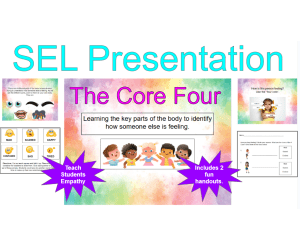
SEL Presentation-The Core Four
Special Resources, Social Emotional Learning (SEL), Social Skills, Special Education Needs (SEN), Life Skills, Kindergarten, Preschool, Grade 1, 2, Worksheets & Printables, Worksheets, Teacher Tools, Lesson Plans, Presentations
In this SEL presentation, students will learn about the "core four" as a way to figure out how someone else is feeling. This is the building block of empathy and understanding how someone is feeling. This product has a 12 slide Google Slides Presentation with the last 4 slides as handouts and activities for the lesson plan. Students will understand that the core four is looking at the key 4 body parts; the eyes, eyebrows, mouth and hands. They will analyze 4 pictures of real people and guess how they are feeling based on the core four. After they analyze the real children, they will play a game of charades with partners or in groups. There are 6 different emotions to act out-each have an emoji as well as the feeling word. No reading is required. Then there are 2 extension SEL worksheets. One is identifying what people are feeling in a picture, they will circle the feeling word and write down which part of the core four helped them figure it out. The next handout is a fun Find the 9 Differences in an emoji picture. The answer is on the following slide. This lesson is good for pre-k, kindergarten, first and second grades. If you are interested in more SEL products, please feel free to visit my SEL store here: https://teachsimple.com/contributor/jennifer-moyer-taylor For more products teaching students about feelings, emotions and SEL skills, check out these products: https://teachsimple.com/product/guess-the-emotion-sel-game (This is a fun lesson kind of like the game Cranium where students get to use play dough, writing, charades or talking to give clues about what feeling card they get.) https://teachsimple.com/product/betsy-the-top-banana-boom-cards-a-story-about-cliques-plus-task-cards-on-excluding-and-including-others-with-audio-plus-extension-activity (This is a combination Boom Cards activity as well as a fruit salad activity to discuss inclusivity with others.) https://teachsimple.com/product/sel-flashcards-for-social-emotional-learning-with-sel-coloring-pages (social emotional flashcards showcasing 16 different feelings. They are black and white as well as in color so students could color them in themselves. You can play memory, go Fish and other games with these flashcards.)
Author Jennifer Moyer Taylor
Tags SEL Presentation, Feelings, Emotions, Sel, Social Emotional Learning, School Counseling, Sen, Special Education Needs, Social Skills

Health | 3rd Grade Unit 2: Growth and Development
P.E. & Health, Life Studies, Physical Education, Health, Special Resources, Life Skills, Social Emotional Learning (SEL), Social Skills, Grade 3, Teacher Tools, Lesson Plans, Worksheets & Printables, Worksheets
This 3rd Grade Health Unit focuses on Growth and Development and is essential to help students with their health and wellness. There are seven units in all taught in 3rd grade that focus on health. These units include: Unit 1 that focuses on Personal Health and Wellness Unit 2 that focuses on Growth and Development Unit 3 teaches students about Nutrition and Physical Activity and how to eat right and stay active Unit 4 that helps students with Substance Use and Abuse and how to avoid bad substances Unit 5 that will teach students about Injury/ Violence Prevention Control and Safety Unit 6 that covers what happened during Covid and how to protect themselves while learning about Prevention/Control of Disease Unit 7 discusses our environment and how to help save our planet with Environmental Consumer Health These units all about health can be taught out of order. They are only numbered for your convenience. At the end of each unit, there is an assessment to test students’ understanding. Through using this Health 3rd Grade Unit 2: Growth and Development, students will be able to study and learn about body organs, our body systems, and their emotional and physical features. Included in this 3rd Grade Health Unit are the following: In this unit, students will learn about several different organs in the body including: brain, lungs, heart, liver, kidneys, and the small and large intestines. They will find a worksheet with a blank body and label all these parts after reading about these vital organs. Students will also learn about the many different body systems we have which include: skeletal and nervous systems, circulatory system, digestive system, respiratory system, muscular system, and learn about our skin and hair. They will assemble in order how these systems look in a body as they compile a book. They will also label each system after looking a drawings. They will explore the emotional and physical features of people when they are sad, surprised, happy, etc. Lastly, they will compare their physical features to other classmates and come to understand how our genes are all different. This unit meets Common Core Standards. It is 13 pages of fun engaging activities! At the end of the unit, there is an assessment to check for understanding. There are seven units that cover all the health requirements for 3rd grade. Here are the links to other health units:
Author K-5 Treasures
Rating
Tags Health Unit, Personal Health, Healthy Goals, Unhealthy Choices, Health Activities, Physical Goals, Health Goals, Health And Wellness, 3rd Grade Health, Third Grade Health

Social Skills Role-Play Scenarios & Empathy Building Sheets
Classroom Management, Resources for Teachers, Community Building, Life Skills, Special Resources, Social Emotional Learning (SEL), Social Skills, Special Education Needs (SEN), Speech Therapy, STEM, Homeschool Curriculum, Homeschool Templates, Grade 3, 4, 5, 6, 7, Worksheets, Worksheets & Printables, Workbooks, Word Searches, Teacher Tools, Assessments, Lesson Plans, Quizzes and Tests, Quizzes, Tests
This comprehensive 33-page digital Social Skills Role-Play Scenarios and Empathy Building Sheets Curriculum for students in Grades 3-6 provides educators with easy-to-implement lessons about powerful and important topics - social-emotional learning (SEL) and developing empathy. Each of the components in this package features relevant supportive research along with fun, engaging, and easy-to-use role-play simulations and seven engaging student worksheets that address the most important life skills our students need, including developing empathy; resolving conflict; practicing active listening; decoding non-verbal cues; navigating peer pressure; providing genuine apologies; and displaying sportsmanship. This curriculum is perfect for teachers in elementary schools, counselors, homeschoolers, and out-of-school-program providers. Included in this 33-page Curriculum are the following components and resources: Phase 1: The Core Theory behind Affective, Cognitive, and Compassionate Empathy/ Supporting Material for Role Playing Phase 2: Seven Printable Student Worksheets with Real-Life Role-Playing Scenarios (Decoding Non-Verbal Cues, The Empathy Bridge, I Statement Architect, Active Listening, Peer Pressure Navigator, Apology Blueprint, Sportsmanship & Fair Play) Phase 3: Curriculum Guides, Teachers Visuals, Implementation Guide, and Answer Key This no-prep resource is designed to provide students with a real-world opportunity to transform abstract concepts into experiential learning through safe role-play and mapping experiential empathy. Therefore, all upper elementary-aged children (8-12) will develop emotional intelligence by reducing the tendency to exhibit hostile attribution bias, and practice prosocial behaviors in a low-stakes learning environment. Immediate digital download is available, and the Curriculum may be easily printed and used immediately or utilized through Google Classroom. Why Schools & Parents are Successful: Both research and classrooms prove this method produces results. The basis for these materials is experiential learning theory, mirror neuron studies, and restorative practice; there is measurable growth in empathy and resolving conflicts. You will find many ready-to-use worksheets, role-play scripts, and teacher guides to help you provide instant lessons that save you hours of planning for your classroom. This is an effective method to help your son or daughter become more emotionally intelligent, eliminate hostile attribution bias, and help them develop real-life scripts for dealing with peer pressure, making apologies, and engaging in fair play. Use this method for the whole classroom or in small groups or during counseling, and it will include different learners, multi-age groups and students with neuro-diversity. Many parents report that their children demonstrate newfound positivebehaviour at home, and schools have successfully adopted this curriculum to reduce relational aggression and meet CASEL standards. Intended target audience: Grades 3 - 6 (approximately 8 to 12 years old) are referenced in every chapter and case study/worksheet in this curriculum as being appropriate for that age range and developmental level. The other target ages of K - 2 will not be appropriate due to more advanced cognitive requirements (the second-order Theory of Mind, perspective-taking, and restorative language frameworks) and to Grades 7+ (middle school) students for their focus on upper elementary social dynamics (recess exclusion, group projects, rumor spreading, sportsmanship). Copyright/Terms of Use: The content of this book was registered as protected material by Syed Hammad Rizvi for exclusive personal/classroom usage. Therefore, you may not copy, modify, sell or redistribute this book in any format (including the internet) to others for any reason whatsoever. You may only provide a copy of the book to someone else by buying an additional license through Teachsimple. Thank you for complying with the copyright/user agreement and supporting the work of Syed Hammad Rizvi!
Author Creative Book Store
Rating
Tags SEL, SocialEmotionalLearning, EmotionalIntelligence, EmpathyBuilding, SocialSkills, MentalHealthForKids, SocialEmotional, SocialEmotionalDevelopment, RolePlayScenarios, SocialSkillsRolePlay

Adaptive Executive Functioning Mastery: A K-Adult Scaffolding Frame
ELA, Resources for Teachers, Classroom Management, Community Building, Social Emotional Learning (SEL), Special Resources, Life Skills, Social Skills, Special Education Needs (SEN), Speech Therapy, Grade 1, 2, 3, 4, 5, 10, 11, Worksheets & Printables, Worksheets, Workbooks, Teacher Tools, Assessments, Diagrams, Lesson Plans, Presentations, Outlines, Literacy Readers
The Adaptive Executive Functioning Mastery: A K-Adult Scaffolding Framework contains everything needed for educators to implement effective executive functioning (working memory, inhibitory control, cognitive flexibility, task initiation, time blindness, metacognition, etc.) in all levels of education from kindergarten through adult. The workbook comprises: • In-depth theory chapters on cognitive load, dynamic scaffolding, and the function of the prefrontal cortex. • 10 fillable student worksheets with real life case studies. • Teacher/facilitator implementation guide with teacher supports such as fading protocols. • Printable visuals (Neuro-Developmental Continuum; Adaptive Scaffolding Matrix; Emotional Regulation Loop). • Answer Key for assessments. An essential part of this workbook is that it will help to reduce environmental friction and support the autonomous development of exobrains that fade into an internal mastery. It is suitable for use in special education, general education, homeschooling, college support programs, and/or in the coaching of adults. This digital download is immediately available via PDF format as well as in a format that may be accessed using Notion. No preparation required. Why Parents and Schools Are Fans : Evidence-based but usable immediately: Break down the latest neuroscience (prefrontal cortex, cognitive load theory, Vygotsky ZPD) into zero-prep, easy-to-use worksheets and visuals for teachers to use on Monday. Neuro-affirmative and compassionate: Replace "laziness" and "try harder" with practical scaffolding that respects how the brain is wired so that the number of meltdowns, anxiety, and learned helplessness decreases. Built-in fading and autonomy: The Bridge-and-Fade Protocol has 4 phases with clearly defined transitional points will reduce dependence on the scaffolding of adults for each student to develop independence and report the skill as internalized. Saves time in planning: Diagnostic answer keys, visual resources, and Notion/PDF hybrid options will save teachers hours of planning for busy IEPs, 504s, and RTI meetings. Versatile across the lifespan: One purchase will allow the entire school to utilize the tools (PreK-12 and adult transitions) or a family will be able to use the tools with their child from kindergarten through college and into their career. Target Audiences and Student Classifications : This Framework has been purposely created for life cycle growth from beginning of time with K-Adult. This Framework identifies all target audiences as follows: Early Childhood/Primary (ages 4-9): Pre-K-3 Special ed., and needs-based learning support. Elementary to Middle Schools (Ages 6-13): 4-8 Special Needs, RtI 2nd/3rd Tier (Academic Interventions) Classrooms, ADHD/Autism support classrooms. High Schools (Ages 14-18): 9-12 Intervention Support Classrooms, Study Skills classrooms, Transition to College programs. Adults & College Students (ages 19+) - Univesity Disability Services, Adult ADHD Coaches, Workplace Executive Skill Training, Homeschool High School/College Preparation. Cross-setting Users: Special Needs and General Education Teachers working with Neurodivergent Students, School Guidance Counselors, Occupational/Physical Therapists, Parents of Neurodivergent Students, Corporate Neurodiversity Trainers/Service Providers. Copyright / Terms of Use: Syed Hammad Rizvi holds copyrights to this book. This resource is for personal use only and may only be used in one classroom at a time. You may not modify, redistribute or sell any part of this resource. In other words, you cannot upload this resource to the Internet for others to find and download publicly. If you would like to share this resource with other educators, you must purchase additional licenses through Teachsimple. Thank you for being respectful of these terms of use. Syed Hammad Rizvi is excited to offer this product.
Author Creative Book Store
Rating
Tags ExecutiveFunctioning, ADHDResources, Neurodivergent, SpecialEducation, ExecutiveFunction, ADHDWorksheets, TeacherResources, IEPTools, 504Plan, Neurodiversity

Misinformation Literacy & News Verification Worksheets
Science, Technology, Computer Science, Engineering, Resources for Teachers, Classroom Management, STEM, Special Resources, Social Emotional Learning (SEL), Social Skills, Grade 6, 7, 8, 9, 10, 11, 12, Worksheets & Printables, Writing Prompts, Worksheets, Word Searches, Workbooks, Teacher Tools, Lesson Plans, Assessments, Presentations, Diagrams
This curriculum provides a complete and easy-to-use, 38-page Information Literacy and News Validation Curriculum written specifically for the students in Middle School. It includes both Theory Chapters with real-world Case Studies (ex. “The Giant Blue Scorpion”, “Riverton Water Crisis”) to support development of the proprietary C.L.E.A.R. Protocol (Cross-check, Locate, Evaluate, Analyze, Read beyond the Headline), 10 interactive Student Worksheets, Answer Keys with Answer Key Samples and all pedagogical tools needed to utilize each resource (i.e. Information Disorder Spectrum, Cognitive Bias Feedback Loop, Lateral Reading Protocol). It is the best curriculum to teach how to identify Fake News,how to differentiate between Disinformation, Misinformation and Malinformation; how to identify ways to manipulate Emotionally; Visual Forensics; Statistical Literacy; building Echo Chambers; the creation of Synthetic media (Deepfakes); and Digital Citizenship. It contains Teacher Implementation Notes, Assessment Protocols and Printable Resources making it ideal for use with students in Grade levels 6-8 within Language Arts, Social Studies or Digital Citizenship classes, for use at home, or in After School Programs. Why Do Parents & Schools Like It? Develops 21st-century skills for protecting students from online scams, viral hoaxes, and manipulation through social media; however, these critical thinking skills are often missing from many of today's school curriculums. Lowers teacher's prep time by providing worksheets/answer keys / visual aids / assessment tools to meet digital citizenship/media literacy standards already established. Provides students with practical examples of how to understand and use abstract concepts (confirmation bias, lateral reading, false context) through relatable case studies & hands-on activities that middle schoolers often find enjoyable. Encourages responsible use of the Internet by teaching students proper online behavior, developing civic responsibility, and facilitating better dialogue about the news as well as social media between parents and children. Cost-effective, high-quality digital resource that can be used in a traditional classroom, cooperative homeschooling, or a remote-learning setting with one print that can be reused over and over again! The target audience for this PDF will be students in the sixth through eighth-grade range (Grades 6-8 / Middle School). The introduction, case studies, and worksheets all have content that references "middle school peer groups," "Sixth through Eighth Grades," and age-appropriate examples (such as school rumors, playground fears, TikTok fears) throughout the PDFs. This PDF is not appropriate for elementary school students (too advanced) or for high school students (too basic). Copyright/Use Guidelines : Copyrighted by Syed Hammad Rizvi. This resource is for a single classroom or personal use only. No modifications or redistribution, for resale, to be made to the resource. For example, uploading to the internet where it will be publicly available for downloading is not allowed. If you wish to share with colleagues, please obtain additional licenses from Teachsimple. Thank you for honoring these guidelines. Syed Hammad Rizvi was happy to provide this product.
Author Creative Book Store
Rating
Tags MediaLiteracy, MisinformationLiteracy, FakeNewsDetection, NewsVerification, DigitalCitizenship, CriticalThinkingSkills, MiddleSchoolCurriculum, Grades68, 6thGradeResources, 7thGradeResources

Money Math Life Skills Worksheet: Clothes Shopping Level 3
Special Resources, Life Studies, Creative Arts, Art, Social Emotional Learning (SEL), Special Education Needs (SEN), Life Skills, Finance, Math, Money, Grade 7, 8, 9, Activities, Worksheets & Printables, Worksheets
Clothes Shopping Money Math Level 3 is a 60-question special education worksheet that builds essential life skills for middle school students. This activity aids in teaching calculations for discounts, sales tax, and determining prices when shopping for various items of clothing. The questions are formatted as real-life word problems followed by multiple choice answers. There are 6 sets of 10 questions for calculating costs of pants, shirts, skirts, accessories, dresses, and shoes. This printable worksheet can be used one-on-one or in small groups to help students become more independent. It's an excellent resource for IEP goals related to money math and practical life skills. Interactive and hands-on, this worksheet is ready to use for grade 7-9 special education, autism life skills, or therapy sessions. With step-by-step instructions, age-appropriate graphics, and real-world examples, this is the perfect money math activity to engage middle school students.
Author Adulting Life Skills Resources
Tags Life Skills Money Math , Independent Living Skills, IEP Goal-Oriented Skills, Life Skills For Autistic Teens And Adults, Life Skills For Visual Learners, Adulting On The Spectrum, Social And Emotional Learning, Life Skills For Teens, Life Skills For Adults, Autism And Money Skills, Math Dresses

Health | 3rd Grade Unit 1: Personal Health
P.E. & Health, Life Studies, Physical Education, Health, Special Resources, Life Skills, Social Emotional Learning (SEL), Social Skills, Grade 3, Teacher Tools, Lesson Plans, Worksheets & Printables, Worksheets
For 3rd Grade Health there are seven standards that need to be taught. Unit 1 Personal Health Unit 2 Growth and Development Unit 3 Nutrition and Physical Activity Unit 4 Substance Use and Abuse Unit 5 Injury/ Violence Prevention Control and Safety Unit 6 Prevention/Control of Disease Unit 7 Environmental Consumer Health These units can be taught out of order. They are only numbered for your convenience. At the end of each unit, there is an assessment to test students’ understanding. In this unit, students will discuss and learn about healthy and unhealthy physical activities. They will discuss with the group what they think happens to their body when they are running, what causes our bodies to sweat and make our heartbeat faster and how long it takes for our bodies to recover. They will even perform some physical activities as a group and monitor what is happening to their bodies. Students will also read about healthy and unhealthy habits they do during the day. Such unhealthy habits they will read about include watching TV, playing video games, or laying around instead of doing physical activities such as skateboarding, swimming, and other activities that are good for our heart. There is a goal sheet included that will help students monitor how they can get more physical activity into their daily routines. After completing the goal sheet, they will compare it to other classmates and even improve on their physical goals that they want to accomplish. In the unit, there is a worksheet about making healthy eating habits. What foods kids should avoid like sugary sweets, greasy foods, chips and sodas. Student will discuss the consequences of eating unhealthy foods verses eating healthy options. Lastly, there is a worksheet on the importance of sleep. How much sleep kids need at their age and why it's important to go to bed on time each night. There are 13 pages included in all. In the end, there is an assignment to test for understanding. There are seven units that cover all the health requirements for 3rd grade. Here are the links to other health units: Health | 3rd Grade Unit 1: Personal Health Health | 3rd Grade Unit 2: Growth and Development Health | 3rd Grade Unit 3: Nutrition and Physical Activity Health | 3rd Grade Unit 4: Substance Use and Abuse Health | 3rd Grade Unit 5: Injury Prevention and Safety Health | 3rd Grade Unit 6: Prevention Control of Disease Health | 3rd Grade Unit 7: Environmental Consumer Health
Author K-5 Treasures
Tags Health Unit, Personal Health, Healthy Goals, Unhealthy Choices, Health Activities, Physical Goals, Health Goals, Health And Wellness, 3rd Grade Health, Third Grade Health
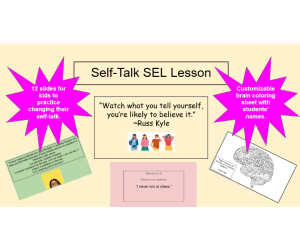
Changing Negative Self-Talk Into Positive Self-Talk SEL Presentation
Special Resources, Social Emotional Learning (SEL), Social Skills, Special Education Needs (SEN), Elementary, Middle School, Activities, Worksheets & Printables, Coloring Pages, Worksheets
In this Google Slide SEL presentation, students will learn how to change their negative thoughts into positive ones. There is a quote at the beginning of the slide show that says "Watch what you tell yourself, you're likely to believe it." by Russ Kyle. The students can share what they think this quote means to them. Then there is an educational slide on the value of changing their negative thoughts into positive ones. Then the students will have 12 slides to practice changing negative thoughts into realistic and positive ones. They can do this as a turn and talk with a partner, whole group instruction, or in their table groups. You can decide the best approach for your students. After they practice 12 different thoughts, the students will participate in an elimination game using a playing deck of cards. You will randomly pull a red or black card and students need to declare which one they think you will pull before you pull it. There are directions on the slide notes. The goal is for them to say out loud to the person next to them about which one they guess is going to get pulled for their own accountability. Ask students to pay attention to their own self-talk during this game. This game is based on luck only. You can play the game as many times as you want as time allows. Lastly, the students will get to color a mindfulness coloring sheet of a brain with their own name on it. You can make as many handouts as you have students in your class. Simply double click on the name and change it to the names of students in your class and press enter. Print off as many copies as you need. For other lessons on thoughts and changing one's thinking, check out this lesson about inner coach versus inner critic: https://teachsimple.com/product/inner-coach-or-inner-critic-boom-cards-plus-extension-handout https://teachsimple.com/product/cut-sort-and-glue-inner-coach-or-critic
Author Jennifer Moyer Taylor
Tags Sel, Social Emotional Learning, School Counseling, Social Skills, Self-regulation, Cognitive, Special Education, Psychology, SEL Presentations, SEL Coloring Pages

AI Image Creation Ethics & Creative Prompt Engineering Pack Worksheets
Research, Resources for Teachers, Classroom Management, Community Building, Science, Technology, Computer Science, Engineering, Special Resources, Social Emotional Learning (SEL), Homeschool Curriculum, Homeschool Templates, Grade 4, 5, 6, 7, 8, Worksheets & Printables, Worksheets, Workbooks, Word Searches, Writing Prompts, Teacher Tools, Graphic Organizers, Lesson Plans, Diagrams, Quizzes and Tests
Prepare your students for a creative and ethical future with a comprehensive (34-page) digital workbook designed specifically for grade level students that covers everything students need to know when creating and using Images created by Machines (AI). That means learning how to use AI ethically. This Creative Prompt Engineering Pack provides elementary teachers, homeschool parents, and digital literacy coaches with everything they need to teach students how to create image-based prompts through the use of the Four Pillars of Prompt Construction (Subject, Environment, Lighting and Aesthetic) while also covering such topics as (but not limited to) Intellectual Property Rights; Digital Consent; Misinformation; Combating Bias; and Full Disclosure. Components Included: *) 4 chapters of hands-on student worksheets (fill-in-the-blank; scenario analysis; prompt rewriting; ethical debates) *) Visual anchors and flowcharts *) 1 Lifecycle diagrams *) 1 complete answer key for educators with complete implementation guide *) No prep, print-and-go/digital Google Classroom compatible Ideal for STEM, Arts, ELA, Digital Citizenship and AI Literacy curricula. Support your students develop into ethical and creative "prompt engineers" who respect artists and tell the truth when creating images generated by AI. Keywords that are integrated naturally into this Creative Prompt Engineering Pack Include AI Prompt Engineering for Kids; AI Ethics Curriculum Grade 93; Text-to-Image AI Workbook; Responsible Digital Art Maker; Digital Literacy PDF; Creative Prompt Engineering Pack. Parents and Schools Appreciate This Product: Provides Students with TRUE 21st Century Skills - Demonstrated through students’ ability to write quality prompts, demonstrate ethical decision making, be good digital citizens and use critical thinking; exactly what was requested in new educational standards. No Preparation Required - Easy to use for the teacher. Includes full answer keys, visual aides, Madlib sheets; everything you need to have no preparation time. This is a time saver! (Additionally, Families can use them to home school.) Promotes Creativity and Responsibility - Ongoing excitement generated by kids learning to create art through AI while at the same time understanding why it is inappropriate to steal the style of an artist, spread false information and/or conceal their use of AI. Ideal for Diverse Learning Needs (Although all materials created/based on target grade level - Fourth Grade) - Case studies, fill in the blanks and pictures make it attainable to all grades 4 & 5 regardless of ability (includes exceptional education students). Future-Proofing Students with Digital Literacy - Equips students with at least an understanding of how to appropriately use technology (Artificial Intelligence), enabling parents and schools to feel good about the ethical use of technology by their children. The target audience : of the material is 4th and 5th graders (ages 9 - 11 years old). The teacher's guide on page 25 clearly indicates this is intended for "students in the 4th/5th grade" and uses "Grade 4-5 Student Pack" as reference. The vocabulary and activities, as well as case studies and visuals, are ideally suited for upper elementary and/or early middle school students. This resource could also be used with success in a homeschool setting, advanced gifted 3rd graders, and as a beginning unit in 6th grade technology/digital literacy/arts classes. Copyright and Usage Terms: This publication is owned by Syed Hammad Rizvi and is intended only for personal and classroom use. You may not sell, alter, or redistribute this publication in any way. In other words, you cannot place it on the World Wide Web for anyone to find and download. If you wish to share this publication with other teachers, please purchase another license from Teachsimple. Thank you for respecting the use of this publication. This publication was created with much joy by Syed Hammad Rizvi
Author Creative Book Store
Rating
Tags AIPromptEngineering, AIForKids, AIEthics, PromptEngineering, AIImageCreation, DigitalLiteracy, AIArtForKids, TextToImage, ResponsibleAI, EthicalAI

Future-Ready Creators: AI Ethics & Career Exploration Gamified Project
Life Skills, Special Resources, Social Emotional Learning (SEL), Social Skills, Special Education Needs (SEN), STEM, Research, Classroom Management, Resources for Teachers, Community Building, Grade 3, 4, 5, 9, 10, 11, 12, Worksheets & Printables, Workbooks, Worksheets, Teacher Tools, Assessments, Lesson Plans, Presentations, Rubrics
Future-Ready Creators: AI Ethics & Career Exploration Gamified Project Unit (Edition) Unleash the future of education by digging into this all-inclusive, gamified AI ethics curriculum for high schoolers, Grades 9-12. Join the AI revolution with theory, real-life case studies, and interactive worksheets that explore algorithmic bias, data privacy, surveillance, transparency, and how AI will shift careers. This 24-page digital PDF unit mingles rigorous academics with activities like a student workbook, ethical audits, SVG visuals of mind maps and flowcharts, and teacher resources filled with answer keys. Suitable for classes dealing with STEM, computer science, ethics, and career guidance, this ready-to-use project nurtures critical thinking, ethical decision-making, and career exploration in an AI-filled world. AI Ethics Lesson Plans, High School AI Curriculum, Gamified AI Projects, AI Bias Activities, Future Careers in AI, Digital Workbook on Ethics, Teacher Resources for AI Education. For homeschooling, classroom use, or in after-school programs, give teens the power to create their vision as responsible AI innovators today! Why Parents/Schools Love It: Prepares Students for the Future with AI: It teaches necessary skills for ethical AI practices, detection of bias in AI, and exploring a job market with a high degree of automation with technology-related jobs. Engaging Gamified Format: Converts difficult-to-understand information into challenges, simulations, and projects, which serve as motivation and learning aids and add fun to learning. Teaching Tools: Teaches educators with comprehensive ready-to-use teaching tools, including illustrations, work sheets, and answered keys, making it easy to integrate into any high school curriculum. Cultivates Ethical Thinking and Responsibility: Helps students deal with pressing issues such as the loss of privacy rights and the need for algorithmic justice, encouraging ethical thinkers capable of living with the consequences of artificial intelligence. Versatile and Inclusive: "The book is very versatile and inclusive, being suitable for learning environments such as classrooms, home-schooling, or online learning with equity, diversity, and increasing AI jobs as the appeal." Target Student Classes : From an exhaustive analysis of the PDF, wherein it is clearly mentioned that it is "designed specifically for high school students (Grades 9-12)" and is targeted at advanced concepts involving AI, you need to target high school students belonging to Grades 9-12. This is in line with the level of material, which is of an advanced level of understanding, assuming that these individuals possess critical and digital literacy skills characteristic of individuals on the threshold of higher education or professional life, in particular: Main target audience: Classes involving Computer Science, STEM, Technology, Ethics/Philosophy, Career Guidance, or Social Secondary Audience: Home-school programs, after-school activities, or classes on digital citizenship, innovation, or future studies. Refrain from targeting younger groups, such as the middle school level or younger, because the contents involve intricate subject matters such as deep learning, data sovereignty, or predictive policing. Copyright/Terms of Use : This Book was copyrighted under the name of Syed Hammad Rizvi. This document or repository is for personal use only. You cannot modify, distribute, or give away a single piece of this document. In other words, you cannot place it on the World Wide Web so that people can download it for free. If you would like to share these resources with your colleagues, you can purchase additional licenses from Teachsimple. Thank you for respecting these use terms. This product is happily brought to you by Syed Hammad Rizvi
Author Creative Book Store
Rating
Tags AIEthics, AICurriculum, ArtificialIntelligence, HighSchoolAI, GamifiedLearning, FutureCareers, EthicalAI, MachineLearning, AIBias, DataPrivacy

Health 2nd Grade Unit 1: Personal Health
P.E. & Health, Health, Physical Education, Common Core, Special Resources, Life Skills, Social Emotional Learning (SEL), Social Skills, Grade 2, Lesson Plans, Teacher Tools, Worksheets & Printables, Worksheets
For 2nd Grade Health there are seven standards that need to be taught. Unit 1 Personal Health Unit 2 Growth and Development Unit 3 Nutrition and Physical Activity Unit 4 Substance Use and Abuse Unit 5 Injury/ Violence Prevention Control and Safety Unit 6 Prevention/Control of Disease Unit 7 Environmental Consumer Health These units can be taught out of order. They are only numbered for your convenience. At the end of each unit, there is an assessment to test students’ understanding. Through using this Health 2nd Grade Unit 1: Personal Health students will explore and learn to identify daily healthy habits by knowing what foods are best to eat and how to set goals for physical activity. Habits included are: * Students will learn about healthy and unhealthy activities. These activities will include what is the difference between physical activities and sedimentary activities. * Students will learn how to make healthy choices that will benefit their nutritional goals. * They will learn about goals. Along with knowing the difference between long-term and short-term goals. And how to set both. * Students will come to understand their emotions and how to they can express those emotions as they learn to deal with their feelings. * Lastly, students will learn when and who they can rely on and who to talk to an adult about how they are feeling and how to get help when needed. At the end of the unit, there is an assessment to check for understanding. A total of 11 pages for this 2nd Grade Health Unit 1 on Personal Health There are seven units that cover all the health requirements for second grade. Here are the links to other health units: Health 2nd Grade Unit 1: Personal Health Health 2nd Grade Unit 2: Growth and Development Health 1st Grade Unit 3: Nutrition and Physical Activity Health 2nd Grade Unit 4: Substance Use and Abuse Health 2nd Grade Unit 5: Injury / Violence Prevention and Safety Health 2nd Grade Unit 6: Prevention / Control of Disease Health 2nd Grade Unit 7: Environmental / Consumer Health 2nd grade Coronavirus / Covid-19 Facts This unit meets Common Core Standards.
Author K-5 Treasures
Tags Health Unit, Personal Health, Healthy Goals, Unhealthy Choices, Health Activities, Physical Goals, Health Goals, Health And Wellness, 2nd Grade Health, Second Grade Health
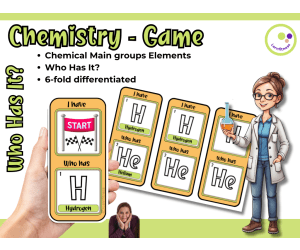
Who Has It? – Main Group Elements Game - 6 Levels of Differentiation
STEM, Science, Chemistry, Physics, Life Sciences, Earth and Environmental Sciences, Basic Science, Special Resources, Social Emotional Learning (SEL), Special Education Needs (SEN), Homeschool Templates, Grade 6, 7, 8, 9, 10, 11, Activities, Games, Worksheets & Printables, Task Cards, Quizzes and Tests, Teacher Tools, Quizzes, Worksheets, Projects, Flashcards
Who Has It? – Main Group Elements Game (6 Levels of Differentiation) A chemistry card game to review the main group elements in a structured and playful way (Grades 7–10) 🧪🎯 This classroom game is based on the “I have… who has?” format and helps students review the main group elements of the periodic table. It focuses on atomic numbers, element symbols, and – depending on the level – the correct element names. The game format encourages full-class participation, supports recall through repetition, and helps even quieter students get involved in a low-pressure way. The special feature: six levels of differentiation , so you can tailor the material to your students’ abilities. Whether you teach a mixed-level group or want to build in progression over time, these sets offer plenty of flexibility. What’s included: 3 card sets × 2 difficulty paths = 6 levels total Each set contains 52 cards (156 cards total) Elements included: all main group elements up to element 118 Levels range from fully labeled to no element names at all Clear instructions for printing, cutting, and gameplay Differentiation overview: Levels 1 & 2: All names included Levels 3 & 4: Only “I have” part includes names Levels 5 & 6: No names – only symbols and atomic numbers How to use in class: In my own lessons, I’ve used this as a review after teaching atomic structure or periodic trends. It works well as a class opener, during stations, or even in a substitute lesson. The A/B sets are helpful when students sit close together – it prevents copying but keeps everyone working on the same task. Students enjoy the rhythm of the game, and because every card depends on the one before, they naturally stay attentive. It’s a great way to combine repetition with interaction. Low-prep, flexible, and genuinely useful for learning chemical elements in a collaborative setting. Best, Heike from Lernfitness Did You Know? I teach with a certified therapy dog, and together we create a positive and welcoming learning environment. 🐶
Author Lernfitness
Rating
Tags Game, Educational Card Games, Chemistry, Physics, STEM Science Matching Game, Chemical Elements, Periodic Table Matching Game, Who Has It, STEM, Main Groups

Health 1st Grade Unit 5: Injury / Violence Prevention and Safety
P.E. & Health, Special Resources, Health, Physical Education, Life Skills, Social Emotional Learning (SEL), Social Skills, Grade 1, Lesson Plans, Teacher Tools, Worksheets, Worksheets & Printables
For 1st Grade Health there are seven standards that need to be taught. Unit 1 Personal Health Unit 2 Growth and Development Unit 3 Nutrition and Physical Activity Unit 4 Substance Use and Abuse Unit 5 Injury/ Violence Prevention Control and Safety Unit 6 Prevention/Control of Disease Unit 7 Environmental Consumer Health These units can be taught out of order. They are only numbered for your convenience. At the end of each unit, there is an assessment to test students’ understanding. Through using this Health 1st Grade Unit 5: Injury / Violence Prevention and Safety students will learn to identify personal information, safety in their environment, trusted adults in their community, and bullying. Included in this unit: * Students will learn how to be safe in their community, household, and community. * Students will learn the importance of knowing their personal information. * Students will learn how to identify trusted adults in their community. * Students will learn when to call 911. * Students will learn about stranger danger. * Students will learn about bullying and who to talk to if this occurs. At the end of the unit, there is an assessment to check for understanding. A total of 14 pages for Health 1st Grade Unit 5: Injury / Violence Prevention and Safety. There are seven units that cover all the health requirements for first grade. Here are the links to other health units: Health 1st Grade Unit 1: Personal Health Health 1st Grade Unit 2: Growth and Development Health 1st Grade Unit 3: Nutrition and Physical Activity Health 1st Grade Unit 4: Substance Use and Abuse Health 1st Grade Unit 5: Injury / Violence Prevention and Safety Health 1st Grade Unit 6: Prevention / Control of Disease Health 1st Grade Unit 7: Environmental / Consumer Health You can also teach your students about keeping yourself safe by studying about the Coronavirus, where and when it started and facts that plagued our world with this virus. 1st grade Coronavirus / Covid-19 Facts by Teach Simple This unit meets Common Core Standards.
Author K-5 Treasures
Tags Health Unit, Injury Prevention, Violence Prevention, Safety, 1st Grade Health, First Grade Health, Healthy Habits, Health Resources, Health, First Grade Resources

Internet Safety Life Skills: How to Create a Secure Password
Special Resources, Creative Arts, Art, Life Studies, Social Emotional Learning (SEL), Special Education Needs (SEN), Life Skills, Coaching, Grade 10, 11, 12, Activities, Worksheets & Printables, Worksheets
"Creating a Strong Password" is an educational activity designed for high school students in special education. It helps them understand why having a secure password is important for safeguarding their money and personal information. The use of this Internet Safety Life Skills resource will allow students to engage in the following: • Understanding Why Usernames and Passwords Matter • Making Passwords with Descriptive Phrases • Learning How Strong Passwords Keep You Safe • Telling Apart Strong and Weak Passwords • Checking If a Password Is Strong or Weak There are 16 reading comprehension questions in this Internet Safety Life Skills resource! This activity aims to help high school students acquire essential life skills, enhancing their independence in school, at home, and in their communities. This handout is particularly suitable for use in special education classes or one-on-one settings like ABA therapy, speech therapy, occupational therapy, and Registered Behavior Technician (RBT) sessions. High school students focusing on independent living can greatly benefit from this activity, as it assists in defining, setting, and measuring IEP goals. Beyond interactive teaching, this resource is excellent for hands-on and community-based learning experiences. Engage your special education class with this highly interactive High School Internet Safety Life Skills Activity! This activity contains step-by-step instructions, questions, and answers that reinforce learning, age-appropriate graphics, real-world examples, and ideas for implementation. This is the perfect special education activity for grade 10, grade 11, grade 12, and autism life skill centers . This special education life skills handout was designed to assist teens and adults with difficulties developing independent living skills. It's a printable, easy-to-use activity ready to hand out! Related Products for Developing Independent Living Skills How to Read a Basic Pay Stub How to Schedule an Appointment How to Fill Out a Job Application How to Create an Emergency Exit Plan A PDF with seven unique pages. Color and black-and-white versions of each page are available for this pdf resource.
Author Adulting Life Skills Resources
Tags Interactive Safety Lessons, Autism Safety Resources, Internet Safety, Independent Living Skills, IEP Goal-Oriented Skills, Life Skills For Autistic Teens And Adults, Adulting On The Spectrum, Social And Emotional Learning, Life Skills For Teens, Life Skills For Adults

Self-Control SEL Game, SEL poster, and Mystery Mosaic Activity SEL Gam
Special Resources, Life Skills, Social Emotional Learning (SEL), Social Skills, Special Education Needs (SEN), Kindergarten, Grade 1, 2, Activities, Games, Worksheets, Worksheets & Printables
The Self-Control Game, Mini-poster, and Mystery Mosaic Activity This resource is designed specifically for kindergarten to second-grade students to introduce or reinforce concepts related to self-control and emotional regulation. Stop & Think Game Board The main component of the resource is an interactive game which includes: 12 STOP cards 12 THINK cards The game stimulates discussions about emotions while exploring strategies for maintaining self-control. Detailed instructions are provided for best practice in facilitating gameplay. This can be used for whole class instruction or student-led group activities. Mini-Poster: Stop, Breathe, & Think An accompanying mini-poster acts as a ready reminder of these essential skills. It is suitable both for classroom display and home use. Mystery Mosaic Activity A mystery mosaic activity further reinforces the lessons learnt from the Stop & Think game in a fun yet educational mode. Fits Special Education Resources and Life Skills Curriculum This resource aligns with many special education resources as well as broader life skills curriculum objectives. It pairs well with books about managing big feelings or self-control. Even some reading recommendations are included. Digital Download Convenience (PDF Format) The resource comes as an easy-to-print digital download so no sorting through physical products. In Summary: The Self-Control Game, Mini-Poster, and Mystery Mosaic Activity provides equitable access to vital social-emotional learning principles through relatable activities. Teaching self-control, understanding emotions or promoting calming breathing techniques have never been this engaging before. If you are interested in other SEL and social emotional resources, please check out my store at: https://teachsimple.com/contributor/jennifer-moyer-taylor I am a full-time school counselor who uses my own resources on the students I serve. If it is not "kid" approved, I change it! I am very willing to tweak a resource if the resource is not as engaging or relevant for the students, I alter the lesson and the activities.
Author Jennifer Moyer Taylor
Tags Self-control Game, Emotional Regulation, Social-emotional Learning, Character Education, Mindfulness, SEL Games, SEL, Social Emotional Learning, SEL Poster