



2,393 products added recently
Music Test

 Show filters


Guitars Reading Comprehension Passage - Cored Ed Encyclopedia
ELA, Language Development, Resources for Teachers, Reading Comprehension, Reading, Pre-Reading, Writing, Music, Creative Arts, Strategies, Grade 2, 3, 4, 5, Worksheets & Printables, Worksheets, Teacher Tools, Centers, Activities, Writing Prompts, Assessments, Tests, Quizzes and Tests, Quizzes
This guitars reading comprehension contains the following: Pre-Reading Trivia Students will write down one thing they already know about the subject and then read five more facts and discuss. These facts are fun, and the students will enjoy learning about the subject before reading more. Reading Passage The text is a high-interest reading passage with set paragraphs, roughly three to four paragraphs long. It contains a variety of themes about the topic, anywhere from history to technology. The passage is between 250 and 350 words in length. Mixed Questions The first question page contains four multiple-choice questions, each with a choice of four answers, and three written response questions that require a sentence or two from the student. Creative Writing In this question, the student will be required to write a five to eight sentence paragraph on a question related to the topic. Extension Activities This page is optional for fast finishers. If there are five to ten minutes left at the end of the lesson, the student can choose one of three activities, each one requiring a different skill. Answer Key There are answers for the multiple-choice questions and three written response questions have sample answers. FULL CATALOG OF DOWNLOAD LINKS AND ENCYCLOPEDIA INDEX HERE Cored Ed Encyclopedia Overview The Cored Ed Encyclopedia is a weekly series of lessons that you can pick up and use right away. These short readings fit into whatever time you have available. Each one includes a warm-up, a reading, and a set of questions, but it’s flexible — you can do just the reading, the full lesson, or skip the writing section if you need to. Each lesson focuses on a single topic so students don’t get lost. The writing is clear but never childish, making it perfect for grades two through five. Topics range from animals and science to history, inventions, and everyday things. No matter the level of the student, everyone should take away at least one new idea or fact from each lesson. The materials are easy to print, easy to explain, and require no setup. They work well for whole-class teaching, partner work, or independent study.
Author Cored Education
Rating
Tags Vocabulary, Spelling, Reading Comprehension, Reading Passages, Reading, Creative Writing, Reading Strategies, Writing Prompts, Guitars, Music
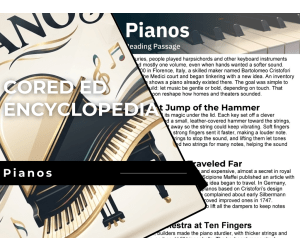
Pianos Reading Comprehension Passage - Cored Ed Encyclopedia
ELA, Language Development, Resources for Teachers, Reading Comprehension, Reading, Pre-Reading, Writing, Strategies, Music, Creative Arts, Grade 2, 3, 4, 5, Worksheets & Printables, Worksheets, Teacher Tools, Centers, Activities, Writing Prompts, Assessments, Tests, Quizzes and Tests, Quizzes
This pianos reading comprehension contains the following: Visualize on the Cover (Teacher Read Aloud Script) Start your lesson by taking a few moments to visualize the topic and share thoughts or feelings about it. Pre-Reading Trivia Students will write down one thing they already know about the subject and then read five more facts and discuss. These facts are fun, and the students will enjoy learning about the subject before reading more. Reading Passage The text is a high-interest reading passage with set paragraphs, roughly three to four paragraphs long. It contains a variety of themes about the topic, anywhere from history to technology. The passage is between 250 and 350 words in length. Mixed Questions The first question page contains four multiple-choice questions, each with a choice of four answers, and three written response questions that require a sentence or two from the student. Vocabulary Questions Practice seven key words from the text in this section across two activities. First section is scrambled words where students will unscramble three words given a clue for each. The second section is a word to meaning matching activity. Creative Writing In this question, the student will be required to write a five to eight sentence paragraph on a question related to the topic. Extension Activities This page is optional for fast finishers or to take home. There are several activities, each one requiring a different skill. Do some, do none, do all, completely optional - but you will feel reassured knowing every possibility is planned for. Includes summary writting question. Answer Key There are answers for the multiple-choice questions, written response questions have sample answers, vocabulary answers and if there is a summary question then a sample summary will be provided as well. FULL CATALOG OF DOWNLOAD LINKS AND ENCYCLOPEDIA INDEX HERE Lesson Snapshot Title: Pianos Genre: Nonfiction (informational text) Subject: Music (Performing Arts) / Reading Informational Text Primary Topic: How the piano was invented and improved Estimated Guided Reading Level (A–Z): S What This Lesson Teaches Best How the piano idea began around 1700 in Florence, Italy , with Bartolomeo Cristofori trying to make music “gentle or bold” depending on touch. How the piano’s key action works: a mechanism sends a leather-covered hammer to strike strings, then pulls back so the string keeps vibrating . How dampers stop strings from ringing—and lifting them lets tones ring longer. How information spread the invention: Scipione Maffei published an article with a diagram , leading builders like Gottfried Silbermann to make pianos based on Cristofori’s design. How the piano grew for bigger spaces: sturdier builds and a wider range from about four octaves to 88 keys , changing where music could be played (homes, schools, apartments, stages). Learning Goals Students will explain why Cristofori began tinkering with a new keyboard instrument around 1700. Students will describe how a key triggers the hammer-and-string action using details from the passage. Students will explain how a player’s touch can make the sound softer or louder according to the text. Students will identify how Maffei helped the piano idea travel and name one builder mentioned who made pianos afterward. Students will describe how the piano’s keyboard range changed over time and state the number of keys many pianos have today. Key Vocabulary From the Text harpsichords — older keyboards that stayed mostly one volume. inventory — a recorded list that showed a piano existed. mechanism — moving parts that make the piano action work. dampers — parts that stop strings from ringing. octaves — groups of notes used to describe keyboard range. Cored Ed Encyclopedia Overview The Cored Ed Encyclopedia is a weekly series of lessons that you can pick up and use right away. These short readings fit into whatever time you have available. Each one includes a warm-up, a reading, and a set of questions, but it’s flexible — you can do just the reading, the full lesson, or skip the writing section if you need to. Each lesson focuses on a single topic so students don’t get lost. The writing is clear but never childish, making it perfect for grades two through five. Topics range from animals and science to history, inventions, and everyday things. No matter the level of the student, everyone should take away at least one new idea or fact from each lesson. The materials are easy to print, easy to explain, and require no setup. They work well for whole-class teaching, partner work, or independent study.
Author Cored Education
Rating
Tags Vocabulary, Spelling, Reading Comprehension, Reading Passages, Reading, Creative Writing, Reading Strategies, Writing Prompts, Music, Pianos
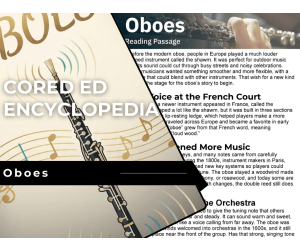
Oboes Reading Comprehension Passage - Cored Ed Encyclopedia
ELA, Language Development, Resources for Teachers, Reading Comprehension, Reading, Pre-Reading, Writing, Strategies, Music, Creative Arts, Grade 2, 3, 4, 5, Worksheets & Printables, Worksheets, Teacher Tools, Centers, Activities, Writing Prompts, Assessments, Tests, Quizzes and Tests, Quizzes
This oboes reading comprehension contains the following: Visualize on the Cover (Teacher Read Aloud Script) Start your lesson by taking a few moments to visualize the topic and share thoughts or feelings about it. Pre-Reading Trivia Students will write down one thing they already know about the subject and then read five more facts and discuss. These facts are fun, and the students will enjoy learning about the subject before reading more. Reading Passage The text is a high-interest reading passage with set paragraphs, roughly three to four paragraphs long. It contains a variety of themes about the topic, anywhere from history to technology. The passage is between 250 and 350 words in length. Mixed Questions The first question page contains four multiple-choice questions, each with a choice of four answers, and three written response questions that require a sentence or two from the student. Vocabulary Questions Practice seven key words from the text in this section across two activities. First section is scrambled words where students will unscramble three words given a clue for each. The second section is a word to meaning matching activity. Creative Writing In this question, the student will be required to write a five to eight sentence paragraph on a question related to the topic. Extension Activities This page is optional for fast finishers or to take home. There are several activities, each one requiring a different skill. Do some, do none, do all, completely optional - but you will feel reassured knowing every possibility is planned for. Includes summary writting question. Answer Key There are answers for the multiple-choice questions, written response questions have sample answers, vocabulary answers and if there is a summary question then a sample summary will be provided as well. FULL CATALOG OF DOWNLOAD LINKS AND ENCYCLOPEDIA INDEX HERE Lesson Snapshot Title: Oboes Genre: Nonfiction (informational text) Subject: Music (Performing Arts) / Reading Informational Text Primary Topic: How the oboe developed and works Estimated Guided Reading Level (A–Z): S Support pages included: Pre-reading trivia, mixed questions, vocabulary activities, creative writing, extension activities, and an answer key. Support-page QA note: The support page uses “orchestra” (singular) in a scrambled-word item, while the passage uses “orchestras” (plural). What This Lesson Teaches Best How the modern oboe developed from earlier instruments, including the shawm and hautbois , across time in Europe. How a double reed starts the oboe’s sound through vibrating and buzzing. How adding more keys helped players move faster and play more notes in tune. Why the oboe often gives the tuning note in an orchestra (clear, steady sound). Using section headings to organize and locate key facts in an informational passage. Learning Goals Students will be able to describe how the shawm relates to the modern oboe. Students will be able to explain what the double reed does to start the oboe’s sound. Students will be able to identify how the hautbois was different from the shawm. Students will be able to explain why new key systems were designed in the 1800s. Students will be able to describe why the oboe often gives the tuning note in orchestras. Students will be able to use the passage’s headings to find information quickly. Key Vocabulary From the Text shawm — a loud older double-reed instrument played long ago. hautbois — an early French version of the oboe. double reed — two reeds that vibrate to start the sound. tuning — matching the same pitch before playing together. blend — mix smoothly with other instruments. Cored Ed Encyclopedia Overview The Cored Ed Encyclopedia is a weekly series of lessons that you can pick up and use right away. These short readings fit into whatever time you have available. Each one includes a warm-up, a reading, and a set of questions, but it’s flexible — you can do just the reading, the full lesson, or skip the writing section if you need to. Each lesson focuses on a single topic so students don’t get lost. The writing is clear but never childish, making it perfect for grades two through five. Topics range from animals and science to history, inventions, and everyday things. No matter the level of the student, everyone should take away at least one new idea or fact from each lesson. The materials are easy to print, easy to explain, and require no setup. They work well for whole-class teaching, partner work, or independent study.
Author Cored Education
Rating
Tags Vocabulary, Spelling, Reading Comprehension, Reading Passages, Reading, Creative Writing, Reading Strategies, Writing Prompts, Oboes, Music
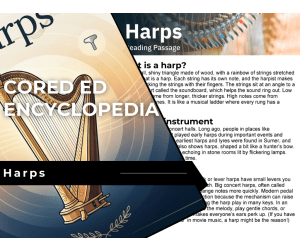
Harps Reading Comprehension Passage - Cored Ed Encyclopedia
ELA, Language Development, Resources for Teachers, Reading Comprehension, Reading, Pre-Reading, Writing, Strategies, Music, Creative Arts, Grade 2, 3, 4, 5, Worksheets & Printables, Worksheets, Teacher Tools, Centers, Activities, Writing Prompts, Assessments, Tests, Quizzes and Tests, Quizzes
This harps reading comprehension contains the following: Pre-Reading Trivia Students will write down one thing they already know about the subject and then read five more facts and discuss. These facts are fun, and the students will enjoy learning about the subject before reading more. Reading Passage The text is a high-interest reading passage with set paragraphs, roughly three to four paragraphs long. It contains a variety of themes about the topic, anywhere from history to technology. The passage is between 250 and 350 words in length. Mixed Questions The first question page contains four multiple-choice questions, each with a choice of four answers, and three written response questions that require a sentence or two from the student. Creative Writing In this question, the student will be required to write a five to eight sentence paragraph on a question related to the topic. Extension Activities This page is optional for fast finishers. If there are five to ten minutes left at the end of the lesson, the student can choose one of three activities, each one requiring a different skill. Answer Key There are answers for the multiple-choice questions and three written response questions have sample answers. FULL CATALOG OF DOWNLOAD LINKS AND ENCYCLOPEDIA INDEX HERE Lesson Snapshot Title: Harps Genre: Nonfiction (informational text) Subject: Music (Informational Reading) Primary Topic: How harps work, types, and early history Estimated Guided Reading Level (A–Z): O What This Lesson Teaches Best Explains what a harp looks like and how it makes sound when strings are plucked. Connects string length and thickness to low and high notes (how pitch changes). Describes the soundboard’s role in helping the sound “ring out.” Introduces harps as an ancient instrument and names early places they were played (Mesopotamia, Egypt, Sumer). Compares types of harps today (lever harps vs. pedal harps) and what levers/pedals do to change pitch. Learning Goals Describe how a harp makes sound using details from the passage. Explain how longer/thicker strings and shorter/thinner strings relate to low and high notes. Identify what the soundboard does for the harp’s sound. Compare lever harps and pedal harps by explaining how each changes pitch. Summarize evidence that harps are very old by naming where early harps were played or found. Key Vocabulary From the Text soundboard — flat wooden part that helps sound ring out. plucking — pulling and releasing strings with fingers to make sound. pitch — how high or low a note sounds. glissando — a swooshing sound moving across many notes. mechanism — parts that work together to change something. Cored Ed Encyclopedia Overview The Cored Ed Encyclopedia is a weekly series of lessons that you can pick up and use right away. These short readings fit into whatever time you have available. Each one includes a warm-up, a reading, and a set of questions, but it’s flexible — you can do just the reading, the full lesson, or skip the writing section if you need to. Each lesson focuses on a single topic so students don’t get lost. The writing is clear but never childish, making it perfect for grades two through five. Topics range from animals and science to history, inventions, and everyday things. No matter the level of the student, everyone should take away at least one new idea or fact from each lesson. The materials are easy to print, easy to explain, and require no setup. They work well for whole-class teaching, partner work, or independent study.
Author Cored Education
Rating
Tags Vocabulary, Spelling, Reading Comprehension, Reading Passages, Reading, Creative Writing, Reading Strategies, Writing Prompts, Harps, Music

Beginner Music Theory Test 1 - US Version
Creative Arts, Art, Music, Grade 1, Tests, Quizzes and Tests, Teacher Tools
Resource: Beginner Music Theory Test 1 - US Version A comprehensive learning and assessment tool for music educators. Alignment: Perfectly aligns with the ABRSM syllabus, thus upholding recognized standards in music education. Digital-Physical Bundle Includes: Tutorial and Answer PDFs Web modules for enhanced online learning experiences Tablet and computer modules, compatible for all classroom environments # Content Structure: Sect.17 (Test 1): An effective revision tool that builds upon musical knowledge from preceding sections/units. The interactive teaching approach appeals to different modes of comprehension: Auditory Visual ' Kinesthetic learners ' Note: Links to access files are given in PDF format within the package. Instructions on the unzipping process and accessing lessons on a tablet using articulate mobile player app are included in the purchase. # Compatibility: Both tablet & computer versions have projection capabilities making it adaptable depending on classroom setup—enables interactive solving with even smart board! # Applicable Grade Level: Grade 1 and beyond! The resource has broad spanned coverage enabling revisiting this resource well beyond first grade too! Subject area catered towards is Art & Music, more precisely Music subsubject - hence ideal for beginning level musicians looking to enhance their music theory skills. # Portability: This resource comes as a PDF file which means it is highly portable can be easily stored on your device serving as a convenient addition to your teaching toolkit !
Author Hbmusicsolutions's Shop
Tags Music Theory, Beginner, Assessment Tool, Blended Learning, Interactive Approach

Scandinavia Song and Test
Creative Arts, Art, Social Studies, Music, Geography, Grade 6, 7, 8, 9, Tests, Quizzes and Tests, Teacher Tools
The Scandinavia Song and Test Resource This teaching tool offers a unique blend of auditory and visual learning techniques, perfect for engaging middle or high school students in grades 6-9. By using music and song related to Scandinavia's geography, this resource adds a layer of enjoyment to learning, facilitating better retention of knowledge. Product Features: Format: MP4 video seamlessly integrated into various lesson plans Tutorial Content: Interactive guide through basic geography concepts, with emphasis on Scandinavia Versatility: Useful for introduction to new topics or reinforcement later in the course curriculum Educational Benefits An effective tool that caters especially well to auditory learners. The video allows for connections across different components of the geography module whilst also fostering better recall during assessments. Suitable For: Art & Music lessons, & Social Studies curricula due its distinct combination of geographical and musical elements. Detailed Specifications: - Subjects: Art & Music; Social Studies - Subsubjects: Musical Arts under Art & Music; Geography under Social Studies - Types: Videos type r File type: Video file - Grades Applicable: Learners from Grade 6 through Grade 9. Rejuvenate your traditional classroom setup; captivate learners with our innovative educational resources such as The Scandinavia Song – an ingenious mix of musical elements and visually stimulating experiences!
Author Audio Memory
Tags Scandinavia, Geography, Music, Multisensory Learning, Middle School

Beginner Music Theory Test - UK Version
Creative Arts, Art, Music, Grade 1, Tests, Quizzes and Tests, Teacher Tools
Beginner Music Theory Test - UK Version The Beginner Music Theory Test - UK Version is a comprehensive teaching resource designed for Grade 1 music students. Perfectly aligning with the ABRSM syllabus, it offers an interactive experience that enhances the student's understanding of basic music theory. Structure and Usage This resource is divided into seventeen sections each catering to specific areas of beginner music theory thereby ensuring a well-rounded musical education. A digital and PDF bundle (6 in 1), it provides both online and offline learning opportunities making it perfect for class lessons and distance learning circumstances. User-friendly layout with instructional pdf files complemented by question pdfs. Answer keys provided alongside each test component for easy assessment of progress. The module adapts to different types of hardware including desktop computers, tablets, smart boards or projectors. Inclusion of web modules enables lessons accessible from browsers without need to install additional software. Note on Compatibility Issues: Current Mac users might find compatibility issues but efforts are underway to ensure availability across all operating systems soon. In conclusion: The Beginner Music Theory Test - UK Version presents educators with an innovative approach to impart essential musical knowledge through engaging methods regardless whether classroom-based or remotely delivered.
Author Hbmusicsolutions's Shop
Tags Music Theory, Beginner, Interactive Learning, ABRSM Syllabus, Online/offline Learning

Mexico Song & Video Test
Creative Arts, Art, Social Studies, Music, Geography, Grade 6, 7, 8, 9, Tests, Quizzes and Tests, Teacher Tools
Mexico Song & Video Test: An Educational Resource The Mexico Song & Video Test is an engaging teaching tool designed for educators working with students in grades 6 through 9. It provides a unique method to help learners understand geographic concepts, making it particularly useful for those who absorb information best through visual and auditory means. The Power of Music in Learning This resource uses music to aid in the retention of geography-based content. Science suggests that songs can enhance memory recall, making this a powerful tool for imparting factual knowledge about Mexico's geography. MP4 Video Included An accessible MP4 video is part of the package and can be seamlessly incorporated into any lesson plan. Whether introducing basic geographic terms or revisiting them later, this versatile resource caters to many educational contexts. Suitable for whole-group instruction or small discussion groups. Ideal as additional material for homework assignments. A Fun Way to Learn Geography! Your students will surely have fun while learning with this visually rich program. As they listen and implicitly absorb lessons on art, music, social studies –and specifically– geography they will naturally form connections between these subjects and their independent work undertaken elsewhere. In Summary: If you are home-schooling or instructing public school classrooms focused on social studies or art music subjects—with an emphasis on Music and Geography—the Mexico Song & Video Test acts as a potent tool. This teaching resource aims at shaping budding learners into becoming conscious global citizens so try out this unique approach today!
Author Audio Memory
Tags Mexico, Geography, Music, Interactive Learning, Visual Aids

South America Song and Video Test
Creative Arts, Art, Social Studies, Music, Geography, Grade 6, 7, 8, 9, Tests, Quizzes and Tests, Teacher Tools
South America Song and Video Test The South America Song and Video Test responds to various learning styles that students possess. It targets both auditory and visual learners, effectively enhancing their participation and setting them up for success in learning geography. Adaptable by design, this resource suits middle school as well as high school students involved in Geography or Social Studies. The package contains a five-minute MP4 video file. The unique use of song as an instructional medium aids better information retention among both young students and adults. Lively Tune: With details about the geography of South America, it propels vocabulary enhancement with enjoyable interactivity. Flexible Use: Suitable across various teaching structures - from large classroom instruction, small peer group sessions to individual assignments. Your style preference dictates its usage; introduce geographic facts with this creative tool one day, then reuse it for revision or assessment activities on another! This song easily integrates into your lessons without trouble! It provides relevant context aligning with other lesson elements while requiring simple access during presentations - ultimate convenience for teachers! Creative options abound! Use it purely for fun enrichment or strengthening purposes. Our inventive resource marries education with entertainment effectively making complex geographical concepts more accessible through music! In conclusion, we aim to create educational resources that make learning not just engaging but unforgettable. Choose invigorating education strategies like our auditory-visual teaching tool –the South America Song & Video Test!
Author Audio Memory
Tags South America, Geography, Song, Video, Learning