Parts of Speech Dice Game – Grammar Practice


- Year levels
- Years 3–5
- File type
- Preparation
- Print ready


- Subject
- Grammar, English
- Topic
- Parts of Speech, Grammar Game
- Resource types
- Parts of and Anatomy of
- Preparation
- Print ready
From the author
About this resource
Here is a fun way to help reinforce the parts of speech: nouns, verbs, adjectives, adverbs, articles, and prepositional phrases. They can be a bit dry and boring to learn about, so playing a fun and silly game might be just the activity your students need!
It is a great activity for literacy centres or partner work.
Each student needs a recording sheet, a pencil, and a die.
They roll and fill in the corresponding part of speech. For example, if they roll a 1, they need to write an article. If they roll a 4, they write a verb. They can be as silly and creative as they want to!
Once one row is filled, they should have a silly sentence!
1) Article
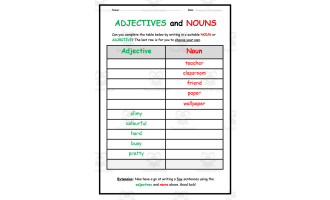
2) Adjective
3) Noun
4) Verb
5) Adverb
6) Prepositional Phrase
Ex: The gigantic kangaroo ate sadly on the slide.
Grades to Use With: This is a fun addition to any primary classroom that is studying parts of speech. It could work in Years 2–5. It could also be used in secondary school special education classrooms or with English Language Learners.
Standards:
CCSSL.2.1e
Use adjectives and adverbs, and choose between them depending on what is to be modified.
CCSSL.3.1a
Explain the function of nouns, pronouns, verbs, adjectives, and adverbs in general and their functions in particular sentences.
CCSSL.4.1
Demonstrate command of the conventions of standard English grammar and usage when writing or speaking.
Related resources
More resources teachers may find useful
More resources on the same subject and topic.



In the classroom
Teaching tips & learning objectives

Learning objectives
Identify and produce examples of six parts of speech (article, adjective, noun, verb, adverb, prepositional phrase) on demand.
Combine individually generated words and phrases into a complete sentence.

Teaching tips
Run as a literacy centre or partner activity, since each student needs only a recording sheet, pencil, and die.
Have students read their finished silly sentences aloud once a row is complete to reinforce which part of speech each word represents.
Reuse across the school year as a quick warm-up or transition activity since it requires no new printing once recording sheets are copied in bulk.

Skills covered
Part of speech identification — students must know an example of an article, adjective, noun, verb, adverb, or prepositional phrase to fill in the correct die roll.
Sentence construction — students assemble their six independently generated words/phrases into one complete, readable sentence.
Grammar recall under constraint — students generate a specific part of speech on demand, in random order determined by the die, rather than from a pre-set list.

No reviews yet
Downloaded this resource? Tell other teachers how it went.
Resource details
Concepts & topics
Core concepts
 Core concepts
Parts of speech
Articles
Prepositional phrases
Sentence construction
Topics
 Topics
Explore more
Categories this resource belongs to
Explore related searches


More to explore