Reading Comprehension Nonfiction Set 3 Sample: All About Horses (PDF)



- Grades
- Grades 4–5
- Pages
- 7
- File type
- Answer key
- Included


- Subject
- Spelling, Resources for Teachers, Reading Comprehension, Creative Writing, ESL, Writing, Reading, Language Development, ELA
- Topic
- Elementary, Reading
- Resource types
- Tests, Quizzes and Tests, Assessments, Writing Prompts, Teacher Tools, Worksheets, Worksheets & Printables
- Answer key
- Included
From the author
About this resource
Reading Comprehension Passages Nonfiction Set 3 Sample
Overview
No prep reading comprehension lessons, with enjoyable articles and topics.
Each lesson has a blend of post-reading activities. Mixed questions to check overall understanding. Vocabulary activities, plus a writing section.
Lessons also contain a bonus extension exercise at the end. Some you may like, some you may not, either way they are there if you wish to use them. Full answer keys are provided.
Passage Included
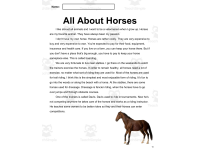
3.All About Horses: How is the author preparing to become a vet when she gets older?
PDF Version
This is the PDF uneditable version. This download is available in GOOGLE Docs, GOOGLE Forms, GOOGLE Slides. PDF, PPT, WORD.
FULL CATALOG OF DOWNLOAD LINKS HERE
Grade 4/5 Links
Fiction Set 1 - Animals
Google Docs
Google Forms
Google Slides
PPT
Word
Guided Reading Materials
Fiction Set 2 - Family
Google Docs
Google Forms
Google Slides
PPT
Word
Guided Reading Materials
Fiction Set 3 - Friends
Google Docs
Google Forms
Google Slides
PPT
Word
Guided Reading Materials
Fiction Set 4 - School
Google Docs
Google Forms
Google Slides
PPT
Word
Guided Reading Materials
Fiction Set 5 - Sports
Google Docs
Google Forms
Google Slides
PPT
Word
Guided Reading Materials
Nonfiction Set 1 - Birds
Google Docs
Google Forms
Google Slides
PPT
Word
Guided Reading Materials
Nonfiction Set 2 - Insects
Google Docs
Google Forms
Google Slides
PPT
Word
Guided Reading Materials
Nonfiction Set 3 - Mammals
Google Docs
Google Forms
Google Slides
PPT
Word
Guided Reading Materials
Nonfiction Set 4 - Nature
Google Docs
Google Forms
Google Slides
PPT
Word
Guided Reading Materials
Nonfiction Set 5 - Sea Animals
Google Docs
Google Forms
Google Slides
PPT
Word
Guided Reading Materials
Reading Passages Overview
Each passage is especially written for Grade 4-5 students, including key vocabulary required for this age group.
Topics are varied and are accompanied by colourful graphics. Topics are meant to educate, yet entertain the modern student.
These passages are perfect for the modern classroom. Whereas textbooks can become outdated in no time, any changes to technology or the world will result in updates to this product.
Mixed Questions
The mixed questions section of each lesson includes a variation of five comprehension, vocabulary and math questions. In addition, key reading strategies are frequently covered including cause & effect, summarizing, compare & contrast and making conclusions.
Two or three of the questions will be MCQs and other questions will require a written response of some kind.
Full answers and example responses appear at the end of the lesson.
Spelling & Vocab
Each reading passage contains a variety of words and phrases designed for Grade 4-5 students. Spelling and vocab activities provide the opportunity to build fluency with these words.
As it can become quite mundane doing the same activities over and over, each lesson in a set will contain a different spelling and vocab activity. Activities include: spelling games, sentence match-ups, mixed-up text and decoding words from the lesson.
Writing Prompts
Writing prompts are designed to continue the theme or lessons learned in the story.
Students are persuaded to write in a variety of ways and each prompt includes several cues to help.
As with the spelling/vocab section, writing prompts will vary. This includes research pieces, reading responses, poetry and creative writing prompts.
Full Answer Keys
Full answer keys and sample responses are provided so no matter how busy you are, you know you're covered!
Mixed question answers provide evidence from the text, math questions contain the relevant workings.
Answers are designed for use by the teacher, but also suitable as a handout to the student.
Just for Fun
Each lesson will have a bonus extension exercise. This is something fun to extend the lesson with. You can find these at the end of each lesson, titled Just for Fun.
Just for Funs are optional. Some you may like, some you may not. Either way, they are there to do with as you wish.
For similar downloads and other frees, do check out Cored Group on TeachSimple.
Related resources
More resources teachers may find useful
10 related resources were found in the released localized catalogue using shared categories and topics.


In the classroom
Teaching tips & learning objectives

Learning objectives
Answer literal and inferential comprehension questions about a nonfiction passage.
Determine the meaning of a word (e.g., 'qualified') using context clues from the passage.
Spell passage-related vocabulary words using partial letter clues.
Research and write about an animal of personal choice, citing sources used.

Teaching tips
Have students read both passage pages before starting the mixed-question page, since questions 3-6 require pulling specific details and inferences (like the meaning of 'qualified' and how horses show they are happy) directly from the text.
The spelling page's partial-letter clues (e.g., 'doctor for animals' for 'veterinarian') work well as a quick vocabulary review tied to the passage's content.
Use the research-and-write page as a take-home or library extension, since it asks students to choose their own animal and cite outside sources rather than working from the provided passage.

Skills covered
Nonfiction reading comprehension — students answer multiple-choice and short-answer questions drawn from passage details.
Vocabulary in context — students determine the meaning of the word 'qualified' as used in the passage.
Spelling with structural clues — students complete six passage-related words from partial letters.
Independent research and citation — students research an animal of their choice and record their sources.
Good to know
Questions teachers ask about this resource
What does the passage say horses use to show how they're feeling, since they can't talk?
Horses communicate through body language — for example, ears forward and a relaxed tail signal that a horse is happy.
What is the difference between trail riding and dressage in this passage?
Trail riding takes horses through places like the woods or along the beach and is described as the simplest, most enjoyable form of riding, while dressage is fancier riding where horses go over jumps and through obstacle courses.

No reviews yet
Downloaded this resource? Tell other teachers how it went.
Resource details
Concepts & topics
Core concepts
 Core concepts
Horse care and riding basics
Nonfiction comprehension
Vocabulary in context
Research and sourcing
 Topics
Explore more
Categories this resource belongs to
Explore related searches


More to explore