4th Grade Math Maze | Back to School Review
- Grades
- Grade 4
- Pages
- 9
- File type
- Answer key
- Included


- Subject
- Math
- Topic
- Fourth grade review, Math maze
- Resource types
- Activities
- Answer key
- Included
Product description
From the author
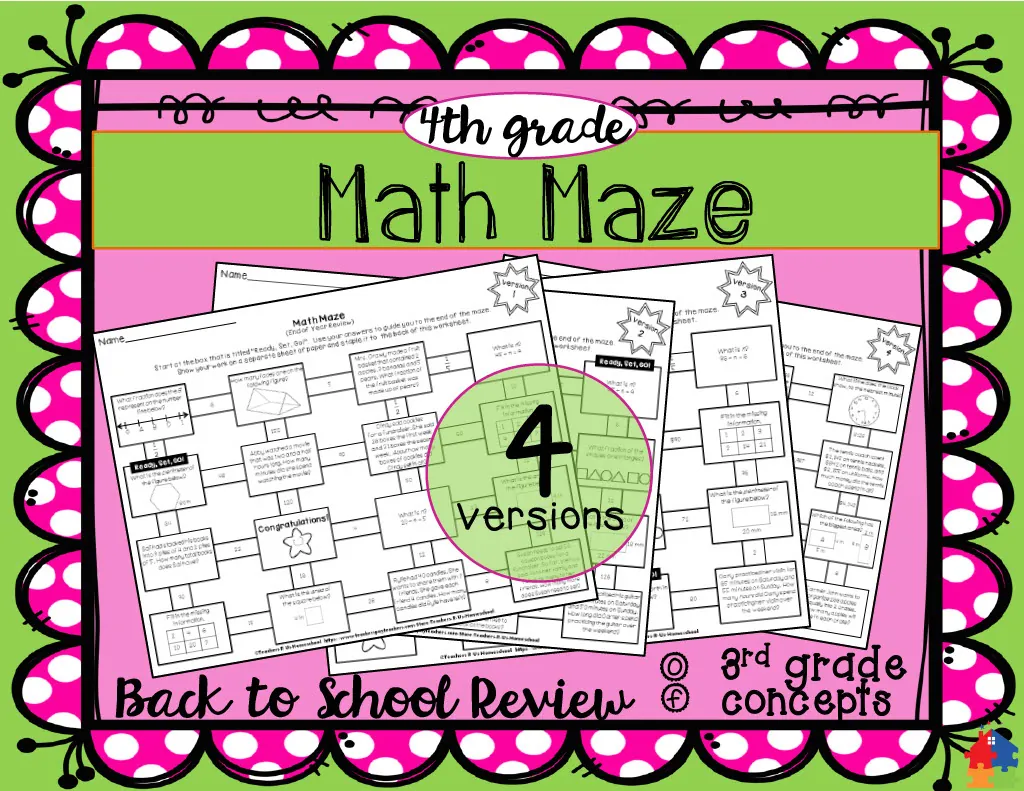
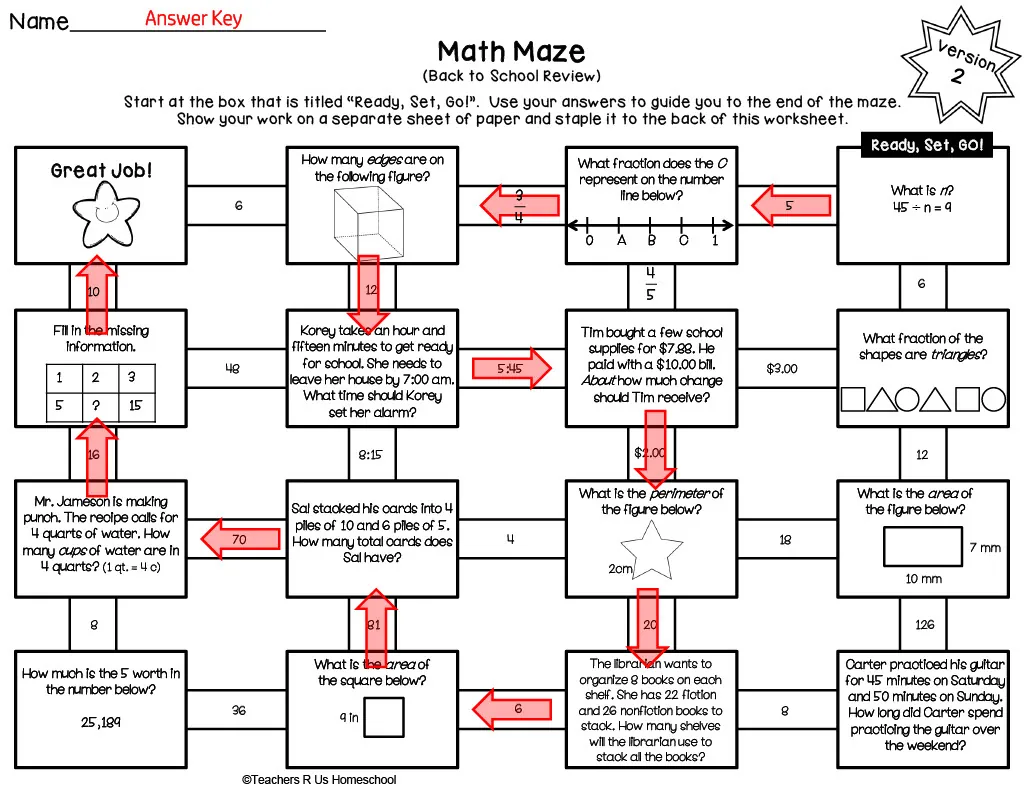
The 4th Grade Math Maze - Back to School Review is an engaging math activity that reinforces key 3rd grade math skills. This back-to-school math worksheet challenges students to navigate through a maze by solving math problems covering concepts like place value, multiplication, division, fractions, measurement, geometry, and more.
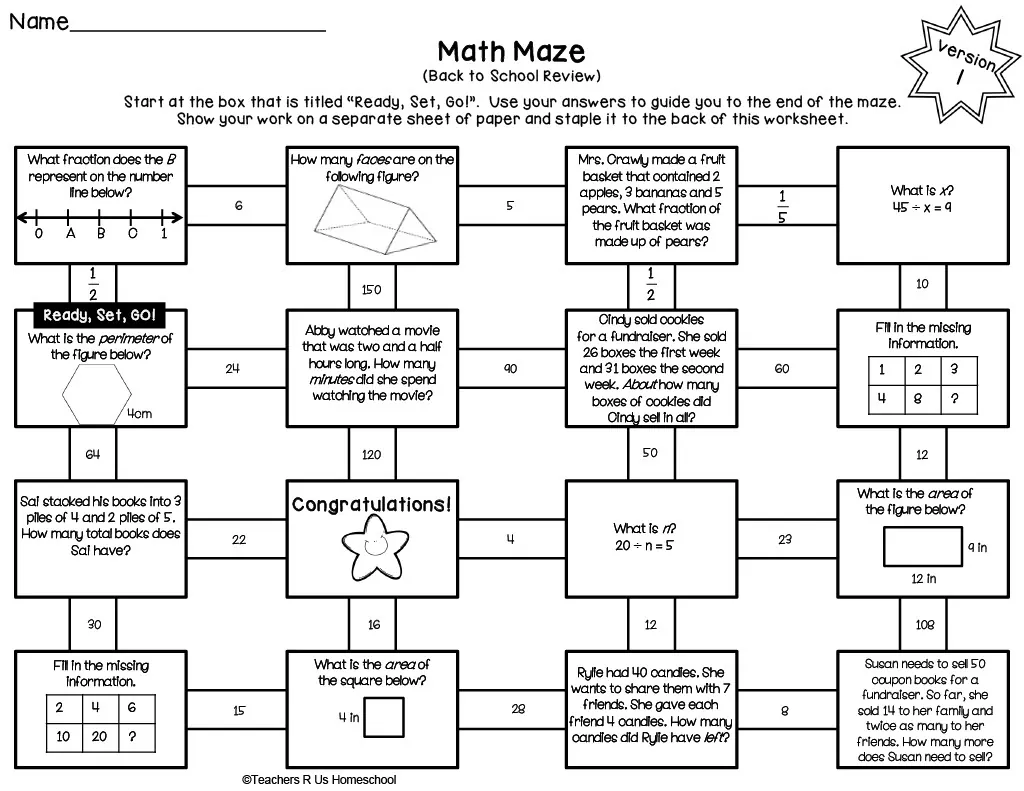
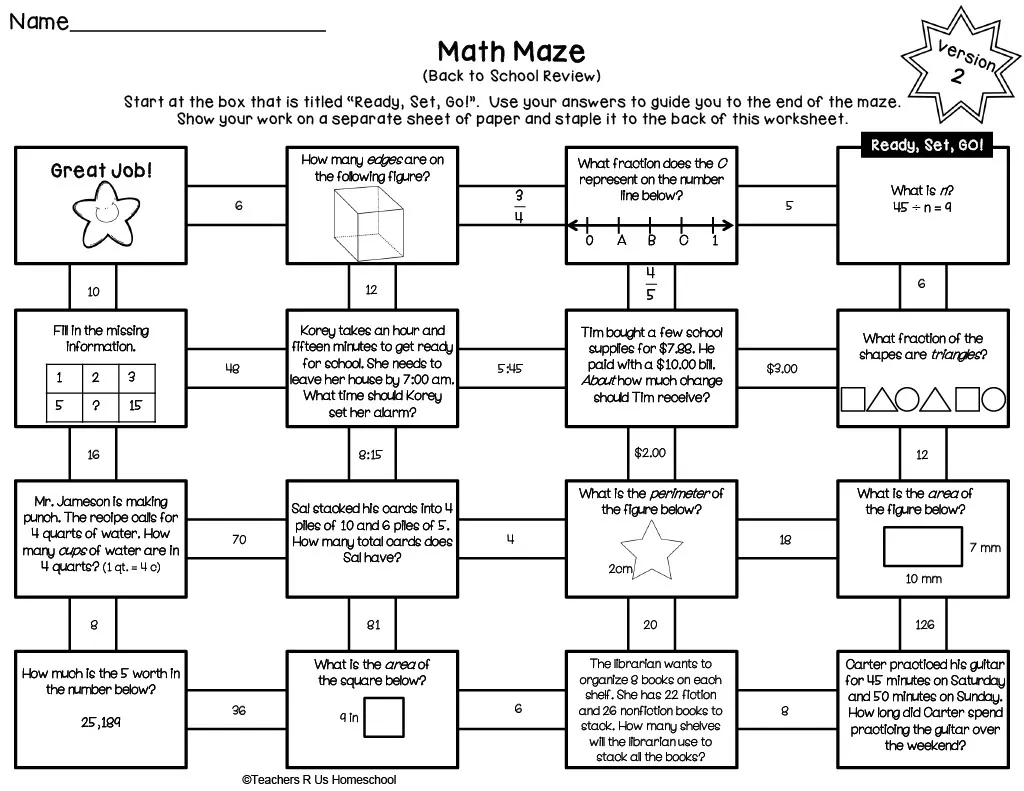
To begin, students start at the "Ready, Set, Go!" box and work through the maze by showing their work on separate paper and using their answers to guide them to the end. With 4 unique puzzle versions, this math review can be used for whole group instruction, small group practice, independent work, or even as a fun homework assignment at the start of 4th grade. The maze format and exposure to mixed math concepts makes this a versatile resource for assessing retention of previous years' knowledge while setting students up for success in mastering new 4th grade skills. An answer key is included for easy grading.
Related resources
More resources teachers may find useful
24 related resources were found using this product's title, contributor, categories and tags.


In the classroom
Teaching tips & learning objectives

Learning objectives
Identify a fraction represented on a number line or as part of a group
Calculate the area and perimeter of rectangles and squares from given dimensions
Use a computed answer to navigate sequentially through a maze of connected problems

Teaching tips
Assign a different one of the four maze versions to each small group or table so students working nearby are not solving identical problems.
Require the separate work-and-staple sheet from the start, since the maze format hides intermediate steps and makes it hard to check reasoning from the maze page alone.
Use the four versions across a week as short daily warm-ups rather than a single long sitting, selecting a suitable stopping point for the class.

Skills covered
Fraction identification — students name the fraction marked on a number line or represented as part of a group, such as identifying what fraction of a fruit basket is pears.
Area and perimeter calculation — students compute the perimeter of a given rectangle and the area of a given square from labeled side lengths.
Equation solving for a missing factor — students solve one-step equations such as "45 ÷ x = 9" or "7 x Y = 63" for the unknown.
Good to know
Questions teachers ask about this resource
Do the four versions cover the same math skills?
They revisit overlapping skills, with different problems and contexts. Preview each maze to match its particular geometry, measurement, fraction and word-problem items to your class.

No reviews yet
Downloaded this resource? Tell other teachers how it went.
Curriculum
Standards, concepts & topics
Standards
 Standards
- 4.MD.A.2
- 4.MD.A.3 — Apply the area and perimeter formulas for rectangles in real world and mathematical problems. For example, find the width of a rectangular room given the area of the flooring and the length, by viewing the area formula as a multiplication equation with an unknown factor.
Core concepts
 Core concepts
Fractions
Area and perimeter
Multi-step word problems
Place value
 Topics
Explore more
Categories this resource belongs to
Explore related searches
More to explore
You may also like