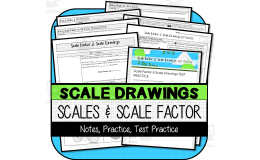
6th Grade Scale Drawings & Maps – Guided Notes & Word Problems


- Grades
- Grades 5–7, Middle School, Elementary
- Pages
- 9
- File type
- Answer key
- Included


- Subject
- Math, Measurements
- Topic
- Matemaths, Guided Notes
- Resource types
- Worksheets, Worksheets & Printables, Teacher Tools, Presentations
- Answer key
- Included
- Standards
- 6.RP.A.3
About this resource
What's inside this resource
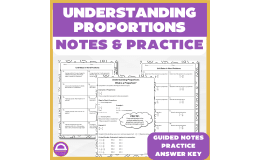
Make proportional reasoning real using this entertaining, no-prep 6th grade guided notes and practice activity on scale drawings and maps. Students will discover how to read, write, and solve proportions based on everyday circumstances, demonstrating for them just how classroom mathematics fit together in real life outside the textbook.
This activity works perfectly for CCSS 6.RP.A.3 and can be utilized just as well for whole-class instruction, small group instruction, independent practice, or sub plans. With real-world multi-step word problems, guided step-by-step notes, and 20 independent practice problems, your students will gain the skills and confidence they need to tackle proportions in any context.
What's Included:
Guided Notes with Step-by-Step Examples
Students learn to set up and solve proportions directly from maps, scale drawings, and blueprints.
Real-World Word Problems
Appropriate situations like scaled diagrams, travel maps, and architectural plans make learning relate to the real world.
Multi-Step Problem Solving
Higher-level thinking problems involving the setup of multiple proportions or unit conversion in order to get a solution.
20 Independent Practice Problems
A good mixture of simple and multi-step problems ensures skill reinforcement as well as application.
Complete Answer Key
Immediate grading and feedback on all guided and independent practice problems.
Skills Instructed:
Setting up and solving proportions from scale drawings and maps
Measurement from drawing/map to actual real-world distance conversion
Multi-step, real-world problem solution involving rates and distances
Real-world application of proportional thinking
Best For:
6th Grade Math – Unit Proportions
Scale Drawing & Map Lessons
Real-World Math Applications
Classwork, Homework, or Review Days
Substitute Plans – Zero prep required
Why Teachers Love It
No Prep – Print and head out straight away
CCSS-Aligned – Meets 6.RP.A.3 requirements
Practical & Interactive – Students understand how proportions apply in everyday life
Flexible Use – Can be utilized with any pacing or instructional approach
Engage your students in applying math they have learned in the classroom to real-world scenarios and make them masters of proportional thinking. This lesson streamlines instruction of scale drawings and maps and keeps students motivated and interested.
Download now and make proportions come alive in your classroom!
Related resources
More resources teachers may find useful
24 related resources were found using this product's title, contributor, categories and tags.

In the classroom
Teaching tips & learning objectives

Learning objectives
- Use a scale to convert between map distance and real distance
- Set up and solve a proportion from a given scale
- Solve multi-step word problems involving maps

Skills covered
- Proportional reasoning — students write and solve a proportion from each map or drawing scale

No reviews yet
Downloaded this resource? Tell other teachers how it went.
Curriculum
Standards, concepts & topics
Standards
 Standards
- 6.RP.A.3 — Use ratio and rate reasoning to solve real-world and mathematical problems, e.g., by reasoning about tables of equivalent ratios, tape diagrams, double number line diagrams, or equations. a. Make tables of equivalent ratios relating quantities with whole-number measurements, find missing values in the tables, and plot the pairs of values on the coordinate plane. Use tables to compare ratios. b. Solve unit rate problems including those involving unit pricing and constant speed. For example, if it took 7 hours to mow 4 lawns, then at that rate, how many lawns could be mowed in 35 hours? At what rate were lawns being mowed? c. Find a percent of a quantity as a rate per 100 (e.g., 30% of a quantity means 30/100 times the quantity); solve problems involving finding the whole, given a part and the percent. d. Use ratio reasoning to convert measurement units; manipulate and transform units appropriately when multiplying or dividing quantities.
Core concepts
 Core concepts
- Scale
- Proportion
- Scale drawing
- Map distance
 Topics
Explore more
Categories this resource belongs to
Explore related searches
More to explore
You may also like