Crash Course Psychology Episode Worksheet | 11 - How to Train a Brain

- Grades
- Grades 10–12, High School
- File type
- Microsoft Word
- Editable
- Yes


- Subject
- Social Studies, History, Psychology
- Topic
- Crash Course Video, Independent Work
- Resource types
- Worksheets & Printables, Worksheets
- Editable
- Yes
About this resource
What's inside this resource
Related resources
More resources teachers may find useful
24 related resources were found using this product's title, contributor, categories and tags.

In the classroom
Teaching tips & learning objectives

Learning objectives
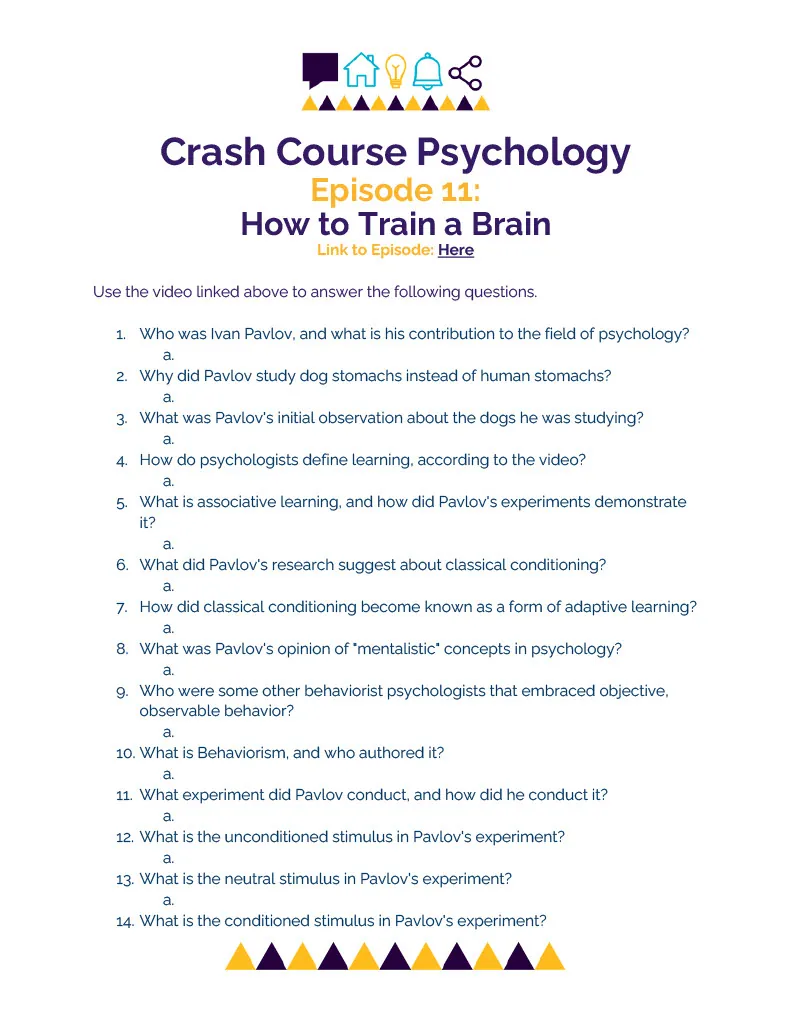
Explain Ivan Pavlov's classical-conditioning experiments and their contribution to behaviorist psychology
Define associative learning and identify its components: unconditioned stimulus, neutral stimulus, conditioned stimulus, and conditioned response
Describe classical conditioning as a form of adaptive learning that helps an animal survive

Teaching tips
Play the linked video and have students complete the worksheet as they watch, since the questions follow the episode in chronological order
Use the final four questions (stimulus/response identification) as a quick formative check, since they isolate the experiment's core terms
Pair with a follow-up discussion connecting Pavlov's dogs to a familiar real-world example of a conditioned response

Skills covered
Video-based note-taking — students extract specific facts and definitions from a psychology video in response to sequential questions.
Scientific process comprehension — students trace why Pavlov studied dog digestion and how his incidental observation of salivation led to his conditioning experiments.
Conceptual application — students apply the terms unconditioned stimulus, neutral stimulus, conditioned stimulus, and conditioned response to the specific details of Pavlov's experiment.
Good to know
Questions teachers ask about this resource
Which other psychologists does the worksheet cover besides Pavlov?
The teacher's solutions page also names B.F. Skinner and John B. Watson as behaviorist psychologists who embraced objective, observable behavior, and identifies Watson as the one who authored Behaviorism.

No reviews yet
Downloaded this resource? Tell other teachers how it went.
Resource details
Concepts & topics
Core concepts
 Core concepts
Classical conditioning
Behaviorism
Associative learning
 Topics
Explore more
Categories this resource belongs to
Explore related searches
More to explore
You may also like