24 related resources

Crash Course Sociology Episode Worksheet | 11 - Cultures, Subcultures, &…
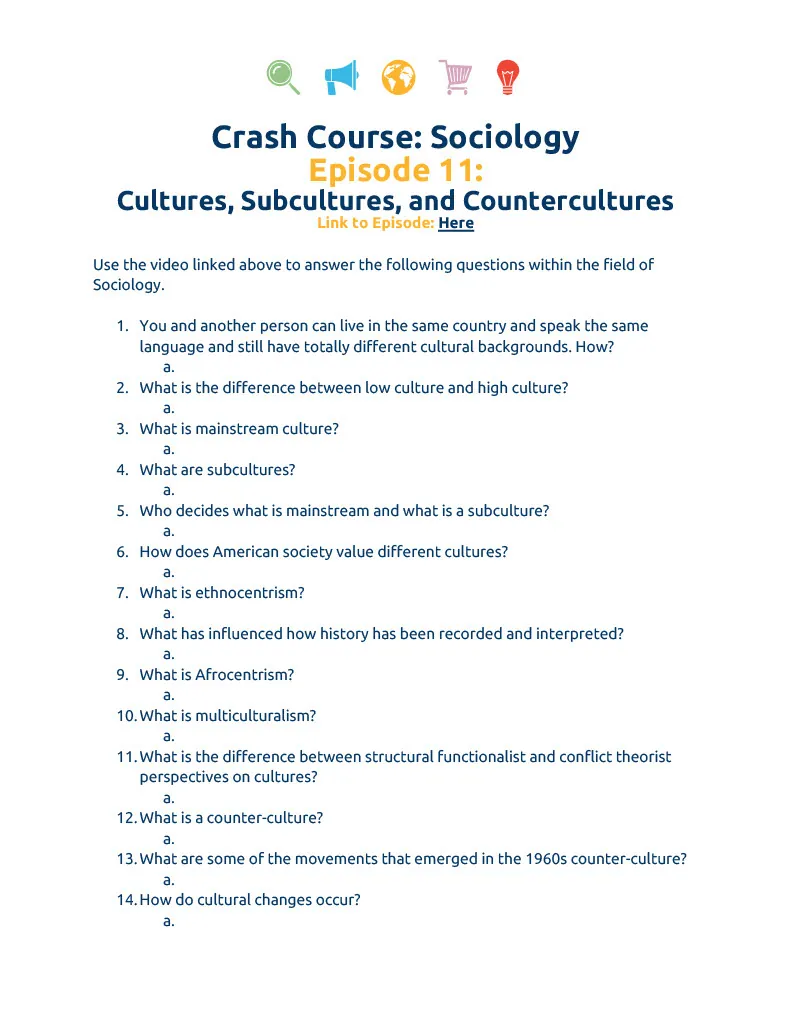
Fifteen video-comprehension questions accompany Crash Course Sociology's episode on cultures, subcultures, and countercultures, with a complete answer key provided.
Grades
Grades 10–12, High School
File type
Microsoft Word
Editable
Yes

Updated Feb 19, 2024

Subject
Social Studies
Topic
Crash Course Videos, Sociology
Resource types
Worksheets & Printables, Worksheets
Editable
Yes

About this resource

What's inside this resource

Video-based comprehension questions guide students through Crash Course Sociology's Episode 11 on cultures, subcultures, and countercultures, with a link to the episode provided at the top of the worksheet. Fifteen short-answer questions cover topics including the difference between low culture and high culture, mainstream culture versus subcultures, ethnocentrism and Eurocentrism, Afrocentrism, multiculturalism, structural functionalist versus conflict theorist perspectives on culture, the 1960s counterculture movements, and how cultural change occurs through invention, discovery, and diffusion. A complete answer key with full-sentence model answers for all fifteen questions is included as a separate document.

Product description

From the author

Cultures, Subcultures, and Countercultures Crash Course Sociology Episode 11 Worksheet This engaging worksheet accompanies the Crash Course Sociology episode on cultures, subcultures, and countercultures. High school students will answer 15 questions about key concepts from the 9-minute video, strengthening their understanding of societal groups. Educators can implement this printable 2-page resource in various ways. Students can complete it independently after watching the video linked at the top. Alternatively, pause the video to discuss questions together as a class. Small groups can also rewatch sections and discuss before recording responses. An answer key allows students to check their own work. Pair this video worksheet with other sociology resources to immerse students in relevant, real-world topics. Extend learning by having students identify examples of cultures, subcultures, and countercultures in their own lives. This worksheet builds on other Crash Course episode resources for government, US history, and sociology. Browse the Active Social Studies store for engaging project ideas, lecture slides, team building activities and more for civics, US history, sociology and psychology. Resources aim to actively engage students, spur discussion, and make social studies concepts relatable.

In the classroom

Teaching tips & learning objectives

Learning objectives

  • Distinguish between low culture, high culture, mainstream culture, and subcultures.

  • Explain ethnocentrism, Eurocentrism, Afrocentrism, and multiculturalism as sociological concepts.

  • Compare structural functionalist and conflict theorist perspectives on how cultures and subcultures interact.

  • Describe how cultural change occurs through invention, discovery, and cultural diffusion, using the 1960s counterculture as a historical example.

Teaching tips

  • Have students watch the linked Crash Course Sociology episode before attempting the worksheet, since all 15 questions are drawn directly from the video's content.

  • Use the answer key's full-sentence model answers as a class discussion guide after students complete their own responses, since several questions (like the 1960s counterculture question) have multi-part answers.

  • Pair the ethnocentrism/Eurocentrism/Afrocentrism questions (7-9) as a mini group discussion, since they build on each other conceptually.

Skills covered

  • Video-based note-taking and comprehension — students answer short-response questions drawn directly from a linked sociology video.

  • Sociological vocabulary — students engage with terms including ethnocentrism, Eurocentrism, Afrocentrism, multiculturalism, and cultural diffusion.

  • Comparative analysis — students distinguish structural functionalist and conflict theorist perspectives on subcultures.

Good to know

Questions teachers ask about this resource

What is the difference between mainstream culture and a subculture in this lesson?

Mainstream culture refers to cultural patterns broadly in line with a society's shared ideals and values, while subcultures are cultural patterns that set apart a segment of the population, such as the example of hipsters rejecting what was once considered mainstream.

How does the lesson explain the way cultures change over time?

The lesson describes three pathways for cultural change: the invention of new things, the discovery of new things, and cultural diffusion, which is how cultural traits spread from one culture to another.

No reviews yet

Downloaded this resource? Tell other teachers how it went.

Resource details

Concepts & topics

Core concepts

  • Culture, subculture, and counterculture

  • Ethnocentrism and cultural relativism

  • Cultural diffusion

  • Structural functionalism vs. conflict theory

Explore more

Categories this resource belongs to

Explore related searches

More to explore

You may also like