FREE Equivalent Ratios Guided Notes & Practice




- Grades
- Grades 5–7, Middle School, Elementary
- Pages
- 8
- File type
- Answer key
- Included


- Subject
- Math, Measurements
- Topic
- Matemaths, Algebra
- Resource types
- Worksheets, Worksheets & Printables, Teacher Tools, Presentations
- Answer key
- Included
Product description
From the author
Make learning Equivalent Ratios easy and stress-free with this FREE Guided Notes & Practice Activity for 6th grade math! This ready-to-print product is great to use when introducing or reviewing the concept of equivalent ratios, saving you time, prep, and stress.
Your students will begin with a brief and neatly organized reference sheet that guides them step by step through the process of solving equivalent ratio problems. The guided notes consist of definitions, descriptions, and solutions so the students can get the hang of it and build confidence.
Once the concept is introduced, students move on to 20 challenging practice exercises. The exercises are carefully designed to reinforce the concept, provide students with a great deal of variety, and facilitate independent or small-group practice. As classwork, homework, bellwork, or a review activity, the included answer key makes checking work easy and quick for busy teachers.
This resource is print and go, no prep! It's also student-centered, with clean layout and clear reading.
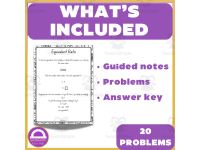
What's Included:
✅ Equivalent Ratios Reference Sheet – step-by-step explanation on how to solve equivalent ratios
✅ 20 Practice Problems – assorted problems to promote mastery
✅ Complete Answer Key – perfect for quick grading or self-testing
Why Teachers Love It:
No prep – Just print and teach
Clear Guided Notes – Perfect for direct instruction or independent practice
Difficult practice problems – Enough variety to challenge students
Flexible Application – Perfect for classwork, homework, review, math centers, or intervention groups
Perfect lead-in to an entire unit – Great as Lesson 1 in a ratios and rates unit
Standards Alignment:
This activity aligns with 6th Grade Common Core Standards, namely:
6.RP.A.1 – Apply the definition of a ratio to express a ratio relationship between two numbers using ratio language
6.RP.A.2 – Apply the definition of a unit rate to a ratio
???? Teach's Tip: Use this FREE resource as an introduction to your ratios unit and then proceed with additional guided notes and practice on Unit Rates, Word Problems, and Proportional Reasoning for a complete progression.
???? And this freebie also works perfectly as part of a Guided Notes & Practice Bundle so students have a clear, consistent structure for the whole unit.
???? Want to save time and kick off your unit in the right direction?
Download this FREE Equivalent Ratios Guided Notes & Practice today!
Related resources
More resources teachers may find useful
24 related resources were found using this product's title, contributor, categories and tags.

In the classroom
Teaching tips & learning objectives

Learning objectives
Explain equivalent ratios as common scaling
Find a missing ratio value using multiplication or division
Apply one scale factor to both ratio terms

Teaching tips
Have learners write the scale factor above both terms.
Check results by simplifying both ratios to the same form.

Skills covered
Ratio reasoning
Scale-factor use
Missing-value calculation

No reviews yet
Downloaded this resource? Tell other teachers how it went.
Curriculum
Standards, concepts & topics
Standards
 Standards
- 6.RP.A.1 — Understand the concept of a ratio and use ratio language to describe a ratio relationship between two quantities. For example, “The ratio of wings to beaks in the bird house at the zoo was 2:1, because for every 2 wings there was 1 beak.” “For every vote candidate A received, candidate C received nearly three votes.”
- 6.RP.A.2 — Understand the concept of a unit rate a/b associated with a ratio a:b with b ≠ 0, and use rate language in the context of a ratio relationship. For example, “This recipe has a ratio of 3 cups of flour to 4 cups of sugar, so there is 3/4 cup of flour for each cup of sugar.” “We paid $75 for 15 hamburgers, which is a rate of $5 per hamburger.”1
Core concepts
 Core concepts
Equivalent ratios
Scale factors
Proportional relationships
 Topics
Explore more
Categories this resource belongs to
Explore related searches
More to explore
You may also like