Free Reading Passage: Classification of Matter PDF


- Grades
- Grades 4–6, Elementary, Middle School
- Pages
- 8
- File type
- Answer key
- Included


- Subject
- ELA, Reading, Reading Comprehension, Science, Chemistry
- Topic
- classification of matter, matter reading comprehension
- Resource types
- Worksheets & Printables, Worksheets
- Answer key
- Included
- Standards
- CCSS.RI.4.1 CCSS.RI.4.4 +1
About this resource
What's inside this resource
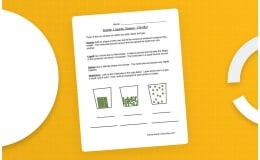
Students start in a sporting-goods store, where balls, tents and shoes each have their own aisle, and learn that this sorting has a name: classification. The free one-page reading passage then turns to matter, explaining that it is anything with mass that takes up space, and sorts it two ways. One way is by state, as a solid, liquid or gas. The other sorts elements into metals and nonmetals by their properties. Two tree-style charts on page 2 show both systems, and iron appears in each.
Five question pages follow, with 22 questions in eight parts. Students answer multiple-choice questions, sort nine everyday items by state and complete word-bank sentences. Element clue cards for gold, bromine, nitrogen and carbon ask them to check a state and group and copy proof words. Later parts have students explain why gold and diamond land in different groups, fix three mistakes in a classmate's chart, build a classification chart of their own and re-sort it another way.
- Grades 4–6: physical science reading on states of matter and classification
- Eight pages: a passage, five question pages and a two-page answer key
- Two PDFs: full color and print-friendly black and white
Related resources
More resources teachers may find useful
24 related resources were found using this product's title, contributor, categories and tags.



In the classroom
Teaching tips & learning objectives

Learning objectives
Define classification and matter in their own words.
Classify objects as solids, liquids or gases.
Sort elements as metals or nonmetals using their properties.

Teaching tips
Have students keep page 2 open while they work; questions across the set refer to both charts.
For the element clue cards, tell students to underline the electricity sentence first; the shape sentence decides the state.
If students stall on Part G, point back to how the passage splits "Sports" into "Ball sports" and "Water sports."

Skills covered
Classification: students group items by shared traits and explain the rule they used.
States of matter: students sort items such as maple syrup, a baseball bat and helium in a balloon.
Properties of elements: students use clues about shine and electricity to place gold, bromine, nitrogen and carbon.
Good to know
Questions teachers ask about this resource
Is this classification of matter passage free?
Yes. The free download includes the passage, both charts, all five question pages and the two-page answer key.
What does the passage cover?
What classification is, what matter is, the three states of matter, and how elements are sorted as metals or nonmetals by their properties.
How many questions are there?
22 questions in eight parts, from multiple choice and sorting to clue cards, fixing a chart and building one of your own.
Is there a group activity?
Yes. The key ends with Sort the classroom, where groups list eight objects, sort them by state and then by metal or not metal.

No reviews yet
Downloaded this resource? Tell other teachers how it went.
Curriculum
Standards, concepts & topics
Standards
 Standards
- CCSS.RI.4.1 — Refer to details and examples in a text when explaining what the text says explicitly and when drawing inferences from the text.
- CCSS.RI.4.4 — Determine the meaning of general academic and domain-specific words or phrases in a text relevant to a grade 4 topic or subject area.
- CCSS.RI.4.7 — Interpret information presented visually, orally, or quantitatively (e.g., in charts, graphs, diagrams, time lines, animations, or interactive elements on Web pages) and explain how the information contributes to an understanding of the text in which it appears.
Core concepts
 Core concepts
classification
matter
states of matter
metals
nonmetals
elements
physical science
 Topics
Explore more
Categories this resource belongs to
Explore related searches
More to explore
You may also like