French Subjunctive Practice Worksheets with Answers: Verb Forms
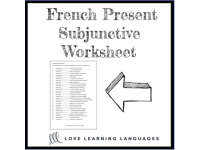
French present subjunctive practice in 34 items: students build forms from the ils and nous stems, complete three verb tables, then conjugate regular, two-stem and irregular verbs in 22 fill-in sentences.



- Grades
- Grades 8–12, Middle School, High School
- Pages
- 5
- File type
- Answer key
- Included


- Subject
- Foreign Languages, French
- Topic
- French grammar, Present subjunctive
- Resource types
- Worksheets & Printables, Worksheets
- Answer key
- Included
About this resource
What's inside this resource
Ils vendent, drop -ent, add the ending: the three-step method up top on this French present subjunctive worksheet turns any ils form into que je vende, and venir, worked out in full, shows why que nous venions takes the nous stem instead.
Part A asks for the stem and the que je form of sortir, lire, mettre and connaître. Part B practices the two stems of devoir and acheter, and Part C fills six-person tables for choisir, prendre and boire. Part D places four verbs in sentences after a trigger, as in « Je doute qu’ils ___ ma lettre avant lundi. », and Part E asks for one sentence that starts Il faut que je …
Page 3 adds 18 sentence items. Part F gives ten Il faut que sentences with regular and two-stem verbs such as finir, dormir, jeter and croire, this time without hint chips. Part G covers être, avoir, aller, faire, pouvoir, savoir and vouloir, with a strip of their special stems. Across Parts F and G every subject pronoun appears, including on and elles. Two answer pages give all 34 answers, a Common mistakes box and a table of more two-stem verbs.
Related resources
More resources teachers may find useful
24 related resources were found using this product's title, contributor, categories and tags.

In the classroom
Teaching tips & learning objectives

Learning objectives
- Find the present subjunctive stem by dropping -ent from the ils form.
- Add the endings -e, -es, -e, -ions, -iez and -ent to build all six forms.
- Use the nous stem for nous and vous in two-stem verbs such as devoir, prendre, voir and croire.

Teaching tips
- Walk through the vendre line in the formation box first, then the venir example, so students see a one-stem and a two-stem verb side by side.
- In Part A, students write the stem before the que je form; checking stems first catches most errors early.
- Point out that Part F has no hint chips: students recall the ils and nous forms of verbs such as jeter, voir and tenir on their own.

Skills covered
- Finding the stem — students drop -ent from ils sortent, ils lisent, ils mettent and ils connaissent.
- Two-stem verbs — students write devoir with its nous stem and its ils stem, then use two-stem verbs such as voir and croire in sentences.
- Full conjugation — students complete all six present subjunctive forms of choisir, prendre and boire.
Good to know
Questions teachers ask about this resource
How do students tell when a verb has two stems?
Compare the ils and nous forms, which the worksheet prints for every verb in Parts B, C and D. When the nous stem differs, as with doivent and devons, que nous and que vous use the nous stem. Part F then asks students to make that check themselves for verbs such as voir, tenir and croire.
Do students have to decide between the subjunctive and the indicative?
Every sentence follows a trigger that takes the subjunctive: il faut que in most items, plus je veux que, je doute que, il est important que and il est possible que. The work stays on building correct forms rather than choosing the mood.
How are the irregular verbs in Part G supported?
A strip above the eight sentences gives the special stem of faire, pouvoir and savoir (fass-, puiss-, sach-), the two stems of aller and vouloir, and all six forms of être and avoir. Students add the usual endings to the stems, and the notes on page 5 explain the aller and vouloir forms in items 33 and 34.
Which verbs can students use in Part E?
Any verb from the worksheet, after Il faut que je … The sample on page 4 is Il faut que je lise trois chapitres pour lundi; check the stem and the ending.

No reviews yet
Downloaded this resource? Tell other teachers how it went.
Resource details
Concepts & topics
Core concepts
 Core concepts
- Present subjunctive
- Verb stems
- Two-stem verbs
- Irregular subjunctive verbs
- Subjunctive endings
 Topics
Explore more
Categories this resource belongs to
Explore related searches
More to explore
You may also like