Homophones Worksheet Set
- Grades
- Grades 2–3, Elementary
- File type
- Preparation
- Print ready


- Subject
- ELA, Grammar, Vocabulary
- Topic
- homophones, homonyms
- Resource types
- Worksheets, Worksheets & Printables
- Preparation
- Print ready
About this resource
What's inside this resource
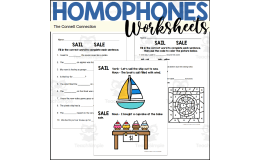
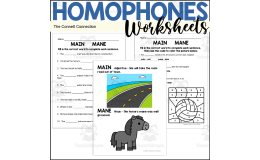
This is a set of Homophones Worksheets that will be great for your Language Arts students at any time of the year for them to practice or demonstrate knowledge.
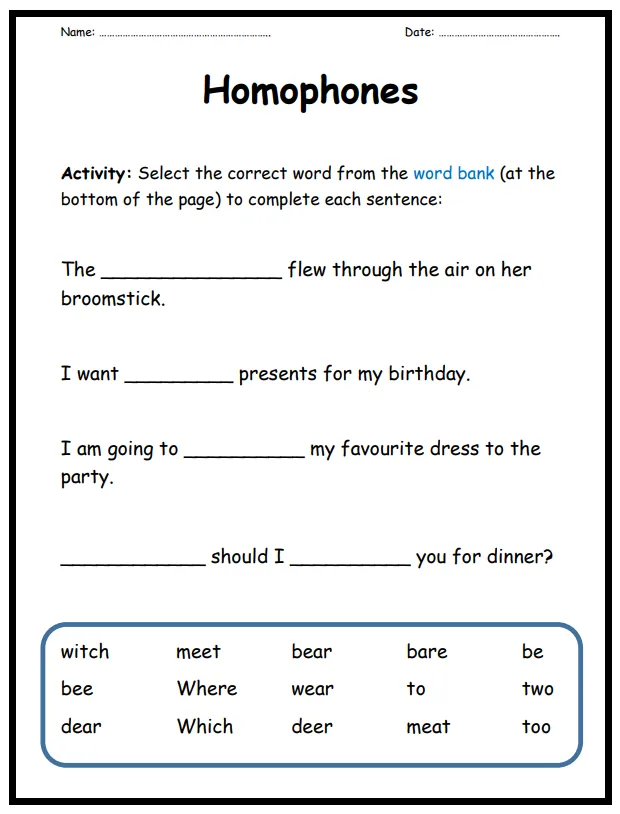
The first activity has fill in the blank sentences for students to select the correct word from the word bank.
There is a total of 12 sentences to complete and a word back with 15 words from which to pick. Some of statements are affirmations and others are questions.
The last activity is a challenge one which will have students choose a pair of homophones and write sentences using them.
This is an effective resource to have students practice their skills.
To differentiate levels within the same group of students, teachers can read at loud the words in the word bank as well as the sentences.
These homophones worksheets may also be used for individual assessment.
This is a ready-to-print and use resource!
Ways in which this resource may be used are:
Individual grammar practice.
ELA centers
Morning work
Homework
Formative assessment
Additionally, this resource was designed for students in 2nd and 3rd grade. However, it may be used by any grade where practice of homophones is identified.
You can find similar grammar resources and more in my store here!
Related resources
More resources teachers may find useful
24 related resources were found using this product's title, contributor, categories and tags.
In the classroom
Teaching tips & learning objectives

Learning objectives
Distinguish between commonly confused homophone pairs, such as bear/bare and meet/meat, based on sentence context.
Select the correct homophone from a word bank to complete a sentence accurately.
Compose original sentences that correctly use both words in a chosen homophone pair.

Teaching tips
Review each sentence's context clues as a class before assigning independent work, since some sentences require distinguishing between three or more similar-sounding word-bank options at once.
Use the Challenge Activity page as an extension for students who finish the fill-in-the-blank pages early.
If teaching in an American-English classroom, flag the British spelling "favourite" used in the text so students aren't marked down for matching the worksheet's own spelling.

Skills covered
Homophone discrimination — students choose the correct sound-alike word (e.g., bear vs. bare, meet vs. meat) based on sentence meaning.
Contextual vocabulary application — students use surrounding sentence context to select the right word from a shared word bank.
Original sentence construction — students write their own sentences correctly using a chosen homophone pair.

No reviews yet
Downloaded this resource? Tell other teachers how it went.
Resource details
Concepts & topics
Core concepts
 Core concepts
homophones
vocabulary in context
sentence writing
 Topics
Explore related searches
More to explore
You may also like