Number Sequences Math Worksheet

- Grades
- Grades 3–5
- File type
- Preparation
- Print ready


- Subject
- Math
- Topic
- Number sequences, Missing numbers
- Resource types
- Worksheets
- Preparation
- Print ready
- Standards
- 4.OA.C.5
Product description
From the author
If you want to give students extra practice with skip counting, I have just the resource for you.
What You Get:
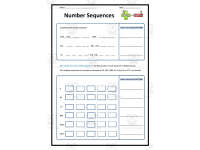
This is a Number Sequences Worksheet that is ideal for 3rd grade students who have been introduced to more complex sequencing patterns. It is a 2-page printable with 3 sets of problems that increase in difficulty. The increasing difficulty allows you to scaffold instruction and model problems to guide students through completing this worksheet.
How To Implement This Resource:
You can print off enough copies of this worksheet for each student to have. You may also choose to print only a few copies and laminate those. If you choose to laminate them, students can use dry erase markers to write answers. This is a great way to turn this into a math center or small group activity.
It can be used during or after a sequencing lesson as a quick informal assessment to determine how well students are grasping the concept.
In the first section, students will complete three different number sequences and write the rule or pattern for each one. The sequences include:
-- 4 digit numbers
-- 3 digit numbers counting down
--Decimals counting down
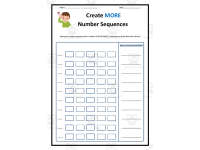
In the second section, students will create their own number sequencing for 6 different starting numbers. Be sure students write the rule or pattern for each one.
In the final section, students will write 10 different number sequencing while also coming up with the starting number. They will write the rule or pattern for each one.
I hope you enjoy!
Here are more of my resources for you to enjoy:
Related resources
More resources teachers may find useful
24 related resources were found using this product's title, contributor, categories and tags.


In the classroom
Teaching tips & learning objectives

Learning objectives
Create a whole-number or decimal sequence using a chosen constant step
State the rule and compare successive terms
Explain how a starting value and increment determine later terms

Teaching tips
Model how consecutive terms reveal a sequence’s step, then check that every supplied term follows it.
Use both whole-number and decimal steps when students create their own sequences.
Have partners continue each other’s sequences using the written rule.

Skills covered
Sequence construction — learners choose a constant step and generate whole-number or decimal terms.
Numerical reasoning — learners explain how the starting value and increment determine each term.

No reviews yet
Downloaded this resource? Tell other teachers how it went.
Curriculum
Standards, concepts & topics
Standards
 Standards
- 4.OA.C.5 — Generate a number or shape pattern that follows a given rule. Identify apparent features of the pattern that were not explicit in the rule itself. For example, given the rule “Add 3” and the starting number 1, generate terms in the resulting sequence and observe that the terms appear to alternate between odd and even numbers. Explain informally why the numbers will continue to alternate in this way
Core concepts
 Core concepts
Number sequences
Patterns
Decimals
 Topics
Explore related searches
More to explore
You may also like