Printable Fraction Bars – Visual Math Manipulative


- Grades
- Grades 3–6, Elementary, Middle School, Not Grade Specific
- Pages
- 5
- File type
- Preparation
- Print ready


- Subject
- Math, Fractions
- Topic
- Fraction Bars, Equivalent Fractions
- Resource types
- Worksheets, Worksheets & Printables
- Preparation
- Print ready
- Standards
- 3.NF.A.3
Product description
From the author
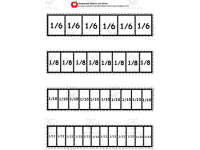
Working on fractions? Here is a hands on way to help make a little more sense out of them. Your child will be able to actually see how these pieces relate to one another. There is a black and white version (you can print and color them how ever you would like) or there is a color version. The one whole piece will fit all of the other fraction pieces. For example, you can show your child how 1/2 plus 1/2 equals one whole by actually placing the two 1/2 pieces on to the one whole piece. You can also demonstrate how 1/4 goes on to the 1/2 piece two times, or goes on to the one whole piece four times.
I hope these can help you and your child when learning about fractions!
Directions: If you are choosing the black and white version, print and color. Laminate for durability if you can. Then, cut out along the dotted lines which ever set of fraction bars you are going to use. You can show your children how fractions work by demonstrating how the fraction pieces relate to each other. The one whole piece will fit all of the other fraction pieces. For example, you can show your child how ½ plus ½ equals one whole by actually placing the two ½ pieces on to the one whole piece. You can do the same with demonstrating how (for example) ¼ goes into ½ twice.
Suggestion: Keep the pieces organized by using small snack size sandwich baggies, then put everything together in a larger zip lock bag. Or, you could paperclip the pieces together by their fractions and store in a small container or baggie. Whatever works for you!
Related resources
More resources teachers may find useful
24 related resources were found using this product's title, contributor, categories and tags.



In the classroom
Teaching tips & learning objectives

Learning objectives
See that a whole can be split into any number of equal parts, and that the parts get smaller as the number of parts grows
Show that unit fractions combine to make a whole by covering the one-whole strip — two halves, three thirds, twelve twelfths
Compare fractions by laying strips side by side and connect the physical lengths to the fraction values

Teaching tips
Print the black-and-white set when you want each denominator in a different colour — the directions leave the colour choice to the student, which makes the pieces easier to sort later
Store by denomination — a small bag per fraction inside one larger bag — so a set can be handed out and returned intact rather than re-sorted each lesson
Start every demonstration from the one-whole strip: it is the only piece that all the others measure against, and the whole point of the common length

Skills covered
Understanding unit fractions — students handle a physical 1/3 or 1/8 piece and see it as one part of an equally divided whole.
Finding equivalent fractions by matching — a quarter fits onto a half twice, as the directions demonstrate, and the same works for sixths against thirds.
Good to know
Questions teachers ask about this resource
Which denominators are included?
Nine rows in all: one whole, halves, thirds, quarters, fifths, sixths, eighths, tenths and twelfths. Sevenths, ninths and elevenths are not part of the set, so a lesson built around those would need a different resource.
How do the two versions differ?
One is printed in colour and the other in black and white for students to colour themselves. The directions cover the second case first: print, colour, laminate for durability, then cut along the dotted lines. Both carry exactly the same nine rows.

No reviews yet
Downloaded this resource? Tell other teachers how it went.
Curriculum
Standards, concepts & topics
Standards
 Standards
- 3.NF.A.3
Core concepts
 Core concepts
Fractions
Unit fractions
Equivalent fractions
Comparing fractions
Math manipulatives
 Topics
Explore more
Categories this resource belongs to
Explore related searches
More to explore
You may also like