


Camping Reading Comprehension Passage with Questions
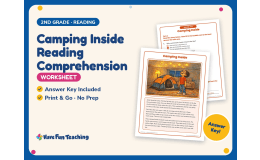
A camping story about Maya and her grandpa leads into eleven questions on details, word meaning, sequence, cause and effect, feelings, best title and main idea, ending with a short opinion paragraph.


- Grades
- Grades 2–4, Elementary
- Pages
- 4
- File type
- Answer key
- Included


- Subject
- ELA, Reading, Reading Comprehension
- Topic
- reading comprehension, 2nd grade reading comprehension
- Resource types
- Worksheets & Printables, Worksheets
- Answer key
- Included
About this resource
What's inside this resource
Maya’s first night sleeping outside, at Campsite 14 beside Pine Lake with Grandpa Leo, is told in a realistic camping story of about 260 words in six numbered paragraphs. She helps push tent stakes in at a slant, gathers fallen sticks for a campfire, waits out a drizzle under a tarp and falls asleep to an owl’s call.
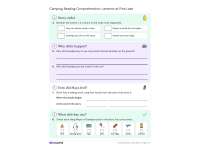
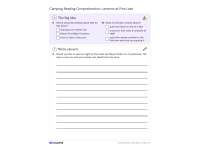
Eleven questions follow over three pages. Page 1 checks two story details and the meaning of drizzle from context. Page 2 asks students to number four events, explain two of Grandpa’s choices, name Maya’s feelings with words from the text and check the four things the characters used. Page 3 moves to the big picture: choosing another good title for the story and what it is mostly about, then writing four or five sentences on whether they would like a night at Pine Lake, with one detail from the story.
The answer page supports each answer with a paragraph or quote, gives a writing checklist for the opinion, lists five words to preview and adds a prove-it tip.
Related resources
More resources teachers may find useful
24 related resources were found using this product's title, contributor, categories and tags.

In the classroom
Teaching tips & learning objectives

Learning objectives
- Answer questions about key details using information from the story.
- Work out the meaning of drizzle from clues in the text.
- Put four story events in the order they happened.

Teaching tips
- Preview the words listed on the answer page, such as stake, tarp, drizzle and fire ring, before students read.
- After questions 1 and 2, have students underline the sentence that proves each answer and write the paragraph number beside it.
- For question 7, show that the short line takes a feeling word and the long line takes words copied from the story.

Skills covered
- Key details — students locate where Campsite 14 was and why the stakes went in at a slant.
- Vocabulary in context — students use clues such as tiny drops tapping on the tent to work out what drizzle means.
- Sequencing — students number four events, from counting trail signs to putting the cooler in the car.
Good to know
Questions teachers ask about this resource
Is the story fiction or nonfiction?
It is realistic fiction. Maya and Grandpa Leo are made-up characters, and the story includes real camping practices such as slanting tent stakes, using only fallen sticks and keeping food away from raccoons.
How do students choose between the title options in question 9?
The best title has to fit the whole story. “Maya’s First Night Outdoors” matches the opening line that she had never slept outside before, while the other two options name things the story never shows: the tent is green, not the car, and no raccoon arrives.
What counts as a correct feeling word in question 7?
For the drizzle, worried, upset or disappointed are accepted, with “Maya frowned” or “Is our trip ruined?” as support from the text. For the end, calm or happy works, supported by “she was asleep, smiling.”

No reviews yet
Downloaded this resource? Tell other teachers how it went.
Resource details
Concepts & topics
Core concepts
 Core concepts
- Key details
- Sequence of events
- Vocabulary in context
- Cause and effect
- Main idea
- Opinion writing
 Topics
Explore more
Categories this resource belongs to
Explore related searches
More to explore
You may also like


