Roller Coasters Reading Comprehension Article

- Grades
- Grades 6–8, High School
- Pages
- 5
- File type
- Multiple File Types
- Answer key
- Included


- Subject
- ELA, Science, Reading Comprehension
- Topic
- Roller coasters, Energy conversion
- Resource types
- Worksheets
- Answer key
- Included
- Standards
- RI.6.1
Product description
From the author
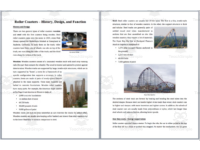
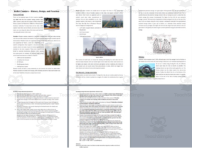
Read about wooden and steel roller-coaster construction and energy conversion, then answer eight questions. The tasks include comparing two hill heights and researching a real coaster’s height for an energy calculation using a supplied train mass.
The five-page PDF contains the article, questions, answer guidance and references. An editable Word version supplies the same material. Answers cover questions 1–7; question 8 supplies equation guidance because results depend on the chosen coaster height.
Related resources
More resources teachers may find useful
24 related resources were found using this product's title, contributor, categories and tags.



In the classroom
Teaching tips & learning objectives

Learning objectives
Explain the physical differences between wooden and steel roller-coaster construction
Describe how energy converts between gravitational potential and kinetic forms as a roller-coaster car moves along the track
Compare two hypothetical roller coasters with different hill heights and justify which produces a faster ride

Teaching tips
Review the GPE = mgh and KE = ½mv² formulas before assigning question 8, since it is the only question that requires applying both equations together
Have students research the height of a real coaster near them for question 8, which builds its calculation on locally sourced height data plus the article's supplied mass figures
Pair the article with its own captioned figures, since several questions (such as the wheel-setup description) connect the article’s written descriptions with its diagrams

Skills covered
Scientific text comprehension — students extract structural and mechanical facts, such as wheel setup and material differences, directly from an informational article.
Energy-conservation reasoning — students explain how gravitational potential energy converts to kinetic energy as a coaster descends and re-ascends smaller hills.
Applied physics calculation — students use the GPE = mgh and KE = ½mv² formulas with supplied mass data to calculate energy values for a real-world coaster.
Good to know
Questions teachers ask about this resource
Does the calculation question use a coaster from the article, or ask students to find their own?
Students research a real roller coaster near them and use the article's supplied mass data (a fully loaded train mass of 4,500 kg) together with that coaster's own height to calculate its gravitational potential and kinetic energy.
Are the wooden and steel construction examples describing the same coaster?
No, they're two different real coasters: the wooden section profiles the American Eagle at Six Flags Great America in Illinois, and the steel section profiles the Pepsi Max Big One at Blackpool Pleasure Beach in England.

No reviews yet
Downloaded this resource? Tell other teachers how it went.
Curriculum
Standards, concepts & topics
Standards
 Standards
- RI.6.1
Core concepts
 Core concepts
Gravitational potential energy
Kinetic energy
Energy conservation
Roller coaster engineering
 Topics
Explore more
Categories this resource belongs to
Explore related searches
More to explore
You may also like