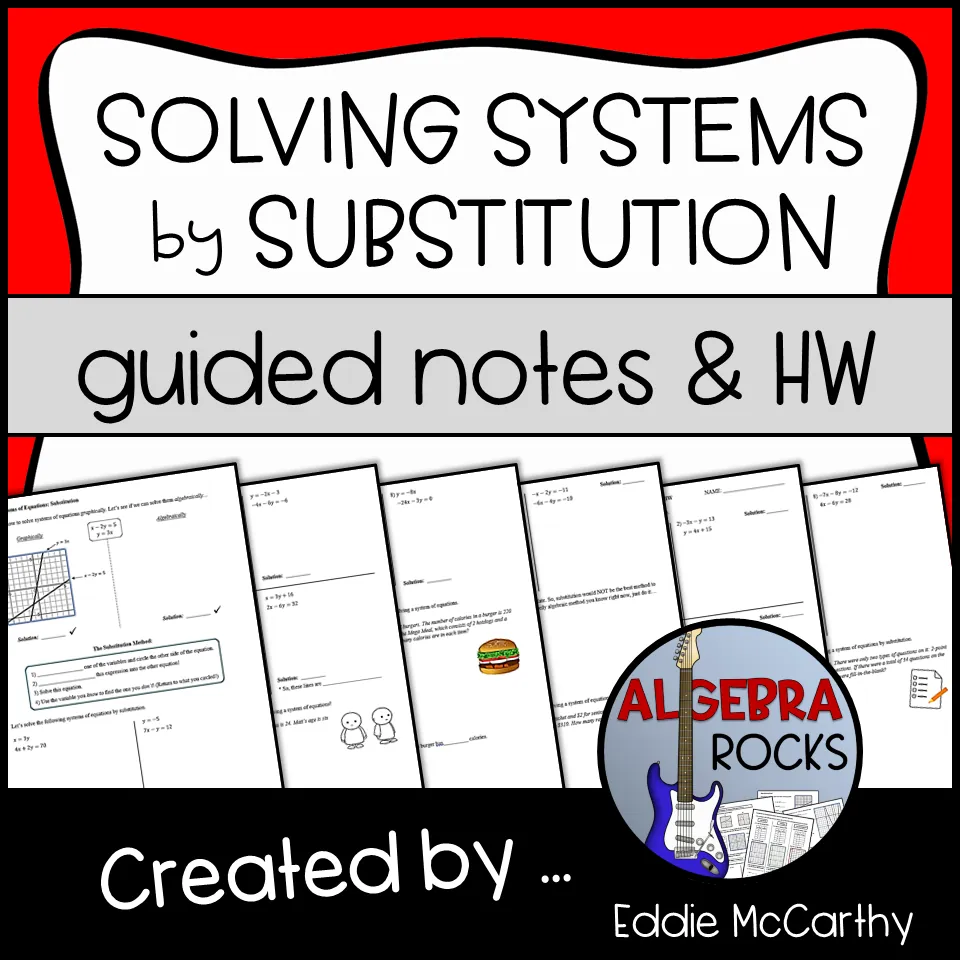
Solving Systems by Substitution Guided Notes + Homework Set
- Grades
- Grades 8–10, Middle School, High School
- Pages
- 16
- File type
- Answer key
- Included


- Subject
- Math, Algebra
- Topic
- Systems of equations, Substitution method
- Resource types
- Worksheets, Worksheets & Printables
- Answer key
- Included
- Standards
- 8.EE.C.8
Product description
From the author
Solving Systems by Substitution Guided Notes and Homework Set
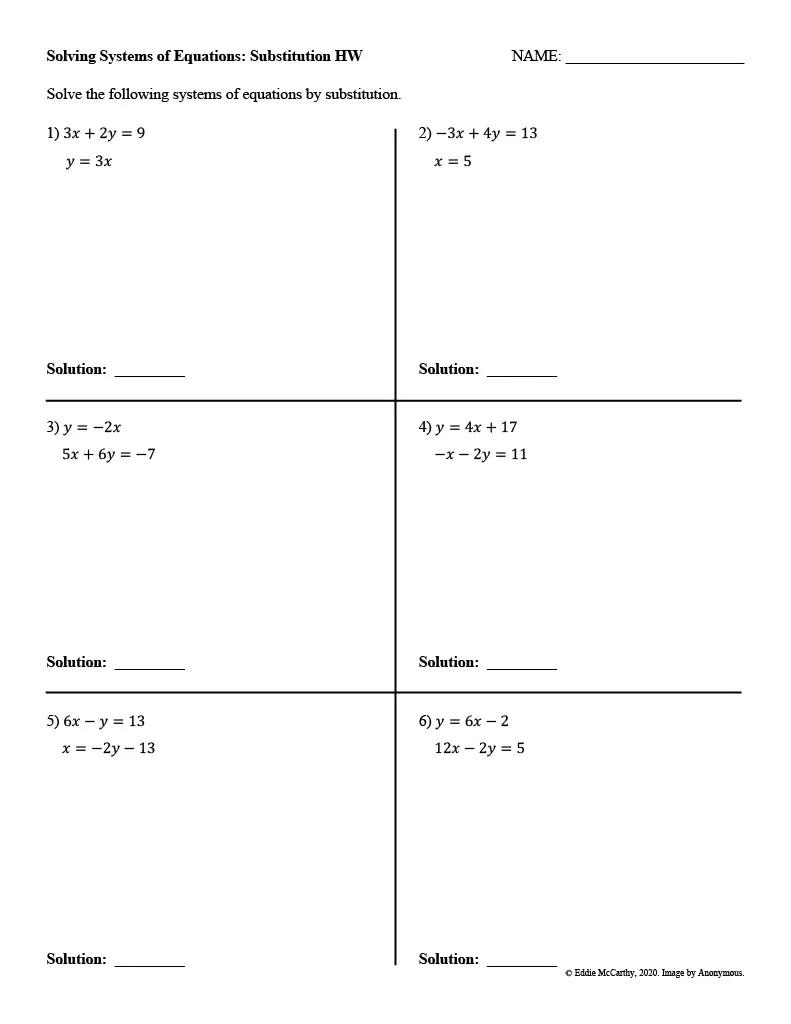
This 9-12th grade algebra resource teaches students to solve systems of equations using substitution. The informative packet begins with step-by-step guided notes that explain the substitution method and provide examples for students to follow along. After learning the concepts, students then apply their knowledge by completing the included homework assignment. Teachers can implement this resource in many ways - as an in-class lesson, a small group activity, or as individual practice. With the answer key provided, this is a versatile resource that allows students to reinforce an essential Algebra 1 skill that lays the foundation for broader math comprehension.
Related resources
More resources teachers may find useful
24 related resources were found using this product's title, contributor, categories and tags.

In the classroom
Teaching tips & learning objectives

Learning objectives
Solve a system of two linear equations by isolating a variable, substituting the expression, and back-substituting to find both values
Recognize systems with no single solution when substitution produces parallel or identical lines
Translate real-world situations — ages, ticket sales, calories, test points — into a system of equations and solve it by substitution

Teaching tips
Teach Part 1 and assign Homework 1 before moving on: each homework set mirrors the problem types of its notes lesson, down to the closing word problem
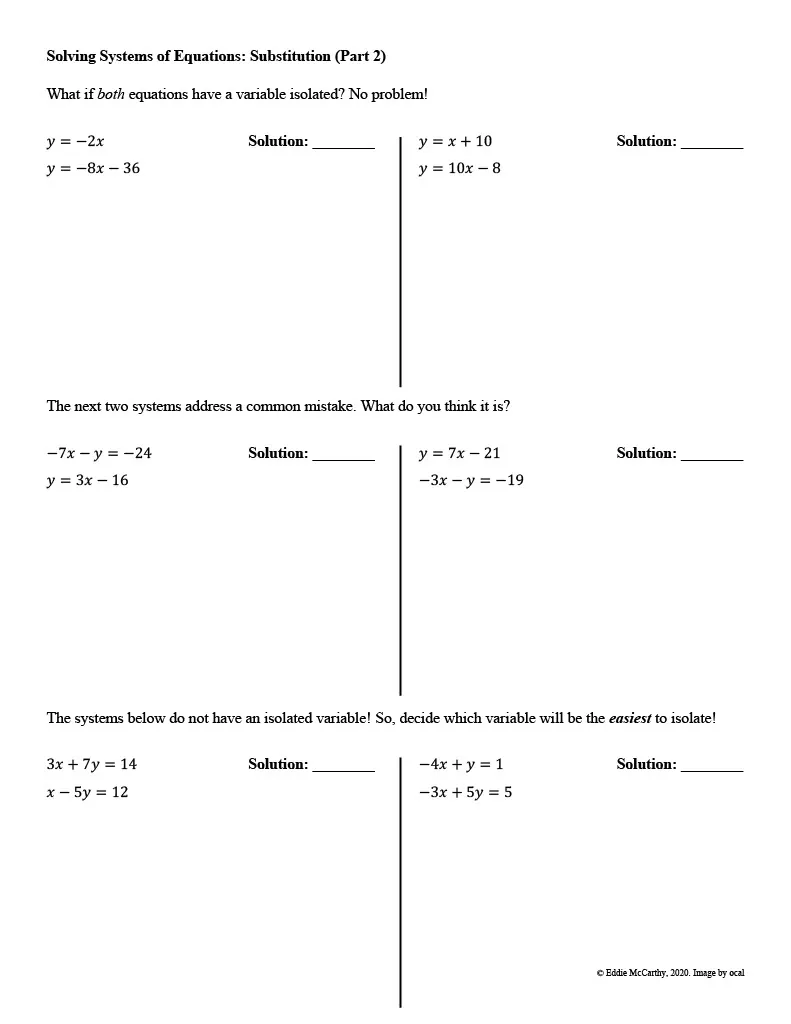
Use the two-system 'common mistake' spread in Part 2 as a class discussion — the notes explicitly ask students to predict what the mistake is before solving
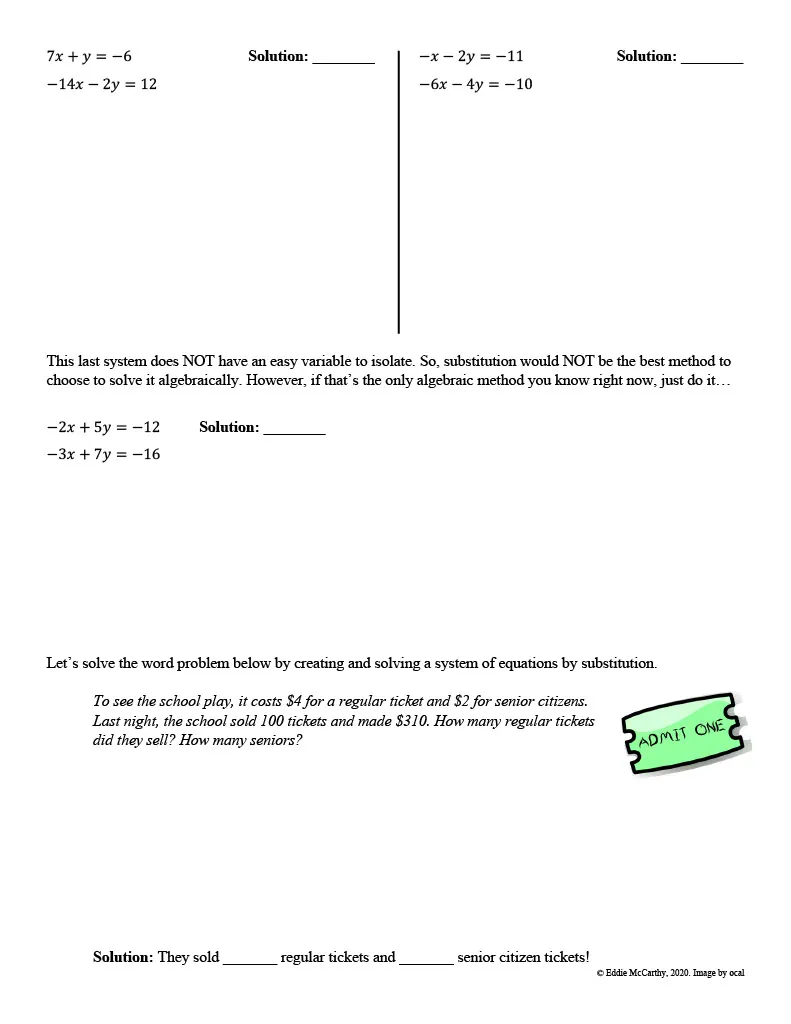
The final Part 2 system, which the notes admit substitution is a poor fit for, sets up a natural motivation for teaching elimination next

Skills covered
Solving systems by substitution — students isolate a variable, substitute the expression into the other equation, and return to the circled expression to find the second value, following the notes' four-step method.
Modeling with systems — four word problems (brothers' ages, play tickets, cafe calories, history-test questions) are translated into equations and solved by substitution.
Evaluating method choice — one system is included precisely because substitution is a poor fit, prompting students to weigh algebraic methods against each other.
Good to know
Questions teachers ask about this resource
Do the notes go beyond systems that already have a variable isolated?
Yes. Part 1 starts from pre-isolated equations, but Part 2 moves to systems where both equations are solved for y, then to systems where nothing is isolated and students choose the easiest variable, and finally to one where substitution itself is a poor choice.
How do special cases like no-solution systems come up?
Part 1 ends with two side-by-side systems whose lines are parallel or identical; after solving, students complete the sentence 'So, these lines are ______' to articulate the special case themselves rather than being told in advance.

No reviews yet
Downloaded this resource? Tell other teachers how it went.
Curriculum
Standards, concepts & topics
Standards
 Standards
- 8.EE.C.8
Core concepts
 Core concepts
Systems of equations
Substitution method
Linear equations
Algebra
 Topics
Explore more
Categories this resource belongs to
Explore related searches
More to explore
You may also like