The Holocaust Lapbook / Interactive Notebook -EBOOK

- Grades
- Grades 8–12, Middle School, High School
- Pages
- 68
- File type
- Preparation
- Print ready


- Subject
- ELA, Social Studies, Creative Arts, Reading, Numbers, Early Math, Math, History, Geography, Art
- Topic
- Holocaust, Interactive learning
- Resource types
- Workbooks, Worksheets & Printables, Crafts, Activities
- Preparation
- Print ready
Product description
From the author
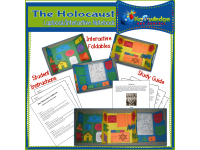
The Holocaust Lapbook / Interactive Notebook EBOOK contains 68 PDF pages with assembly guidance, booklet templates, a study guide, a timeline and source references.
Students organize responses in 28 booklets across three file folders. Additional activities include a word search, matching quiz, map work, copywork, a recipe, coloring pages and four Interesting Facts booklets.
Read the publisher’s content advisory before teaching. The sensitive nature of the material calls for teacher preparation and support. Select sections appropriate to your students and gather the materials listed in those assembly instructions.
Related resources
More resources teachers may find useful
24 related resources were found using this product's title, contributor, categories and tags.


In the classroom
Teaching tips & learning objectives

Learning objectives
Explain the origin and meaning of the word Holocaust and what made it possible in Germany after the First World War
Describe the Völkisch Movement, Nazi idealism and what changed for Jews across the 1930s
Set out what the ghettos, the Einsatzgruppen, the Wannsee Conference and the extermination camps were and what each was intended to achieve

Teaching tips
The content advisory sits on page 3, before any instructions: the study covers horrific acts, discrimination and death, and the advisory asks that students be prepared beforehand. Read that page first.
Gather three file folders and the supplies required by the booklet sections you choose. The general supply list offers several fastening options; review each assembly instruction before printing.
The booklet instructions tell the student what to write as well as how to fold, which means the templates can be handed out one at a time across a unit rather than all at once.

Skills covered
Historical knowledge organised by question - each of the first seventeen booklets poses a specific question, from what the Einsatzgruppen were meant to do to why Jews were reluctant to resist, and the answer is written inside that booklet.
Mapping quantitative data - the map booklet is shaded to a six-band key, from more than a million deaths down to fewer than twenty-five thousand.
Precise construction - every booklet carries its own cutting, folding and fastening method, from brad-fastened circles to triangle folds and stapled stacks.
Good to know
Questions teachers ask about this resource
What preparation does the lapbook need before a lesson?
More than most printables. Three file folders are folded to make the base, booklet templates are printed on 24# coloured paper, and individual booklets call for glue sticks or hot glue, scissors, metal brad fasteners, a hole punch, staples, paper clips, ribbon and yarn.
What additional formats accompany the historical booklets?
The set also includes a word search, a Kugel recipe, copywork, coloring pages, and four blank Interesting Facts booklets for additional notes.

No reviews yet
Downloaded this resource? Tell other teachers how it went.
Resource details
Concepts & topics
Core concepts
 Core concepts
The Holocaust
World War II
Nazi Germany
Interactive notebook
Timelines
 Topics
Explore more
Categories this resource belongs to
Explore related searches
More to explore
You may also like