Triangles Reference Chart – Types and Angles



- Year levels
- Years 3–6
- Pages
- 2
- File type
- Preparation
- Print ready


- Subject
- Geometry, Maths
- Topic
- Triangles, Geometry
- Resource types
- Diagrams, Charts, Anchor Charts, Graphic Organizers, Posters
- Preparation
- Print ready
- Australian Curriculum content descriptions
- AC9M7SP02 — classify triangles
From the author
About this resource
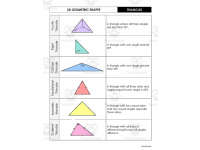
2D Geometry Shapes Triangles Reference Chart
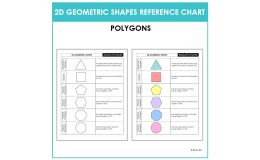
Learning about triangles doesn’t have to be tricky. This reference chart makes it easy for students to understand the different types of triangles, including acute, right, and obtuse angles, as well as equilateral, isosceles, and scalene sides. The chart comes in a full-colour version that works beautifully as a classroom wall display, on a whiteboard, or even projected digitally. There is also a black-and-white version that fits perfectly in student binders or interactive notebooks, providing a handy reference sheet that students can keep at their desks.
This resource is ideal for lessons on 2D shapes and triangle classification. It’s especially helpful for visual learners who benefit from seeing concepts clearly illustrated, and it makes a useful addition to maths centres, classroom displays, or study materials. Using the chart regularly can help students build confidence in recognising and naming different triangle types while reinforcing key geometry vocabulary and concepts. Teachers will also appreciate the time saved, since the chart is ready to print and use immediately. It works best for students in Years 3–6, but it can also serve as a helpful review tool for older students. Whether you display the colour chart on your maths wall or provide the black-and-white version for individual students, this reference chart is a flexible and practical resource for any geometry unit.
Related resources
More resources teachers may find useful
More resources on the same subject and topic.

In the classroom
Teaching tips & learning objectives

Learning objectives
Classify a triangle as acute, right, or obtuse based on its largest angle.
Classify a triangle as equilateral, isosceles, or scalene based on its side lengths and angle equality.
Use the chart's definitions to identify and name a given triangle correctly.

Teaching tips
Display the colour version on a maths wall as an ongoing visual reference during a geometry unit.
Give students the black-and-white version to keep in a maths notebook or interactive notebook for quick reference during independent work.
Have students sort a set of triangle cutouts into acute/right/obtuse and equilateral/isosceles/scalene groups using the chart's definitions as a check.

Skills covered
Angle-based triangle classification — students use the chart's angle-measure definitions to sort triangles into acute, right, and obtuse.
Side-based triangle classification — students use the chart's side-and-angle-equality definitions to sort triangles into equilateral, isosceles, and scalene.
Geometry vocabulary — the chart reinforces precise terms for each triangle type and its defining property.

No reviews yet
Downloaded this resource? Tell other teachers how it went.
Australian Curriculum (Version 9.0)
Australian Curriculum content descriptions
Australian Curriculum content descriptions
 Australian Curriculum content descriptions
- AC9M7SP02 — classify triangles, quadrilaterals and other polygons according to their side and angle properties; identify and reason about relationships
Core concepts
 Core concepts
Triangle classification by angle
Triangle classification by side
Geometry vocabulary
 Topics
Explore more
Categories this resource belongs to
Explore related searches




More to explore