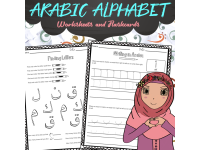
Arabic Alphabet Worksheets & Flashcards – 28 Letters


- File type
- Preparation
- Print ready


- Subject
- Foreign Languages
- Topic
- Arabic Worksheets, Arabic Alphabet
- Resource types
- Flashcards
- Preparation
- Print ready
- Australian Curriculum content descriptions
- AC9LA2U02 — recognise that the Arabic alphabet AC9LA2U03 — notice that Arabic has features that may be similar to or…
From the author
About this resource
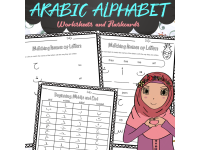
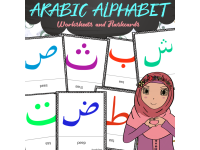
This printable set comes in a PDF file that will allow your students -who are new to the Arabic language- learn to write and read each letter. This set of sheets includes writing and tracing practice for all 28 letters in the Arabic alphabet. Includes practice for the name of each letter along with identification of each letter when among a group. Includes a chart to show how the letters look when used isolated, initially, in the middle, and end of words. Includes 28 flashcards to quiz the students on what letter is being shown. Total of 78 pages including the answer key.
The student will:
✅trace, colour, and write all 28 Arabic letters
✅know the name of each letter
✅identify a letter among a group of letters
✅know what a letter looks like in the beginning, middle, and end of a word
Have fun!
Related resources
More resources teachers may find useful
More resources on the same subject and topic.

In the classroom
Teaching tips & learning objectives

Learning objectives
Students trace and write each of the 28 Arabic letters from right to left.
Students match a letter's written form to its spoken name using a word bank or line-matching format.
Students identify how many times a target letter appears within a grid of similar letters.
Students identify whether a given Arabic letter form is in its initial, medial, final, or isolated position within a word.

Teaching tips
Introduce letters in the same two-at-a-time order the tracing pages use, since matching and fill-in pages later reuse the same letter groupings.
Use the fold-over flashcards for a quick partner drill once students have gone through the tracing pages, since each card pairs a letter's shape with its name.
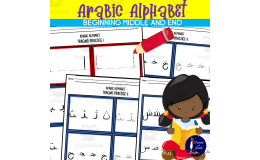
Save the ‘Beginning, Middle and End’ pages for after students are comfortable with individual letter shapes, since positional forms are a more advanced concept than isolated letter recognition.

Skills covered
Arabic letter formation — students trace and write all 28 letters of the Arabic alphabet from right to left.
Letter-name matching — students match a written Arabic letter to its spoken name from a word bank.
Visual letter discrimination — students find and count occurrences of a target letter within a grid of similar shapes.
Positional letter forms — students identify whether an Arabic letter appears in its initial, medial, final, or isolated form.
Good to know
Questions teachers ask about this resource
Why does this resource include a section on letter position (initial, medial, final, isolated)?
Arabic letters change shape depending on where they fall in a word, so the ‘Beginning, Middle and End’ section gives students practice recognising and writing each letter in all four positional forms rather than only its standalone shape.

No reviews yet
Downloaded this resource? Tell other teachers how it went.
Australian Curriculum (Version 9.0)
Australian Curriculum content descriptions
Australian Curriculum content descriptions
 Australian Curriculum content descriptions
- AC9LA2U02 — recognise that the Arabic alphabet and features of language are used to construct meaning in Arabic
- AC9LA2U03 — notice that Arabic has features that may be similar to or different from English
Core concepts
 Core concepts
Arabic alphabet
Letter formation
Right-to-left writing
 Topics
Explore more
Categories this resource belongs to
Explore related searches


More to explore
You may also like