Factoring Trinomials Worksheet – When a is Not 1




- Year levels
- Years 9–12
- Pages
- 4
- File type
- Answer key
- Included


- Subject
- Algebra, Maths
- Topic
- Factoring, Trinomials
- Resource types
- Worksheets
- Answer key
- Included
- Australian Curriculum content descriptions
- AC9M10A01 — expand
From the author
About this resource
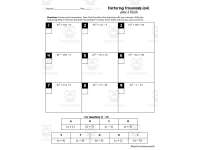
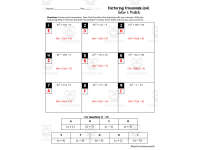
Practice factoring 18 trinomials whose leading coefficient is greater than one. Each student page contains nine expressions and a lettered bank of binomial factors. Students write the complete factorisation, then match one factor to a letter in the bank.
The four-page PDF includes two student pages and two answer-key pages showing complete factorisations and matching letters. The task is factoring expressions; it does not ask students to solve equations for zeros.
Related resources available separately
maths worksheet
Related resources
More resources teachers may find useful
More resources on the same subject and topic.



In the classroom
Teaching tips & learning objectives

Learning objectives
Factor a trinomial whose leading coefficient is greater than 1, such as 3x² + 10x − 8 = (3x − 2)(x + 4)
Factor trinomials where both binomial factors carry a coefficient, as with 20x² − 96x + 27 = (10x − 3)(2x − 9)
Recognise a perfect square trinomial, as in 9x² + 24x + 16 = (3x + 4)(3x + 4)
Use a matching bank as a self-check, treating a letter that is already taken as a signal to revisit the working
Handle negative constant and middle terms confidently across signs, from 2x² − 7x − 30 to 7x² − 31x + 30

Teaching tips
The two pages are graded deliberately: on page one only one factor of each pair is monic, so the bank gives away the easier half, while page two's bank lists binomials that both carry coefficients
Because each letter is used exactly once, a student who finds a letter already taken knows immediately that one of the two answers is wrong — worth pointing out before they start, since it turns the sheet into its own feedback loop
Problem 18, 9x² + 24x + 16, factors as (3x + 4)(3x + 4), which makes it the natural example for spotting a perfect square trinomial before grinding through the general method
Problem 13, 20x² − 96x + 27, has the largest coefficients on the sheet and the most factor pairs to test, so it is the one worth modelling or leaving as an extension
The key prints both factors rather than the letter alone, so it can be used to mark the working as well as the matching

Skills covered
Factoring trinomials with a leading coefficient above 1 — every one of the eighteen problems has an x² coefficient between 2 and 27, so the simple sum-and-product method will not work.
Testing factor pairs systematically — problems such as 20x² − 96x + 27 and 27x² + 66x − 16 require working through the factor pairs of both the leading coefficient and the constant.
Managing signs in a factorisation — the set mixes all four sign patterns, from 5x² + 19x + 18 through 6x² − 29x − 5 to 7x² − 31x + 30.
Recognising a perfect square trinomial — 9x² + 24x + 16 resolves to two identical factors, the only such case on the sheet.
Self-checking against a fixed bank — each lettered binomial is used exactly once across nine problems, so a clash reveals an error without a marker being involved.
Good to know
Questions teachers ask about this resource
How does the matching work when a trinomial has two factors?
The bank lists only one factor from each pair. On the first page it is always the monic one — (x + 4) for 3x² + 10x − 8, whose full factorisation is (3x − 2)(x + 4). On the second page the listed factor carries its own coefficient, as with (2x − 9) for 20x² − 96x + 27 = (10x − 3)(2x − 9).
Do the two pages differ in difficulty?
Yes, and the answer banks show how. Page one keeps one factor monic, so the coefficients stay small — 3x² + 10x − 8, 5x² + 11x + 6. Page two moves to expressions like 20x² − 96x + 27 and 27x² + 66x − 16, where both factors carry coefficients and far more factor pairs have to be tested.
What stops a student from guessing their way through the matching?
The direction that each letter will only be used one time. Nine problems share nine letters, so a wrong factorisation forces a clash somewhere else on the page and the student has to go back into the working rather than settle for a plausible-looking answer.

No reviews yet
Downloaded this resource? Tell other teachers how it went.
Australian Curriculum (Version 9.0)
Australian Curriculum content descriptions
Australian Curriculum content descriptions
 Australian Curriculum content descriptions
- AC9M10A01 — expand, factorise and simplify expressions and solve equations algebraically, applying exponent laws involving products, quotients and powers of variables, and the distributive property
Core concepts
 Core concepts
Factoring trinomials
Quadratic expressions
Binomial factors
Leading coefficient
 Topics
Explore more
Categories this resource belongs to
Explore related searches


More to explore