Help Sophia Find the Items: Things You Wear

- Year levels
- Pre-school, Foundation–Year 2
- File type
- Preparation
- Print ready


- Subject
- Basic Science, Speech Therapy, Special Education Needs (SEN), Life Skills, Special Resources, Early Math, Science, Maths
- Topic
- Vocabulary, Clothes for Seasons
- Resource types
- Activities
- Preparation
- Print ready
From the author
About this resource
Why we sort by feature - function - class
Teaching children to sort or group items by feature, function, and classification is important for several reasons:
Cognitive development: Sorting and grouping require children to think critically and make connections between items based on their characteristics. This helps to develop their cognitive abilities and improve their problem-solving skills.
Organisation: Sorting and grouping items based on their features, function, or classification can help children to organise information and make sense of their environment. This can improve their memory and make it easier for them to retrieve information later.
Language development: Sorting and grouping can also help to develop children's language skills by providing them with the vocabulary to describe different features, functions, and classifications. This can improve their ability to communicate effectively and express their ideas clearly.
Mathematical skills: Sorting and grouping can also help to develop children's mathematical skills, such as counting, categorising, and comparing. This can lay the foundation for more complex mathematical concepts later on.
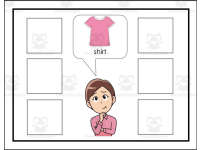
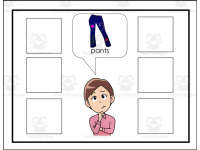
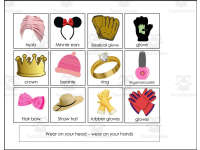
This activity involves sorting clothing items based on their features, functions, and classes - the items in this activity are commonly seen as "girl" clothes.
The learners will be presented with a collection of various clothing items such as shirts, pants, jackets, sweaters, and so on. The objective of the activity is to categorise these items based on their unique features, functions, and classes.
To begin the activity, the instructor will introduce the concept of feature, function, and class, providing examples and a brief description of each. The learners will then be given a set of clothing items and asked to sort them into categories based on FEATURE- describing something 'the shirt is red' 'things with zippers' FUNCTION - what it is used for 'wear a coat when it is cold' CLASS - a category 'all shirts' or 'all socks'
*For example, the learners could sort clothing items based on the feature of long sleeves, the function of keeping warm, or the class of pants.
Overall, teaching children to sort and group items by feature, function, and classification can provide them with a range of cognitive, organisational, language, and mathematical benefits that can support their development in various areas.
This activity is easy to create - Print and laminate all cards, cut out the individual sorting cards and velcro to the corresponding activity mat. You can hole punch the mats and put them in a binder for many years of teaching and learning.
Enjoy,
IFIO girl
I'll Figure It Out
Related resources
More resources teachers may find useful
More resources on the same subject and topic.



In the classroom
Teaching tips & learning objectives

Learning objectives
Sort clothing items by a shared feature such as zippers, strings or sleeve length
Group clothing by function, such as where it is worn or the weather it suits
Name everyday clothing items

Teaching tips
The descriptor cards could be introduced one type at a time, starting with function (where it is worn) before features like colour or sleeve length.

Skills covered
Classifying by feature — placing clothing cards into groups such as clothing with zippers or red clothing
Classifying by function — deciding whether an item is worn on the head, hands or feet, or when hot or cold

No reviews yet
Downloaded this resource? Tell other teachers how it went.
Resource details
Concepts & topics
Core concepts
 Core concepts
Sorting
Feature, function and class
Clothing vocabulary
 Topics
Explore more
Categories this resource belongs to
Explore related searches


More to explore