Solving Unit Rate Problems Practice Sheet

- Year levels
- Years 6–7
- Pages
- 2
- File type
- Answer key
- Included


- Subject
- Maths
- Topic
- Ratio, Proportion
- Resource types
- Word Problems, Worksheets
- Answer key
- Included
- Australian Curriculum content descriptions
- AC9M8M05 — recognise
From the author
About this resource
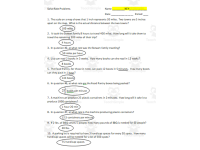
Develop your students' maths skills with this 10-problem practice sheet on solving unit rate word problems. Unit rates, which compare two different units, are an important concept for lower secondary students to master. This educational resource provides quality practice with real-world unit rate scenarios that will boost your students' proficiency.
The word problems on this practice sheet encourage students to calculate unit rates in the context of situations like travel, reading, food-pantry packing, production, barbecue servings and parking-space ratios. As students solve these maths problems, they will sharpen their ratio reasoning, proportional thinking, and analytical abilities. The variety of unit rate problems pushes them to read carefully, set up the unit rate equation, and compute the maths accurately.
With space provided to show work, this practice sheet promotes good mathematical practices as students solve each problem. The answer key provides easy checking for students and teachers. Include this practice sheet in a unit on ratios, proportional relationships, or multi-step word problems to reinforce unit rate skills. The real-life examples give meaning to the maths, while building skills for future ratio and rate calculation needs on high-stakes exams, careers, finances, and daily decision making. The standard covered is 6.RP.A.3b
Related resources
More resources teachers may find useful
More resources on the same subject and topic.



In the classroom
Teaching tips & learning objectives

Learning objectives
Students will calculate unit rates (such as miles per hour, books per week, or containers per minute) from real-world word problems.
Students will apply proportional reasoning to scale a given ratio up to a larger quantity, as in the parking-space and barbecue-serving problems.
Students will interpret a computed rate that does not reduce to a whole number and express it as a mixed number.

Teaching tips
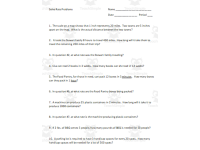
Use the blank second copy as independent practice or homework after modelling the worked answer key as a class.
Have students show their division work in the margin, since the sheet provides only a single answer line per problem.
Highlight the food-pantry packing question, whose rate comes out to 2 2/5 boxes per minute, to introduce students to rates expressed as mixed numbers.

Skills covered
Unit rate calculation — students compute rates such as miles per hour, books per week, and containers per minute from given quantities.
Proportional reasoning — students scale ratios like handicap spaces per parking spots and barbecue pounds per person up to larger totals.
Real-world rate word problems — students translate travel, reading, and packing scenarios into rate calculations.
Non-integer rate interpretation — students express a computed rate as a mixed number rather than rounding it away.
Good to know
Questions teachers ask about this resource
What real-world situations does this sheet use to practice unit rate?
Map-scale distance, family travel time, reading pace, food-pantry box packing, machine production, barbecue quantity per guest, and parking-lot handicap-space ratios.
How should students express the food-pantry packing rate, since it doesn't divide into a whole number of boxes per minute?
As the mixed number 2 2/5 boxes per minute, since 12 boxes divided by 5 minutes does not reduce evenly.

No reviews yet
Downloaded this resource? Tell other teachers how it went.
Australian Curriculum (Version 9.0)
Australian Curriculum content descriptions
Australian Curriculum content descriptions
 Australian Curriculum content descriptions
- AC9M8M05 — recognise and use rates to solve problems involving the comparison of 2 related quantities of different units of measure
Core concepts
 Core concepts
Unit rate
Proportional reasoning
Ratios
Word problems
Topics
 Topics
Explore more
Categories this resource belongs to
Explore related searches


More to explore
You may also like