Cardinal Directions and the Compass Rose Guide


- Year levels
- Years 2–5
- File type
- Preparation
- Print ready


- Subject
- Geography, Social Studies
- Topic
- Geography, Compass
- Resource types
- Lesson Plans, Worksheets & Printables
- Preparation
- Print ready
From the author
About this resource
Cardinal directions are the most commonly used form of directions, and now it's never been easier to learn them!
Now, with the help of this 28-page PDF, you can easily help your students understand directions to navigate their local community and beyond!
Related resources
More resources teachers may find useful
More resources on the same subject and topic.

In the classroom
Teaching tips & learning objectives

Learning objectives
Identify and place the four cardinal directions (north, south, east, west) on a globe or map.
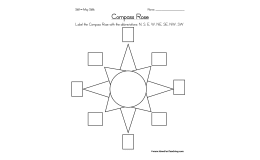
Construct a compass rose including intermediate/intercardinal directions such as northwest and southeast.
Apply cardinal and intermediate directions to answer questions using real maps of the world, the United States, and Canada.
Use mnemonic devices to recall the order and placement of directions on a compass rose.

Teaching tips
Teach the 'we' (west-east) and 'Never Eat Shredded Wheat' mnemonics explicitly before Worksheet A, since later worksheets assume students can recall direction order without a labelled reference.
Use Worksheets C and D (the Christopher Columbus puzzle and Debbie's neighbourhood map) as engaging practice before moving to the more demanding state- and province-level map worksheets E and F.
Have students name their own mnemonic device on the intermediate-directions page as a quick creativity check before assigning the country- and continent-level worksheets.

Skills covered
Cardinal and intercardinal direction identification - students place N, S, E, W and intermediate directions like NW and SE onto globes, compass roses, and maps.
Map-based directional reasoning - students answer questions such as which US state lies south of Montana or which Canadian province sits furthest west using real reference maps.
Mnemonic strategy use - students learn and apply memory devices such as 'we' for west-east and 'Never Eat Shredded Wheat' for the compass rose order.

No reviews yet
Downloaded this resource? Tell other teachers how it went.
Resource details
Concepts & topics
Core concepts
 Core concepts
Cardinal directions
Compass rose
Intermediate directions
Map reading
Topics
 Topics
Explore more
Categories this resource belongs to
Explore related searches


More to explore