


Search results for BIOLOGY
Results use exact search terms from the released Australia inventory.


Informational Text Basic Structure | Nonfiction Simple Passage 4
, Not Grade Specific,
Lemur facts, organised around what lemurs are, their appearance, habitat, diet and special traits, show early readers how informational text is built from simple questions and answers.
Author WORDS ASIDE
Rating
Tags Esl, Reading, Writing, Nonfiction, Task Cards, Centers, Literacy Centers, Homework, Independent Work, Words Aside

Jungle Animals Crossword Puzzle
, Not Grade Specific,
Build animal vocabulary with a picture-clue crossword. Students identify jungle animals and fit their names into the grid, then check the answer key.
Author TheBrightestKid
Rating
Tags Animals, Biology, Jungle, Tropical, Rainforest, Orangutan Habitat Crossword
Krebs Cycle and the ETC - Aerobic Cellular Respiration- Biology lesson
, Not Grade Specific,
Aerobic cellular respiration from pyruvate oxidation through the Krebs cycle and electron transport chain, taught with teacher and fill-in-the-blank student slide decks plus a Citric Acid Cycle worksheet.
Author Teach With Fergy
Rating
Tags Senior Biology, Biology Lesson, Aerobic Respiration, ETC, Krebs Cycle, Citric Acid Cycle, Pyruvate Oxidation, Proton Gradient, Chemiosmosis

Life Cycle of a Venus Flytrap Worksheet- Plant Science Unit Study
, Not Grade Specific,
The introductory reading explains how the plant supplements nutrients by trapping small insects and notes its wetland habitat and sunlight needs. A life-cycle reference is paired with cutout images covering seed, germination, young growth, buds, flowers, and fruit. The fact page adds trap movement, size, and winter dormancy. Learners also receive a cycle flash card and a standalone Venus flytrap colouring page.
Author Perfect_Printables
Rating
Tags Venus Flytrap , Life Cycle, Carnivorous Plant , Plant Science Unit, Life Cycle Printables, Homeschool Botany, Venus Flytrap Activities, STEM Plant Study, Nature Study For Kids, Montessori Botany Unit

Liver Activity
, Not Grade Specific,
Liver facts cut-and-glue sheet: students cut out word and number pieces such as bile, glucose and 1.5 KG and glue them into blanks to complete facts about the liver's weight, location and jobs.
Author Educational Voice
Rating
Tags Liver, Digestive System, Liver Facts For Kids, Digestive System Facts, Human Body, Human Body Facts For Kids, Human Liver Worksheet, Liver Activity

Lymphatic Vessel Activity
, Not Grade Specific,
Lymphatic vessel experiment in which students build a model from a straw, balloon, rubber band and water, squeeze the balloon like a contracting muscle and drop in sequins to watch how particles move.
Author Educational Voice
Rating
Tags Lymph, Lymphatic Vessel, Lymphatic System, Lymphatic System Experiment , Lymph Node , Lymphatic System Facts, Experiment For Kids, Human Body

Mammal vs Reptile Sort – Picture Worksheet
, Not Grade Specific,
Reptile or Mammal? provides a two-category classification supported by short trait reminders. The page states that mammals have fur or hair and breathe air, while reptiles have scales and also breathe air. Students inspect each animal picture, connect visible or known features with those definitions, and write the appropriate group beneath it. Including air breathing in both descriptions encourages attention to the distinguishing body covering instead of treating every listed trait as unique.
Author Have Fun Teaching
Rating
Tags Have Fun Teaching, Reptile Pictures, Pictures Of Mammal, Picture Of Mammal, Reptile Pictures.com, Pics Of Mammal, Is A Reptile A Mammal

Mammals Activity – Animals Around the World
, Not Grade Specific,
Cut-and-glue mammal activity in which students match animal pictures to six fact statements, such as the fastest mammal, a nocturnal hunter and the largest mammal.
Author Educational Voice
Rating
Tags Mammals Activity, Mammals, Mammal, Mammals Facts, Mammals Facts For Kids, Animal, Animals, Animals Facts, Animals Facts For Kids

Microorganisms Activity
, Not Grade Specific,
Cut-and-glue microorganisms worksheet: students label eight panels, from yeast and mould to bacteria and penicillin, with a cut-out Harmful, Useful or Both tag and write a reason for each.
Author Educational Voice
Rating
Tags Microorganisms Activity, Microorganisms, Microorganism, Microorganisms Facts, Microorganisms Facts For Kids, Stem, Stem For Kids, Activities For Kids

Muscular System PowerPoint Presentation
, Not Grade Specific,
Three guided-notes presentations cover muscle tissue anatomy, the eight steps of skeletal muscle contraction, and muscle energy use and disorders.
Author The Teacher Team
Rating
Tags Anatomy, Physiology, Muscular System, Body Systems, Biology

Ocean Acidification Reading Comprehension Article
, Not Grade Specific,
Informational article on ocean acidification for Year 8 and up, covering the logarithmic pH scale, carbonic acid and bicarbonate chemistry, links to global warming and the effects on calcifying marine organisms.
Author Teach With Fergy
Rating
Tags Ocean, Acids, Animals, Reading, Comprehension, Ocean Acidification Worksheet Pdf, Ocean Acidification Worksheet Answers

Ocean Animals Activity
, Not Grade Specific,
Ocean animal cut-and-glue scene: students glue yarn along dotted lines, attach cut-out animals to the base page, then label each endangered animal and write what they know about it.
Author Educational Voice
Rating
Tags Ocean Animals Activity, Ocean Animals, Ocean Animal, Ocean Animals Facts, Ocean Animals Facts For Kids, Fish, Animal, Animals Fact, Fish Facts

Octopus Activity
, Not Grade Specific,
Students label an octopus diagram and write what they know about the animal. The page combines anatomy vocabulary with an open science response.
Author Educational Voice
Rating
Tags Octopus Activity, Octopus, Octopi , Octopus Facts, Octopus Facts For Kids, Animal, Animals, Animals Facts, Animals Facts For Kids

Ostrich Activity – Animal Diagram and Labelling
, Not Grade Specific,
An ostrich diagram labels six body parts — big eyes and eyelashes, a long bald neck, thick feathers with small wings, muscular legs, and split two-toed hooves — for students to explain their survival function.
Author Educational Voice
Rating
Tags Ostrich Activity, Ostrich, Ostriches, Birds, Body Parts, Anatomy, Labeling, Life Science

Paper Plate Skull Activity
, Not Grade Specific,
Skull craft built from a paper plate and black and white sugar paper, with four squares on which students write their own facts about the human skull.
Author Educational Voice
Rating
Tags Skull, Skeleton, Skeletal System, Skeletal System For Kids, Bone, Bones, Human Body, Science

Pasta Reefs Activity
, Not Grade Specific,
Painted pasta in assorted shapes is arranged on a cut and painted cardboard base to build a model coral reef, from a five-item materials list, four written steps and a closing fun-fact writing prompt.
Author Educational Voice
Rating
Tags Pasta Reefs Activity, Pasta Reefs, Coral Reefs Activity, Coral Reefs, Coral Reefs Facts, Coral Reefs Facts For Kids, Coral Reef, Fun Activity, Craft, Crafts

Plant Needs Worksheet
, Not Grade Specific,
The activity presents plant needs through short clues rather than a direct label-and-picture match. Learners infer which need is being described and record a response, then address an additional statement about soil. The clue format asks them to connect each resource with its role in plant growth rather than merely reciting a memorised list. Teachers can use the responses to identify confusion between what plants require and the medium or conditions that support access to those needs.
Author Have Fun Teaching
Rating
Tags Plants, Needs Of A Plant Worksheet, Basic Needs Of Plants Worksheet, What Plants Need To Grow Worksheet
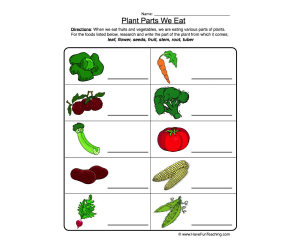
Plant Parts We Eat Worksheet
, Not Grade Specific,
The introduction explains that foods described as fruits and vegetables come from different parts of plants. Learners investigate each listed food and record whether the edible portion is a leaf, flower, seed, fruit, stem, root, or tuber. The task therefore combines botanical vocabulary with everyday food knowledge and research practice. It does not provide a completed chart, definitions for the seven structures, or assertions about any specific food in the customer-facing copy.
Author Have Fun Teaching
Rating
Tags Living And Non-Living Things, Plants, Health And Nutrition, Parts Of Eat, Parts Of Plant We Eat

Predator-Prey Relationship - Science Reading Article - Years 5–7
, Not Grade Specific,
The predator-prey population cycle is explained through the Everglades' invasive Burmese pythons in this reading passage and comprehension set.
Author Teach With Fergy
Rating
Tags Predator, Prey, Relationship, Reading, Comprehension, Predator Prey Relationship Worksheet, Predator Prey Relationship Worksheet Answers, Predator Prey Activities Elementary, Predator And Prey Worksheet

Rainforest Animals Worksheet
, Not Grade Specific,
The worksheet presents several animal illustrations without supplying a written habitat explanation or research text. Students rely on prior knowledge of rainforest wildlife to decide which pictures fit the target environment and circle those choices. The mixed set requires discrimination between animals from different habitats rather than simple recognition of a single species. Follow-up discussion can focus on observable adaptations or known habitat needs.
Author Have Fun Teaching
Rating
Tags Environments, Habitats And Biomes

Science Game: Guess Who? Cells Unit
, Not Grade Specific,
A grid of term cards covering human body systems and cell organelles supports a print-and-cut guess-who style vocabulary game.
Author Resource Garden
Rating
Tags Science Education, Cellular Biology, Interactive Game, Digital Learning, Organelle Concepts

Senses Smell Worksheet
, Not Grade Specific,
Sense of Smell asks learners to connect familiar objects with information gathered by the nose. Students inspect each picture and circle those whose odor can help identify or describe them. The choice format reinforces that not every object is primarily investigated with the same sense. A follow-up discussion can introduce words such as fragrant, smoky, fresh, or unpleasant and can address safe smelling practices. The page serves as a concise component of a broader five-senses lesson.
Author Have Fun Teaching
Rating
Tags Have Fun Teaching

Senses Taste Worksheet
, Not Grade Specific,
Sense of Taste builds an early science classification around how people gather information. Children look across the pictured items and decide which can appropriately be learned about by tasting. The task requires connecting the sensory organ and action with relevant object properties such as flavour. It also creates an opportunity to distinguish what is theoretically tasted from what is safe to put in the mouth. Students can explain each choice using the sentence frame “I can taste…” and name a likely flavour.
Author Have Fun Teaching
Rating
Tags Have Fun Teaching

Sheep Heart Dissection Lab ~ Anatomy and Physiology
, Not Grade Specific,
A sheep heart dissection lab has students locate and identify 15+ heart structures, answer 20 procedural questions about blood flow and anatomy, and complete a partner structure-and-function checklist, with full answer keys for both.
Author The Teacher Team
Rating
Tags Science Lab, Anatomy, Physiology, Biology, ELL, Labeled Sheep Heart Dissection, Heart Dissection Lab, Sheep Heart Dissection Guide, Sheep Heart Dissection Lab, Sheep Dissection Lab, Heart