



Search results for Temperature
Results use exact search terms from the released Australia inventory.

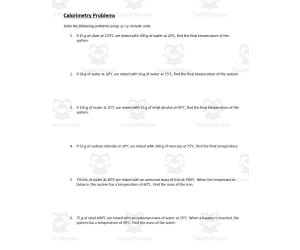
Calorimetry Practice
, Not Grade Specific,
Ten calorimetry word problems require students to apply q = -q to solve for final temperature, unknown mass, or unknown initial temperature, with a fully worked answer key.
Author Schrim's Chem
Rating
Tags Chemistry Practice, Temperature
lower secondary Maths Stations or Centres: Adding and Subtracting Integers
, Not Grade Specific,
Each station approaches signed-number operations from a different angle. Learners solve real-world situations, generate positive and negative values with dice, compare temperatures from warm and cold locations, model gains and losses on a football field, and complete a final computation set with number-line explanation. Moving among the stations combines individual calculation with peer discussion. A completed reference distinguishes fixed results from activities whose responses depend on rolls or selected cities.
Author Grace Under Pressure
Rating
Tags Math Stations, Integers, Adding And Subtracting Integers, Number Lines, Math Games, Math Centers, Math Centres, Negative Numbers, Word Problems, Temperature

Reading a Thermometer Worksheet
, Not Grade Specific,
What Is the Temperature? reverses a typical scale-reading task. Instead of interpreting a pre-drawn level, students receive a temperature and must show it on each thermometer by marking the correct height. The diagrams include Celsius and Fahrenheit labels and visible intervals, so learners need to identify the unit, count to the target, and place the level proportionally. Producing the representation offers a direct check of whether they understand scale direction and spacing rather than merely reading printed values.
Author Have Fun Teaching
Rating
Tags Have Fun Teaching, Reading A Themometer, Reading A Thermometer, Measuring Temperature Worksheet

What's the Temperature Worksheet
, Not Grade Specific,
What’s the Temperature? asks students to interpret several thermometer diagrams in two complementary ways. For each image, learners record numerical readings in Celsius and Fahrenheit, then classify the condition as hot, warm, or cold. This connects exact scale values with everyday temperature language. The diagrams vary in range and include negative markings, requiring attention to interval direction. Comparing classifications can also prompt discussion that descriptive temperature words depend on context even when a numerical reading is precise.
Author Have Fun Teaching
Rating
Tags Have Fun Teaching