4 Communication Styles PowerPoint and Survey



- Grades
- Grades 6–12
- File type
- Microsoft PowerPoint
- Use
- Digital activity


- Subject
- Life Skills, Special Resources
- Topic
- Self Assessment, Life Skills
- Resource types
- Presentations
- Use
- Digital activity
From the author
About this resource
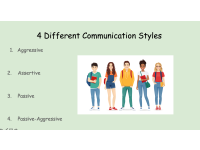
This is an engaging resource aimed primarily at students in grades 6 through 12, and it focuses on highlighting the four main styles of communication: Assertive, Aggressive, Passive-aggressive, and Passive.
About the Resource
- The material includes a nine-slide PowerPoint presentation with comprehensive explanations and examples for every style.
- The teaching tool makes use of engaging visuals to promote student interaction.
- Real-life video demonstrations are inserted into the seventh slide for better understanding.
Distinguishing Feature - The Survey
A ten-question survey is provided. This unique feature aids students in identifying their individual dominant communication style for self-introspection purposes making this experience personal as well as interactive.
Educational Advantage
The summaries included break down each style's impact on a person’s interactions. They also offer practical tips on improvement, fostering healthier forms of expression among students.
Possible Implementations:
- In-class group discussions or debates circulating around different styles of communication;
- Analyzing specific life instances utilizing small groups; or Note: these should ideally reflect instances corresponding to each category.
Last but not least:
Made For Classroom Use – Uniquely Equipped simply needing only Microsoft PowerPoint compatibility:
This PowerPoint and survey pack isn’t just another resource created to teach communication styles. What sets it apart is the inclusion of video links effectively interspersed in a Progressive PowerPoint presentation requiring no additional hassles for educators.
Unbeatable Value For All Learning Environments: Available for typical classroom setups – even special education classes or Homeschooling situations:In conclusion, The 4 Communication Styles PowerPoint And Survey serves as an invaluable addition to teach crucial life skills across various teaching environments.
Related resources
More resources teachers may find useful
More resources on the same subject and topic.


In the classroom
Teaching tips & learning objectives

Learning objectives
Identify the defining traits of assertive, aggressive, passive and passive-aggressive communication.
Apply the four styles to real-life scenarios by predicting how each style would respond.
Determine a personal dominant communication style using a scored quiz.
Evaluate the likely long-term impact of a communication style and identify one way to shift toward more assertive communication.

Teaching tips
Have students complete the quiz individually before discussing styles as a class, since the coded scoring (P, A, AG, PA) is meant to reveal a personal pattern rather than a single right answer.
Use the closing reflection prompts (noticing communication styles on TV, or in their own lives) as a follow-up discussion or journal entry after the quiz.
Pair each style summary's specific improvement tip, such as taking a breath before reacting for the aggressive style, with role-play practice of the quiz's scenario questions.

Skills covered
Communication-style identification — students match behaviour descriptions, such as pointing and interrupting, to one of four named styles.
Self-assessment through scenario response — students choose their likely response to ten real-life situations, then score the pattern using a coded answer key.
Perspective-taking and reflection — students consider how their communication choices affect others, guided by the closing slide's reflection questions.
Applying feedback for behaviour change — each style summary offers a specific, actionable suggestion that students can apply to themselves.
Good to know
Questions teachers ask about this resource
How is the quiz scored?
Each of the ten scenario questions has four answer choices coded P (passive), A (assertive), AG (aggressive) or PA (passive-aggressive); the letter chosen most often points to the student's likely dominant style.
Does the presentation include discussion prompts, or just style definitions?
Both — after defining the four styles, the closing slide asks students to reflect on their own dominant style and to notice communication styles in TV shows they watch.

No reviews yet
Downloaded this resource? Tell other teachers how it went.
Resource details
Concepts & topics
Core concepts
 Core concepts
Assertive communication
Aggressive communication
Passive communication
Passive-aggressive communication
Topics
 Topics
Explore more
Categories this resource belongs to
Explore related searches


More to explore