Adding & Subtracting Positive and Negative Numbers


- Grades
- Grades 6–7
- Pages
- 3
- File type
- Answer key
- Included


- Subject
- Subtraction, Addition, Addition and Subtraction, Math
- Topic
- Integers Worksheet, Adding Positive Numbers
- Resource types
- Worksheets
- Answer key
- Included
From the author
About this resource
We are always searching for engaging ways to teach our students new skills and review skills that they already know! This is a 1-page worksheet that will allow students enough practice to sharpen their skills.
Students will practice with Adding and Subtracting Positive and Negative Numbers. The objective is for students to be able to understand the difference in the rules and apply them effectively to a variety of problems.
This worksheet is most appropriate for Grade 4 students. You may have Grade 5 students who need the additional practice.
There are 2 pages included broken down into 4 sections.
In the first section, students will:
Solve each addition problem. If the numbers have the same SIGNS (e.g. negative + negative) your answer will be NEGATIVE.
In the second section, students will:
Solve each addition problem. This time, the signs are DIFFERENT (e.g. negative + positive)! If the signs are different, instead of adding them, you SUBTRACT them. To determine whether the answer is positive or negative, you look at the BIGGEST number in the question. If it is negative, the answer is negative; if it is positive, the answer is positive.
In the third section, students will:
Solve each subtraction problem. Remember to turn subtraction questions into addition ones (when the starting number is smaller than the number you are taking away) and move the subtraction sign next to the last number (e.g. 2 – 8 becomes 2 + -8).
In the fourth section, students will:
Solve each subtraction problem. Remember, DON’T attempt to do subtraction questions SO turn them into addition ones (e.g. -7 - -3 becomes -7 + --3). When you do this, you get a negative and a negative. A negative and a negative is always a positive so -7 + --3 becomes -7 + 3.
You can easily print and laminate these pages, so they retain their durability for repeated use. Students can write answers with a dry erase marker.
This will make a great math centre or small group activity.
This worksheet set is also great as an assessment.
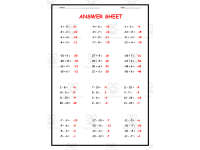
Answer key included.
I hope you enjoy!
Here is a link to a similar resource in my store: https://teachsimple.com/product/addition-using-a-number-line
Here is a link to my store to enjoy other resources from me: https://teachsimple.com/contributor/elementary-resources-4-u
I can be contacted for questions and concerns at harlandm2000@yahoo.co.uk.
Related resources
More resources teachers may find useful
More resources on the same subject and topic.


In the classroom
Teaching tips & learning objectives

Learning objectives
Add two negative numbers and recognise that matching signs keep the answer negative
Add numbers of opposite sign by subtracting and taking the sign of the larger value, as in -30 + 5 = -25 and 27 + -9 = 18
Rewrite a subtraction as an addition, converting 2 – 8 into 2 + -8 before calculating
Subtract a negative number by recognising that two negatives together give a positive, turning -7 - -3 into -7 + 3
Self-score a completed sheet out of 48 and convert the result to a percentage

Teaching tips
Each block restates the rule it needs, so a single block can be lifted out for a focused ten-minute drill without printing the whole set
The first question of every block is worked, which makes each block usable as a guided example followed by independent practice
Numbers stay small and whole throughout — the largest are 80 and -80 — so this works as sign-rule practice rather than as computation practice
The sheet is headed PRACTICE SHEET B, which suggests a lettered companion; each block is self-contained, so it can be used on its own regardless
The score line invites students to convert 48 raw marks to a percentage, which turns the marking step into a short additional exercise

Skills covered
Adding numbers with the same sign — twelve questions from -3 + -5 to -12 + -6 practise the rule that matching signs keep the answer negative.
Adding numbers with opposite signs — twelve questions such as -30 + 5, 27 + -9 and -63 + 9 require subtracting and then deciding the sign from the larger value.
Rewriting subtraction as addition — students convert questions like 2 – 8, 9 – 12 and 13 – 20 into additions of a negative before solving.
Subtracting a negative — the final block turns -7 - -3, -18 - -5 and -20 - -8 into additions, using the rule that two negatives make a positive.
Self-marking and percentage conversion — the closing line asks for a total out of 48 alongside a percentage.
Good to know
Questions teachers ask about this resource
How is each block of questions introduced?
By a rule written in ordinary words directly above it. Block one: matching signs keep the answer negative. Block two: different signs mean you subtract instead of add. Block three: turn 2 – 8 into 2 + -8. Block four: two negatives together become a positive, so -7 - -3 becomes -7 + 3. The first question in every block is also worked.
What size of numbers do students work with?
They stay small and whole throughout. The largest values anywhere on the sheet are -80 + 10 and 80 – 20, and most questions sit within thirty, so students are working on the sign rule rather than on difficult arithmetic.
Does the sheet depend on an earlier one in the series?
It stands alone. The heading reads PRACTICE SHEET B, so a companion sheet exists, but every block restates its own rule and works its own first question, so nothing here relies on having seen sheet A.

No reviews yet
Downloaded this resource? Tell other teachers how it went.
Resource details
Concepts & topics
Core concepts
 Core concepts
Negative numbers
Integers
Addition and subtraction
Signed number rules
Topics
 Topics
Explore more
Categories this resource belongs to
Explore related searches



More to explore