Animals and Plants Characteristics Venn Diagram


- Grades
- Grades 1–3
- File type
- Preparation
- Print ready


- Subject
- Nature & Plants, Animals, Life Sciences, Science
- Topic
- Animals, Plants
- Resource types
- Diagrams
- Preparation
- Print ready
From the author
About this resource
This is an Animals and Plants Characteristics Venn Diagram.
It is a 1-page printable that features one Venn Diagram and a list of words to complete at the bottom.
The words that will be put in the chart are:
arms
breathe
grow
eyes
roots
ears
leaf
die
stem
back
alive
eyebrows
seed
drink
petal
move
moon
This worksheet is intended for young learners, including 1st – Grade 3 students.
This worksheet will be great implemented into a science unit when students are learning about characteristics of plants and animals. This Venn Diagram printable could be given to students prior to the start of the unit. It will make a great pre-assessment and post-assessment at the end of the learning unit.
You can implement this printable in a few ways:
1. You can begin with displaying it on your smart board for all students to be able to see. Allow students the opportunity to brainstorm and discuss in small groups where they think words belong. Have a few students share out for which words go in which circle. Encourage students to provide an explanation.
2. You can print a copy of this Venn Diagram for each student to complete. Students can complete it individually and then partner up and compare their answers with a classmate.
3. On the other hand, you can allow students to brainstorm in partner groups and then return to their seats to complete the chart individually.
Extension activity:
Students can write complete sentences on the back using some of the words that they placed in the Venn Diagram.
Related resources
More resources teachers may find useful
More resources on the same subject and topic.


In the classroom
Teaching tips & learning objectives

Learning objectives
Classify a physical characteristic or life process as belonging to plants, animals, or both.
Identify life processes shared by plants and animals (breathing, growing, dying, being alive, needing water, movement).
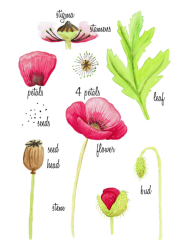
Distinguish structural features unique to plants (roots, leaf, stem, seed, petal) from those unique to animals (arms, eyes, ears, back, eyebrows).

Teaching tips
Sort the shared terms (breathe, grow, die, alive, drink, move) as a class discussion first, since placing them in the overlap region is the most conceptually demanding part of the task.
Point out the distractor word 'moon' explicitly, since students may try to force every word bank term into one of the two circles.
Use the completed answer version to self-check before discussing why each shared term applies to both plants and animals.

Skills covered
Venn diagram classification — students sort 16 terms into plant-only, animal-only, and shared regions of a two-circle diagram.
Life-process identification — students recognize that breathing, growing, dying, and movement apply to both plants and animals.
Distractor filtering — students must recognize that 'moon' does not belong to either category.
Good to know
Questions teachers ask about this resource
Is every word in the word bank used somewhere in the diagram?
No — 'moon' is included in the word bank but does not belong to either category; it is a distractor term not assigned to either side of the completed diagram.

No reviews yet
Downloaded this resource? Tell other teachers how it went.
Resource details
Concepts & topics
Core concepts
 Core concepts
Living things
Plant characteristics
Animal characteristics
Venn diagrams
Topics
 Topics
Explore more
Categories this resource belongs to
Explore related searches



More to explore