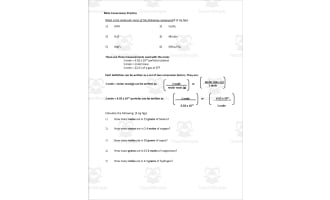
Chemistry: Atoms, Elements, and Compounds - Speed Quizzing


- Grades
- Grades 9–11
- File type
- Microsoft Word


- Subject
- Chemistry, Science
- Topic
- Speed Quizzing, Chemistry Quiz
- Resource types
- Assessments
From the author
About this resource
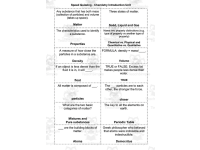
This activity will get your students out of their seats, moving around, and discussing the material. It is fully editable and requires very little preparation. Simply print, cut out the flash cards, and pass them out to students.
Note. This resource can also be used as an excellent question bank as it contains 32 high-quality questions that you can use in any way you see fit.
This activity contains 32 questions designed to test your students’ knowledge of the unit they are studying. The questions come directly from the lessons and cover the following topics:
• Physical and Chemical Properties and Changes
• The GUESS Method of Problem Solving
• Density
• Particle Theory and Classification of Matter
• Atomic Theory – The History of the Atom
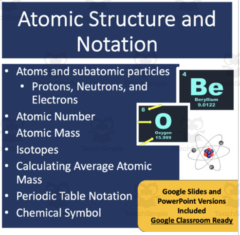
• Atomic Structure and Notation
• The Periodic Table
• Ions
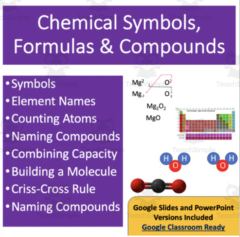
• Chemical Symbols, Formulas, and Compounds Introduction
Here’s how you implement them:
1. Provide each student with a flash card
2. Pair up students using the stand up/hands up/pair up method
3. Partner A reads the question to Partner B, who answers. Partner A praises if correct or coaches if incorrect.
4. Partners switch roles
5. Students thank each other and switch cards
6. Partners raise their hands to find a new partner
7. Repeat for a specified amount of time
Alternate way to ensure each student gets a new partner each time:
Divide students into groups A and B.
Have every student pair up with someone from the other group (if there is an odd number of students you participate too!)
1) Do Speed Quizzing
2) Then have group A move to the right and group B stay still.
3) Do Speed Quizzing
4) Then have group B move to the left and group A stay still.
Every student in group A will meet every student in group B, but students will not meet students in their own group (a clever way to keep apart students who should not be partnered for whatever reason).
This activity can be used to:
• Prompt meaningful student conversation
• Review prior knowledge
• Review new terms/problems after a unit
• Gather student ideas
• Remediate weak skills
• Practice new skills
Thank you for your interest in my products. If you have any questions, please send me an email - [REDACTED-EMAIL]
Related resources
More resources teachers may find useful
More resources on the same subject and topic.


In the classroom
Teaching tips & learning objectives

Learning objectives
Distinguish physical from chemical properties and changes
Describe atomic structure and the history of atomic theory
Write and name chemical formulas and ions

Teaching tips
The two-group rotation in the directions lets every student in one group meet every student in the other without repeat pairings

Skills covered
Recall under time pressure — answering a partner's card question before rotating
Peer checking — reading a card's answer to confirm or coach a partner

No reviews yet
Downloaded this resource? Tell other teachers how it went.
Resource details
Concepts & topics
Core concepts
 Core concepts
Properties of matter
Atomic structure
Periodic table
 Topics
Explore more
Categories this resource belongs to
Explore related searches



More to explore