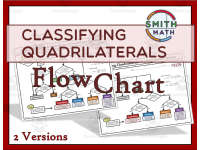
Classifying Quadrilaterals – Flow Chart Reference

- Grades
- Grades 9–10
- File type
- Preparation
- Print ready


- Subject
- Algebra, Geometry, Math
- Topic
- Graphic Organizers, Geometry
- Resource types
- Charts
- Preparation
- Print ready
From the author
About this resource
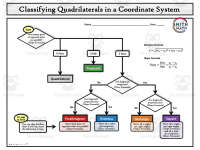
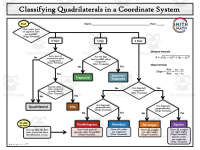
Two flow charts support classifying quadrilaterals using slope and distance calculations. Both fully branch the two-pairs-of-parallel-sides path; the fuller version also tests for kites and isosceles trapezoids. Each provides slope and distance formulas and optional shortcuts using defining properties. Use alongside separately supplied coordinate problems.
Related resources
More resources teachers may find useful
More resources on the same subject and topic.


In the classroom
Teaching tips & learning objectives

Learning objectives
Classify a quadrilateral as a trapezoid, kite, parallelogram, rhombus, rectangle, or square using coordinate-geometry tests.
Apply the slope formula to determine whether pairs of sides are parallel or perpendicular.
Apply the distance formula to determine whether sides or diagonals are congruent.
Follow a decision-tree structure to narrow a shape's classification step by step from a general quadrilateral to a specific type.

Teaching tips
Use the shorter chart (page 2) for a unit limited to parallelograms, rhombi, rectangles and squares; use the fuller chart (page 3) once trapezoids and kites are also in scope.
Keep the printed slope and distance formula box visible as a quick reference while students work through either chart.

Skills covered
Coordinate-geometry classification — students trace a decision tree from "how many pairs of opposite sides are parallel?" to a final quadrilateral type.
Slope formula application — students test whether sides are parallel (equal slopes) or perpendicular at each relevant branch point.
Distance formula application — students test whether sides or diagonals are congruent by comparing computed lengths.
Property-based justification — students name a shape from its defining property, such as "all 4 sides are congruent" for a rhombus, rather than by appearance alone.

No reviews yet
Downloaded this resource? Tell other teachers how it went.
Resource details
Concepts & topics
Core concepts
 Core concepts
Quadrilateral classification
Slope formula
Distance formula
Coordinate geometry
Topics
 Topics
Explore more
Categories this resource belongs to
Explore related searches


More to explore