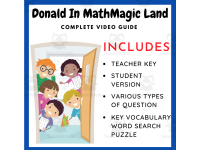
Donald in Mathmagic Land: Video Worksheet & Word Search (Bundle)

- Grades
- Grades 4–7
- File type
- Preparation
- Print ready


- Subject
- Patterns, Earth Sciences, Earth and Environmental Sciences, Science, Math
- Topic
- Math, Science
- Resource types
- Word Searches
- Preparation
- Print ready
From the author
About this resource
Donald Duck in Mathmagic Land is a great video that helps students understand the importance of mathematics in everyday life. Essentially, the video explains to students how mathematics can be helpful in real life and the video gives students examples on how math can be seen in nature and in everyday objects! The video uses a simple format to explain complex ideas for students.
I used to be a substitute teacher for many years, and this was one of the lessons that I always carried with me while substituting Grades 4, 5, 6, and 7 (just in case I needed to fill in time). This will be a great lesson for your regular classroom instruction or as an emergency lesson plan. Additionally, it is a great video to show students interested in math.
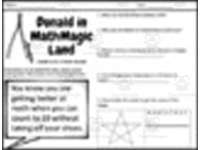
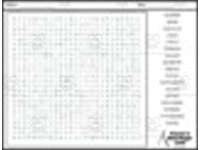
These 16 teacher-generated questions will keep your student's attention during this informative video. Afterwards, have the students complete a word search on key vocabulary from the video (I have included easy, medium, and difficult word searches for you to choose from). Answer keys included for both the videos and word searches! Ready to print and easy to use!
You can find the video here: Donald in Mathmagic Land
Related resources
More resources teachers may find useful
More resources on the same subject and topic.



In the classroom
Teaching tips & learning objectives

Learning objectives
Answer questions while a video plays, tracking information in the order the film presents it
Recall specific mathematical facts from the film — the first three digits of pi, the octave produced when a string is halved, and the pentagram
Name three pentagon shapes that occur in nature

Teaching tips
Question 7 wants three pentagon shapes in nature; the intended answers are Petunia, Star Jasmine and Starfish, all worth pausing the film on
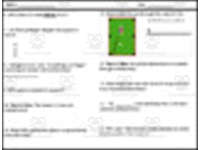
Questions 5 and 12 depend on a printed picture and a single letter rather than on text, so check that both graphics reproduce clearly before copying
The film runs about half an hour, which leaves the marking pass and any follow-up puzzle work for a second block of the lesson

Skills covered
Mathematical vocabulary recall — octave, infinity, pentagram and pentagon are all defined by the film and written into the blanks.
Linking shape to activity — students name chess as the game played on squares, two of baseball, football, basketball or soccer as games on geometric areas, and the circle as the shape behind many inventions.
Attributing quotations — two items ask who spoke a given line, answered as Pythagoras and Galileo Galilei.
Good to know
Questions teachers ask about this resource
How are the sixteen questions sequenced against the film?
In the film's own order. The instruction line reads "As you watch the video, please answer each question. The answers are in chronological order," so question 1 on the digits of pi lands early and question 16 on the Galileo quotation closes the set.
Question 11 asks for two games played on geometric areas — which responses count?
Baseball, football, basketball and soccer are all accepted, and any two of them satisfy the item. Question 9's square-based game is chess, and question 12's scrambled game is Billiards.
What appears on the page for questions 5 and 12?
Each pairs a picture with a single opening letter — P beside question 5 and B beside question 12 — and students work out the word from what the film has just shown. The intended responses are Pentagram and Billiards.

No reviews yet
Downloaded this resource? Tell other teachers how it went.
Resource details
Concepts & topics
Core concepts
 Core concepts
Math in nature
Geometric shapes
History of mathematics
 Topics
Explore more
Categories this resource belongs to
Explore related searches



More to explore