ee or ea Phonic Card Game for Spelling Practice


- Grades
- Preschool–Junior Kindergarten, Grades 1–2
- Pages
- 11
- File type
- Preparation
- Print ready


- Subject
- Phonics, Language Development, ELA
- Topic
- Ee, Or Ea Phonic Game
- Resource types
- Games
- Preparation
- Print ready
From the author
About this resource
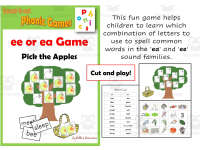
Pick the Apples — ea or ee Spelling Families Card Game: A game for 2 players
A simple, fun board game I made to help children distinguish between ea and ee: two digraphs that sound the same but belong to different spelling families.
Reading words with these sounds is straightforward once the patterns have been taught — but spelling is much harder. The child must remember not just the sound, but which family the word belongs to. Does feet use ee? Does eat use ea? This game gives children repeated, low-pressure practice sorting words into the right family, building the kind of memory that eventually makes correct spelling automatic.
How to play:
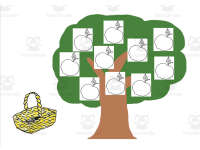
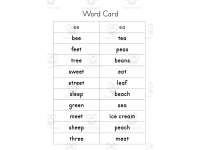
Each player takes a tree baseboard loaded with apple cards. Sound cards (ea and ee) and a couple of bad apple cards go into a feely bag. Picture cards are laid face up on the table. On each turn, a player draws a sound card from the bag and must find a picture card showing a word that contains that sound. A Word Bank Card is on hand for checking — the adult can help younger or less confident children locate the right word at first. A correct match lets the player keep the cards and move one apple from the tree to the basket. Draw a bad apple card, and the turn is lost. The first player to pick all their apples wins.
Games make for stress-free learning!
The bad apple cards introduce an element of luck that children love — and which serves a real purpose. When a child loses, it was the bad apple's fault, not theirs. For children who are used to struggling, that small thing makes a surprising difference. They stay in the game, stay relaxed, and the sorting and matching does its work quietly in the background.
Useful for assessment too!
Teachers will find the game useful for assessment too. Watch how the child approaches each picture card. Are they thinking about the sound and searching their memory for the right spelling family? Or are they recognising words by sight and hoping for the best? The answer tells you a lot about what to do next.
Related resources
More resources teachers may find useful
More resources on the same subject and topic.

In the classroom
Teaching tips & learning objectives

Learning objectives
Choose between ee and ea when spelling a known long e word
Match a picture to a word containing a named spelling pattern

Teaching tips
A feely bag or other opaque container holds the sound and bad apple cards for drawing.
Play assumes ee and ea have each been taught already, so it works as review rather than a first introduction.

Skills covered
Spelling pattern discrimination — deciding whether a pictured word takes ee or ea
Self-checking — confirming each choice against the word bank card

No reviews yet
Downloaded this resource? Tell other teachers how it went.
Resource details
Concepts & topics
Core concepts
 Core concepts
Long e
Vowel digraphs
Ee and ea spelling families
 Topics
Explore more
Categories this resource belongs to
Explore related searches
More to explore