Enthalpy Stoichiometry Practice – 10 Problems

- Grades
- Grades 8–12
- File type
- Microsoft Word


- Subject
- Chemistry, Science
- Topic
- Enthalpy, Stoichiometry
- Resource types
- Activities
From the author
About this resource
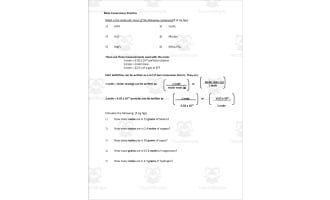
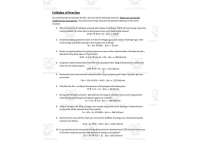
This resource includes 10 practice problems which covers enthalpy stoichiometry.
With this resource, students are expected to use mole ratios to determine the ΔH of various reactions.
The problems included in the resource are of mol to energy, mass to energy, and conversions of energy to mass.
Also included in some problems as extra challenge are limiting reactants.
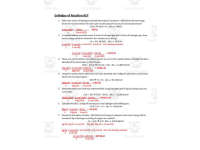
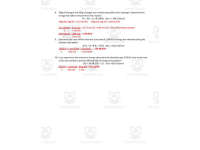
The answers and solutions are included.
Korean and Spanish versions available!
Related resources
More resources teachers may find useful
More resources on the same subject and topic.


In the classroom
Teaching tips & learning objectives

Learning objectives
Apply a ∆Hrxn stated for a balanced equation to a different quantity of reactant, so that 6 mol of H2O2 against a 2H2O2 equation gives -570 kJ
Convert a mass in grams or kilograms to moles before applying the enthalpy factor
Identify the limiting reactant when two starting quantities are given, and base the energy calculation on that reactant alone
Reverse the conversion chain to find the mass of reactant consumed from a stated quantity of energy
Read the wording and the sign of ∆Hrxn together to tell energy released from energy absorbed

Teaching tips
The solutions are written as full dimensional-analysis chains with each conversion factor set out, so they double as worked examples for a first lesson on the topic.
Only problems 1 and 2 are stated in moles; the rest need a molar mass, and no molar masses are printed anywhere in the file, so students need a periodic table beside them.
Problems 2, 7 and 8 fold a limiting-reactant comparison into the enthalpy work, which suits a class that has already met limiting reactants rather than one meeting them here for the first time.
The sign convention shifts within the solutions - released energy is written negative in problems 1, 2 and 6 but positive in problems 5, 7 and 8 - so agree with the class how a released quantity should be reported before marking.

Skills covered
Mole-ratio reasoning from a balanced equation - each problem prints its own equation and its ∆Hrxn belongs to those coefficients, so 6 mol of hydrogen peroxide against a 2H2O2 equation releases three times the printed value.
Mass-to-mole conversion - problems 3 to 8 supply grams or a kilogram, as with 1 kg of propane at 44 g per mole and 75 g of water at 18 g per mole, before any energy factor can be applied.
Limiting reactant identification - problems 2, 7 and 8 give two reactant quantities, so the equation's ratio has to be tested first, as with 3 mol of nitrogen against 5 mol of hydrogen.
Reverse stoichiometry - problems 9 and 10 start from 2,000 kJ released and 4,750 kJ absorbed and ask for the mass of hydrazine and of sulfur dioxide consumed.
Exothermic and endothermic reading - the set mixes negative ∆Hrxn values (-190, -92.6, -2,220, -622.3 kJ/mol) with positive ones (2,803, 92.3, 319.5 kJ/mol), so released and absorbed have to be told apart from the wording.
Good to know
Questions teachers ask about this resource
Which problems bring a limiting reactant into the calculation?
Three of the ten. Problem 2 gives 3 mol of nitrogen against 5 mol of hydrogen, problem 7 gives 6 g of hydrogen against 45 g of oxygen, and problem 8 gives 100 g of nitrogen against 150 g of oxygen with hydrogen in excess. The solutions work the comparison out in full before applying the enthalpy factor.
Do all ten problems run in the same direction?
Both directions appear. Problems 1 to 8 start from a quantity of reactant and finish at an energy, while problems 9 and 10 start from a stated energy - 2,000 kJ released and 4,750 kJ absorbed - and ask for the mass of reactant that produced it.
What do students need in front of them before starting?
A periodic table. Each problem supplies its own balanced equation and its ∆Hrxn value, but no molar masses are printed anywhere in the file; the solutions use 18 g/mol for water, 36 for HCl, 44 for propane, 128 for HI, 32 for hydrazine and 64 for sulfur dioxide.

No reviews yet
Downloaded this resource? Tell other teachers how it went.
Resource details
Concepts & topics
Core concepts
 Core concepts
Enthalpy of reaction
Stoichiometry
Mole ratios
Limiting reactant
Thermochemistry
 Topics
Explore more
Categories this resource belongs to
Explore related searches




More to explore