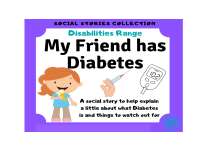
My Friend has Diabetes Social Story

- File type
- Preparation
- Print ready


- Topic
- Social Story, Explaining Diabetes
- Preparation
- Print ready
From the author
About this resource
Social stories use a patient and reassuring tone to teach children about social situations in a way that can be easily understood. Social stories are particularly useful for children on the autistic spectrum for whom social cues can be challenging and who often suffer anxiety if they do not know what to expect from a situation however social stories can also be useful for any child who is struggling to understand a situation or concept or needs help to understand a social skill or social cue, expectations, perspectives, common responses or is troubled about an upcoming event.
This social story is designed to help explain a little about what it is like and what it means to have diabetes to a child who knows someone with diabetes.
These books should be used over and over to reinforce the point so I would suggest either putting the pages into a display book or laminating and binding them.
Clipart images courtesy of Kari Bolt, Hidesy’s Clipart and Rossy’s Jungle.
Related resources
More resources teachers may find useful
More resources on the same subject and topic.



In the classroom
Teaching tips & learning objectives

Learning objectives
Students can describe two things a friend with diabetes needs to manage the condition day to day, such as insulin and blood-glucose testing.
Students can identify at least three physical or behavioural signs that a friend may be having a hypo, such as shaking, paleness, sweating, or an unusual mood change.
Students can state the correct response when they notice those signs in a friend: telling a grown-up right away.

Teaching tips
Read the story aloud before a classmate begins insulin therapy or returns to class after a diagnosis, so peers already have the vocabulary and context.
Pause on the hypo-signs pages to check that students can name the physical and behavioural cues described, since the story asks readers to recognize signs rather than just the term.
Follow the reading with a discussion of the closing pages, which emphasize that a friend with diabetes can still join in every activity.

Skills covered
Reading comprehension — following a first-person narrative sequence that explains a friend's daily diabetes-management routine.
Social-emotional awareness — recognizing physical and behavioural cues (shaking, paleness, sweating, mood change) that signal a friend needs help.
Peer support and empathy — the story models telling a trusted adult when a friend shows hypo warning signs, rather than reacting with confusion.
Good to know
Questions teachers ask about this resource
Who is telling this story — the child with diabetes or their friend?
The friend of the child with diabetes narrates in first person, describing what they've learned about the condition and how to help.
What does the story tell a reader to do if a friend shows signs of a hypo?
Tell a grown-up right away — the story shows this leads to the friend getting a snack or insulin and feeling better again.

No reviews yet
Downloaded this resource? Tell other teachers how it went.
Resource details
Concepts & topics
Core concepts
 Core concepts
Diabetes basics
Insulin and blood-glucose testing
Hypo warning signs
Peer empathy and inclusion
Topics
 Topics
Explore related searches

More to explore