Poetry Terms Vocabulary Booklet – 8 Key Terms



- Grades
- Grades 3–6
- File type
- Preparation
- Print ready


- Subject
- Poetry, Literature, Creative Writing, Vocabulary, Writing, Language Development, ELA
- Topic
- Poetry Terms, Figurative Language
- Resource types
- Literacy Readers
- Preparation
- Print ready
From the author
About this resource
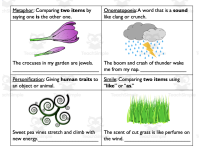
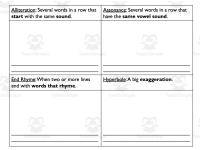
This 3-page Poetry Terms Booklet is a great way to let students learn and practice eight key vocabulary words: alliteration, assonance, end rhyme, hyperbole, metaphor, onomatopoeia, personification, and simile.
Each student will choose a theme; then they will write and illustrate an example for each poetry term using their theme.
There is a sample booklet completed that has the definitions filled in and eight examples related to the theme spring. Go through this with your class. For example, for alliteration there is a sample sentence: "Pretty pink petals pile on the pavement." Talk about why this is alliteration, identify the repeated sound, and notice how it relates to the theme of spring. Do this for each of the eight terms.
Two student versions are included: definitions already filled in or left blank. You choose which is best for your class. Each student gets a three-page booklet. They fill in the definitions (if needed), then write and illustrate a sentence (or couplet) to demonstrate the poetry term and convey their theme.
Grades to Use With:
This booklet is designed for students in grades 4-7 or high school special education classes.
Standards:
CCSSL.4.5
Demonstrate understanding of figurative language, word relationships, and nuances in word meanings.
CCSSL.4.5a
Explain the meaning of simple similes and metaphors (e.g., as pretty as a picture) in context.
CCSSL.5.5
Demonstrate understanding of figurative language, word relationships, and nuances in word meanings.
CCSSL.5.5a
Interpret figurative language, including similes and metaphors, in context.
CCSSL.6.5
Demonstrate understanding of figurative language, word relationships, and nuances in word meanings.
CCSSL.6.5a
Interpret figures of speech (e.g., personification) in context.
CCSSL.7.5
Demonstrate understanding of figurative language, word relationships, and nuances in word meanings.
If you enjoy this product, check out my Idiom Picture Dictionary or Make a Magazine Project.
Related resources
More resources teachers may find useful
More resources on the same subject and topic.



In the classroom
Teaching tips & learning objectives

Learning objectives
Recall or apply the definition of eight poetry terms: alliteration, assonance, end rhyme, hyperbole, metaphor, onomatopoeia, personification, and simile
Write an original sentence that demonstrates a given poetry term, connected to a chosen theme
Illustrate a written example to reinforce its meaning

Teaching tips
Model the task using the completed spring-themed sample booklet before assigning either student version, walking through why each example sentence fits its term
Assign the definitions-included version to students who need support recalling the eight terms, and the definitions-blank version to students ready to demonstrate that recall independently
Have students pick a single theme for their whole booklet, as the sample does with spring, so all eight examples connect to one idea

Skills covered
Poetic device identification — students recall the definitions of eight commonly taught poetry terms.
Original composition — students write a new sentence or couplet that demonstrates each term, tied to a theme of their choosing.
Illustration of abstract language — students draw a picture to accompany and reinforce each written example.
Good to know
Questions teachers ask about this resource
What is the difference between the two student booklet versions?
One version already lists the definition of each of the eight terms, leaving students to write and illustrate their own example. The other version lists only the term names with no definitions, so students must recall the definition themselves before writing their example.

No reviews yet
Downloaded this resource? Tell other teachers how it went.
Resource details
Concepts & topics
Core concepts
 Core concepts
Figurative language
Poetry terms
Similes and metaphors
Sound devices
 Topics
Explore more
Categories this resource belongs to
Explore related searches


More to explore