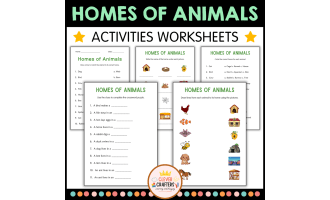
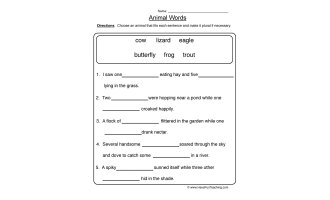
Printable Classification of Animals Activity Worksheets for Grade 2, 3


- Grades
- Grades 1–5
- Pages
- 12
- File type
- Preparation
- Print ready


- Subject
- Animals, Life Sciences, Science
- Topic
- Classification of Animals Worksheets, Animal Groups Worksheets
- Resource types
- Worksheets
- Preparation
- Print ready
From the author
About this resource
Introduction
This Classification of Animals worksheet set helps young learners understand how animals are grouped based on their characteristics, habitats, and diets. students explore different animal groups such as mammals, birds, reptiles, amphibians, fish, and insects, while building essential science vocabulary and classification skills.
What’s Included:
Sorting and categorizing animals based on characteristics
Herbivores, carnivores, and omnivores classification activities
Domestic vs. wild animal identification
Vertebrates and invertebrates exercises
Endangered animals recognition activities
Grades / Ages:
Ideal for Grades 2–6
Implementation Format:
Perfect for science lessons, literacy centres, morning work, small group instruction, independent learning, classroom activities, or homework.
Answer Key:
Not included
File Type:
PDF (Non-editable)
Number of Pages:
12 pages total
License:
Paid product for personal or single-classroom use only
Tags to Use:
Classification of animals worksheets, animal groups worksheets, science worksheets for kids, animal classification activities, herbivores carnivores omnivores worksheets, vertebrates and invertebrates, endangered animals worksheets, grade 2 science, grade 3 science, grade 4 science
Related resources
More resources teachers may find useful
More resources on the same subject and topic.


In the classroom
Teaching tips & learning objectives

Learning objectives
Sort familiar animals into the six main groups - mammal, bird, reptile, amphibian, fish and insect - by picking them out of mixed lists
Separate animals by what they eat, distinguishing herbivores from carnivores and both from omnivores
Decide whether an animal is domestic or wild and record the decision by matching it to the right label
Classify animals as vertebrate or invertebrate, working from examples such as earthworm, octopus, snail and starfish against fish, bird and dolphin
Name animals currently at risk, using a list that includes panda, rhinoceros, blue whale, sea turtle and snow leopard

Teaching tips
The same animals reappear as distractors from page to page - eagle is a wrong answer on the reptile page and a right one on the carnivore page - so working the pages in order builds the habit of rereading the instruction rather than the list
Each page uses a different mark, which makes a completed set easy to check at a glance and gives a reason to read the direction line every time
Pages 1 to 6 stay inside taxonomic grouping while pages 7 to 9 move to diet; a natural break sits between them if the set is being spread over two lessons
The insects page includes spider and scorpion among the eleven names, which is the page most likely to need a follow-up conversation about what makes an insect an insect
No solutions are supplied, so mark the pages alongside students or agree the answers as a class before they are collected

Skills covered
Classifying animals by group - students pick the mammals, birds, reptiles, amphibians, fish and insects out of mixed lists that deliberately include members of the other groups.
Following a changing instruction - each page names a different mark (circle, underline, box, highlight, star, checkmark), so the direction line has to be read afresh on every sheet.
Sorting by diet - three pages ask students to separate herbivores such as giraffe and buffalo, carnivores such as cheetah and hyena, and omnivores such as raccoon and badger.
Applying the vertebrate distinction - one page asks for a V or an I beside eleven animals, contrasting earthworm, ant, octopus, snail and starfish with fish, frog, human, bird, snake and dolphin.
Recognising conservation status - the final page asks students to identify the endangered animals among eleven names, including blue whale, sea turtle and snow leopard.
Good to know
Questions teachers ask about this resource
How do the twelve pages differ in what students actually do?
The mark changes with the category. The first six ask students to circle, underline, box, highlight, star or checkmark the members of one animal group; the last three switch format altogether - drawing a line to Domestic or Wild, writing V or I, and marking endangered animals with an X.
Do the same animals turn up on more than one page?
By design. Eagle appears on the bird, reptile, amphibian and carnivore lists; snake shows up on five different pages; frog is a distractor among the reptiles and a correct answer among the amphibians. Each repeat forces students to judge against the category being asked for.
What does the last page cover?
Conservation rather than classification. Students mark the endangered animals among eleven names - panda, bald eagle, elephant, rhinoceros, cheetah, blue whale, giraffe, tiger, sea turtle, koala and snow leopard - which extends the set beyond biological grouping.

No reviews yet
Downloaded this resource? Tell other teachers how it went.
Resource details
Concepts & topics
Core concepts
 Core concepts
Animal classification
Vertebrates and invertebrates
Herbivores, carnivores and omnivores
Endangered species
 Topics
Explore more
Categories this resource belongs to
Explore related searches


More to explore