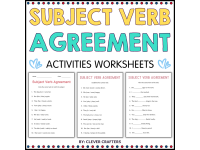
Subject Verb Agreement Grammar Worksheets Practice for Grade 2, 3, 4



- Grades
- Grades 1–5
- Pages
- 8
- File type
- Preparation
- Print ready


- Subject
- Grammar, Language Development, ELA
- Topic
- Subject Verb Agreement Worksheets, Grammar Worksheets
- Resource types
- Worksheets
- Preparation
- Print ready
From the author
About this resource
Introduction
This worksheet pack helps students practice subject-verb agreement through a variety of engaging grammar activities. Learners strengthen sentence structure, reading comprehension, and writing skills while learning how subjects and verbs work together correctly in sentences.
What’s Included:
A variety of subject-verb agreement activities
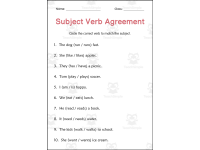
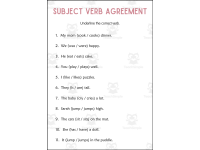
Circle-the-correct-verb exercises
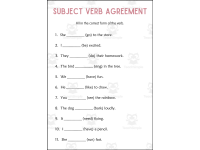
Fill-in-the-blank verb practice
Singular and plural subject activities
“Is or Are” grammar exercises
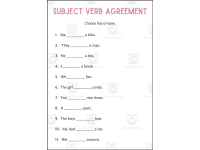
“Has or Have” practice tasks
Sentence sorting activities
Sentence correction and verb identification exercises
Fun and simple grammar activities designed for young learners
Grades / Ages:
Ideal for Grades 1–5
Implementation Format:
Perfect for classwork, homework, literacy centres, or independent practice
Great for grammar lessons, ESL activities, and language review
Supports both guided and independent learning
Answer Key:
Not included
File Type:
PDF (Non-editable)
Number of Pages:
8 pages total
License:
Paid product for personal or single-classroom use only
Tags to Use:
subject verb agreement worksheets, grammar worksheets, english grammar practice, singular and plural verbs, sentence structure activities, elementary grammar worksheets
Related resources
More resources teachers may find useful
More resources on the same subject and topic.


In the classroom
Teaching tips & learning objectives

Learning objectives
Select the verb form that agrees with a singular subject (he, she, it, or a singular noun)
Select the verb form that agrees with a plural subject (they, we, or a plural noun)
Choose between is and are, and between has and have, based on the subject of the sentence
Classify a complete sentence as having a singular or plural subject

Teaching tips
Start with the circle- and underline-the-verb pages, which give both verb-form choices in the sentence, before moving to the fill-in-the-blank pages that require producing the form independently
Treat the "is or are" and "has or have" pages as their own short lessons, since irregular verbs are isolated from the regular-verb practice used on the rest of the packet
Use the sorting page as a wrap-up check, since it asks students to classify finished sentences rather than fix or complete one
Assign the final mixed page last, since it combines regular verbs, is/are, and has/have in a single set after each has been practiced separately

Skills covered
Regular-verb subject-verb agreement — students select or supply the correct verb form (e.g., runs/run, eats/eat) for singular and plural subjects across four worksheets.
Irregular-verb agreement with 'to be' and 'to have' — students choose is/are and has/have to match a sentence's subject on two dedicated pages.
Singular/plural subject classification — students sort eleven complete sentences by whether their subject is singular or plural.
Mixed-format verb selection — students apply regular- and irregular-verb agreement together on a combined final worksheet.
Good to know
Questions teachers ask about this resource
Does the sorting page ask students to fix a sentence, or just classify it?
Just classify it — all eleven sentences on the sorting page are already correct, and students sort each one into a "Singular Subject" or "Plural Subject" column rather than choosing or fixing a verb.

No reviews yet
Downloaded this resource? Tell other teachers how it went.
Resource details
Concepts & topics
Core concepts
 Core concepts
Subject-verb agreement
Singular and plural subjects
Irregular verbs (is/are, has/have)
 Topics
Explore more
Categories this resource belongs to
Explore related searches


More to explore