Understanding Conflict- SEL Lesson | Grades 3, 4, 5, and 6

- Grades
- Grades 3–6
- File type
- Preparation
- Print ready


- Subject
- Social Emotional Learning (SEL), Social Skills, Life Skills, Special Resources
- Topic
- Conflict, Understanding Conflict
- Resource types
- Teacher Tools
- Preparation
- Print ready
From the author
About this resource
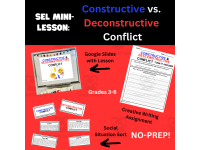
Easily impart Social Emotional Learning with this ready-to-use lesson on Constructive vs. Deconstructive Conflict! Aimed at students in grades 3 to 6, this lesson showcases how conflicts can positively impact their lives. Engage them with an interactive session using Google Slides, a Social Situation Sort, and a Creative Writing Activity.
Included in the package:
Teacher's Lesson Outline with step-by-step instructions
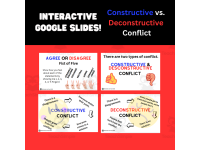
13 Google Slides for interactive learning
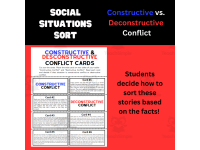
Constructive vs. Deconstructive Conflict Social Situations Sort with 2 Title Cards and 6 Situation Cards
Answer Key for the Social Situations Sort
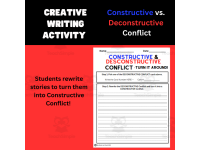
Creative Writing Task: Students transform a deconstructive conflict narrative into a constructive one.
Additional Optional Activities for extended learning.
1 HOUR of Activities
Grades- 3,4,5 and 6
Lesson Outline--
Define Constructive Conflict vs. Deconstructive Conflict - Slides (15 Minutes)
Put slides on the board
Google Slide Deck or PDF versions available!
See below
Complete the "Fist of Five" Activity
Introduce Definition of Conflict
TIP: Have student readers read these aloud
Discuss the difference between Constructive Conflict and Deconstructive Conflict
TIP: Discuss what similarities and differences between Constructive and Deconstructive Conflict
Constructive vs. Deconstructive Conflict Sort (10 Minutes)
Pass out Constructive vs Deconstructive Conflict Cards to students
Read the directions with students
Tell students that these are not in any specific order right now!
Have them cut on the dotted line
Give students time to sort these into two piles-- Constructive Conflict & Deconstructive Conflict
Constructive vs Deconstructive Conflict Sort Answers (10 minutes)
See Answer Key below!
Go over answers with students
Reminder-- These are SUGGESTED ANSWERS! If students come up with different ways to sort these, that is okay as long as they can justify why they have it sorted the way they do. Invite students to have a discussion about this if they disagree!
Constructive & Deconstructive Conflict - Turn it Around Writing Activity (25 Minutes)
See page below
Pass this out to students
Have them pick one of the Deconstructive Conflict Cards and write the number in Step 1
Have students rewrite the Deconstructive Conflict Situation to make it a Constructive Conflict Card
Tell students to use the same characters and situation but change the details to make the conflict constructive!
Possible EXTENSION ACTIVITIES
Group students into small groups based on the card they chose to write about and have them read their stories aloud
Have students read their stories aloud to the whole class.
Have students draw a picture to go with their Constructive Conflict Story
Have students rewrite all three stories
Have students write their own Deconstructive Conflict Story, trade with a classmate, then rewrite their classmates Deconstructive Conflict story to be a Constructive Conflict Story
Related resources
More resources teachers may find useful
More resources on the same subject and topic.


In the classroom
Teaching tips & learning objectives

Learning objectives
Explain the difference between constructive and deconstructive conflict
Identify constructive and deconstructive responses in everyday social situations

Teaching tips
The Google Slides deck needs a Google account to copy and edit; the PDF slides work without one.
Sort answers are suggested answers, so a card students place differently could be discussed rather than marked wrong.

Skills covered
Categorizing — placing each scenario card under the constructive or deconstructive title card
Narrative revision — changing a deconstructive conflict story so it ends constructively

No reviews yet
Downloaded this resource? Tell other teachers how it went.
Resource details
Concepts & topics
Core concepts
 Core concepts
Constructive conflict
Deconstructive conflict
Conflict resolution
 Topics
Explore more
Categories this resource belongs to
Explore related searches



More to explore