Writing Numbers 1-10


- Grades
- Junior Kindergarten–Kindergarten
- File type
- Preparation
- Print ready


- Subject
- Numbers, Math
- Topic
- Numbers, Handwriting
- Resource types
- Worksheets
- Preparation
- Print ready
- Ontario expectations
- B1.1 — Ontario grade 1 mathematics b1.1
From the author
About this resource
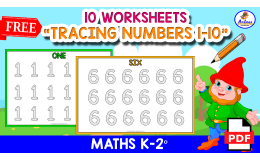
Worksheets in which children can practice tracing over and writing numbers 1-10. There are also activities to count and draw the correct number of objects and match numbers to counting fingers.
Clipart images courtesy of Kari Bolt Children's Illustrator and Arty Clips Graphics
Related resources
More resources teachers may find useful
More resources on the same subject and topic.


In the classroom
Teaching tips & learning objectives

Learning objectives
Students trace and form the numerals 1 through 10.
Students demonstrate one-to-one correspondence by drawing the correct quantity of objects (apples, dots, spots) to match a numeral.
Students match written numerals 1-10 to a corresponding number of fingers.

Teaching tips
Assign the 1-5 set before the 6-10 set, following the file's built-in numeral progression.
Rotate through the four picture themes (apples, dice, ladybird, fingers) across different sessions so the same numbers are practiced in varied contexts.
Have students count aloud as they draw each object to reinforce the number-quantity connection verbally as well as visually.

Skills covered
Numeral formation — students trace printed numerals 1 through 10.
One-to-one counting correspondence — students draw the exact number of apples, dice dots, or ladybird spots that matches a given numeral.
Number-quantity matching — students draw a line connecting a numeral to the matching number of fingers shown.

No reviews yet
Downloaded this resource? Tell other teachers how it went.
Ontario curriculum
Ontario curriculum expectations
Ontario expectations
 Ontario expectations
- B1.1 — Ontario Grade 1 Mathematics B1.1: read and represent whole numbers up to and including 50, and describe various ways they are used in everyday life.
Core concepts
 Core concepts
Numeral formation
Counting
One-to-one correspondence
 Topics
Explore more
Categories this resource belongs to
Explore related searches


More to explore