50 Math Puzzles for Grade 6


- Grades
- Grades 6–8
- Pages
- 7
- File type
- Answer key
- Included


- Subject
- Math
- Topic
- Math puzzles, Grade 6
- Answer key
- Included
- Standards
- 6.RP.A.3
Product description
From the author
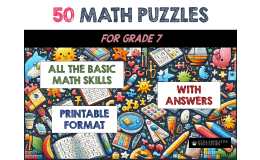
This seven-page PDF contains fifty mixed short-answer math problems, answer lines and a complete key. Topics include equations, decimal and fraction operations, ratios, percentages, geometry, coordinates, median, mode, range and simple probability.
Use selected questions for review or extension. The publisher labels the set Grade 6, although some topics fit later middle-school study. Mean and interquartile range are not tasks in this download.
Related resources
More resources teachers may find useful
24 related resources were found using this product's title, contributor, categories and tags.


In the classroom
Teaching tips & learning objectives

Learning objectives
Solve one-step and two-step linear equations for an unknown, e.g., 3x + 7 = 22
Perform operations with decimals, fractions, and mixed numbers, including multiplication, division, addition, and subtraction
Simplify ratios and solve proportional word problems, e.g., pencils-per-dollar rate problems

Teaching tips
Choose a small mixed set based on the topics learners have studied.
Provide coordinate-grid paper for the plotting item.
Compare items 19 and 45 to discuss scientific notation for a small decimal and a large whole number.

Skills covered
Linear equation solving — students isolate x in equations like 3x + 7 = 22 and x/4 = 9.
Fraction and decimal computation — students multiply, divide, add, and subtract values such as 2.4 × 0.15 and 1⅔ + 2¼.
Percent and ratio reasoning — students find a percent of a number, compute percent change, and simplify ratios such as 18:24.

No reviews yet
Downloaded this resource? Tell other teachers how it went.
Curriculum
Standards, concepts & topics
Standards
 Standards
- 6.RP.A.3 — Use ratio and rate reasoning to solve real-world and mathematical problems, e.g., by reasoning about tables of equivalent ratios, tape diagrams, double number line diagrams, or equations. a. Make tables of equivalent ratios relating quantities with whole-number measurements, find missing values in the tables, and plot the pairs of values on the coordinate plane. Use tables to compare ratios. b. Solve unit rate problems including those involving unit pricing and constant speed. For example, if it took 7 hours to mow 4 lawns, then at that rate, how many lawns could be mowed in 35 hours? At what rate were lawns being mowed? c. Find a percent of a quantity as a rate per 100 (e.g., 30% of a quantity means 30/100 times the quantity); solve problems involving finding the whole, given a part and the percent. d. Use ratio reasoning to convert measurement units; manipulate and transform units appropriately when multiplying or dividing quantities.
Core concepts
 Core concepts
Algebra
Fractions
Decimals
Ratios and percents
Geometry
Probability and data
 Topics
Explore related searches
More to explore
You may also like