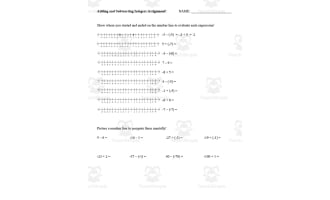
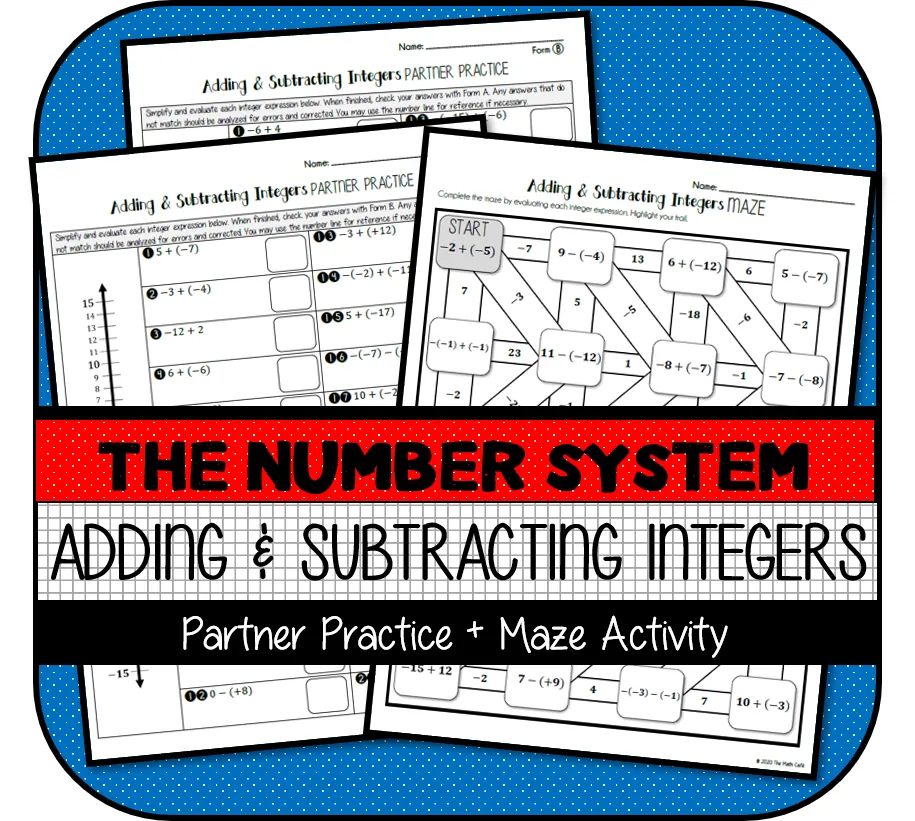
Adding & Subtracting Integers PARTNER PRACTICE & MAZE ACTIVITIES
- Grades
- Grades 6–7
- Pages
- 5
- File type
- Answer key
- Included


- Subject
- Math
- Topic
- Integer addition, Integer subtraction
- Resource types
- Worksheets, Mazes
- Answer key
- Included
- Standards
- 7.NS.A.1
Product description
From the author
This resource was developed to PARTIALLY meet the requirements of the 7th Grade Number Systems Standards below.
CCSS.MATH.CONTENT.7.NS.A.1
Apply and extend previous understandings of addition and subtraction to add and subtract rational numbers; represent addition and subtraction on a horizontal or vertical number line diagram.
CCSS.MATH.CONTENT.7.NS.A.1.A
Describe situations in which opposite quantities combine to make 0. For example, a hydrogen atom has 0 charge because its two constituents are oppositely charged.
CCSS.MATH.CONTENT.7.NS.A.1.B
Understand p + q as the number located a distance |q| from p, in the positive or negative direction depending on whether q is positive or negative. Show that a number and its opposite have a sum of 0 (are additive inverses). Interpret sums of rational numbers by describing real-world contexts.
CCSS.MATH.CONTENT.7.NS.A.1.C
Understand subtraction of rational numbers as adding the additive inverse, p - q = p + (-q). Show that the distance between two rational numbers on the number line is the absolute value of their difference, and apply this principle in real-world contexts*
Related resources
More resources teachers may find useful
24 related resources were found using this product's title, contributor, categories and tags.

In the classroom
Teaching tips & learning objectives

Learning objectives
Simplify and evaluate integer expressions involving double signs, such as -(-4) + (-3), using addition and subtraction.
Cross-check computed answers with a partner working a parallel form to identify and correct errors.
Apply integer addition and subtraction rules across a sequence of problems to complete a maze.

Teaching tips
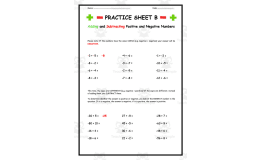
Assign Form A and Form B to partners so each student works independently before comparing answers, since the two forms use different numbers but arrive at the same 24 answers.
Use the number line printed on each form as a scaffold for students who are still building confidence with negative-direction movement.
Save the maze activity for after the partner practice, since it requires the same double-sign simplification skill in a single-student, find-the-path format.

Skills covered
Integer addition and subtraction with double signs — students simplify expressions like -(-4) + (-3) before evaluating them.
Self-checking through partner comparison — Form A and Form B use different numbers but produce identical answers, so a mismatch signals a computational error to find.
Sequential problem-solving under a maze constraint — students must correctly evaluate each expression in turn to trace a valid path from start to finish.
Good to know
Questions teachers ask about this resource
Do Form A and Form B use the same numbers?
No — the two forms use different expressions but are designed to produce the same 24 answers, so partners can compare and catch errors.

No reviews yet
Downloaded this resource? Tell other teachers how it went.
Curriculum
Standards, concepts & topics
Standards
 Standards
- 7.NS.A.1 — Apply and extend previous understandings of addition and subtraction to add and subtract rational numbers; represent addition and subtraction on a horizontal or vertical number line diagram. a. Describe situations in which opposite quantities combine to make 0. For example, a hydrogen atom has 0 charge because its two constituents are oppositely charged. b. Understand p + q as the number located a distance |q| from p, in the positive or negative direction depending on whether q is positive or negative. Show that a number and its opposite have a sum of 0 (are additive inverses). Interpret sums of rational numbers by describing real-world contexts. c. Understand subtraction of rational numbers as adding the additive inverse, p – q = p + (–q). Show that the distance between two rational numbers on the number line is the absolute value of their difference, and apply this principle in real-world contexts. d. Apply properties of operations as strategies to add and subtract rational numbers.
Core concepts
 Core concepts
Integer addition and subtraction
Additive inverses
Number line representation
Rational number operations
 Topics
Explore more
Categories this resource belongs to
Explore related searches
More to explore
You may also like