Adding and Subtracting Integers Printable Scavenger Hunt

- Grades
- Grades 6–8, Middle School
- Pages
- 8
- File type
- Answer key
- Included


- Subject
- Math, Addition and Subtraction, Addition, Subtraction
- Topic
- Integer Operations, Scavenger Hunt
- Resource types
- Worksheets & Printables, Activities, Task Cards
- Answer key
- Included
- Standards
- 7.NS.A.1
Product description
From the author
Turn the Routine into an Adventure!
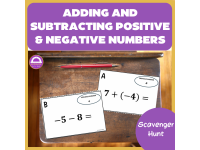
Transform addition and subtraction of integers into an exciting math experience with this interactive printable scavenger hunt! Tailored for middle school students, this hands-on activity combines learning with fun, reinforcing essential skills in adding and subtracting positive and negative numbers.
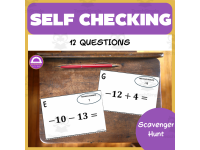
With 12 engaging problems, this resource provides an interactive, self-checking tool that’s perfect for math practice, review, or test prep. Plus, it’s completely no-prep—just print, cut, and go!
About this Resource
Self-Checking Structure
This scavenger hunt lets students independently check their answers. Once students solve the final problem, they’ll see that the last answer is also the answer to the first card, completing the loop!No Prep Needed
Simply print, cut, and distribute the cards—no additional setup or materials needed! This makes it an easy, time-saving addition to any lesson plan.Interactive and Engaging
The scavenger hunt format promotes active participation as students move around the classroom, working to solve each problem while seeking out the matching answers. This dynamic approach boosts both focus and energy, helping students stay engaged.Versatile Use
Ideal for math centers, classroom activities, collaborative small group work, or test review sessions, this flexible resource fits into a wide range of instructional settings and supports diverse student needs.
How It Works
Starting Point
Students begin at any card in the set, where they’ll find an integer addition or subtraction problem. After solving, they search for the next card with the correct answer.Progress Through the Hunt
This active “hunt” continues as students solve each problem, diligently progressing from one card to the next.Loop Back to Start
The activity concludes when they return to their starting card, reinforcing accuracy with a self-checking, confidence-building loop.
Why This Activity Works
The Adding and Subtracting Integers Scavenger Hunt combines essential math practice with an engaging, hands-on approach, offering a refreshing alternative to traditional worksheets. Moving card to card, students not only get physical activity but also strengthen their understanding of integer operations in a fun, low-pressure setting. With its self-checking nature, this activity empowers students to take charge of their progress and build confidence—perfect for middle school math classes focused on engagement and comprehension.
Ideal For:
Math Centers
Excellent for rotating groups or focused practice sessions.Classroom Activities
Provides a pleasant break from traditional lessons while promoting active participation.Small Group Work
Perfect for collaborative learning environments.Test Review
An efficient, enjoyable tool for reinforcing skills before an exam.
Give your students a fun, active way to practice integer operations with this no-prep scavenger hunt! Just print, distribute, and watch them enjoy a self-paced and self-checking math adventure.
Related resources
More resources teachers may find useful
24 related resources were found using this product's title, contributor, categories and tags.


In the classroom
Teaching tips & learning objectives

Learning objectives
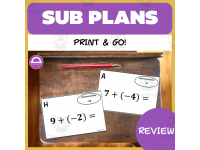
Add a positive and a negative integer, as on card A (7 + (-4)) and card H (9 + (-2))
Subtract a negative integer, recognising it as addition, on card D (6 - (-8)) and card K (-4 - (-9))
Use a closed answer chain to self-check: if the final card is not the starting card, an error has occurred earlier in the sequence

Teaching tips
Model matching a calculated answer to another card’s PREVIOUS ANSWER corner; the corner does not answer that card’s own question.
Have students record the card letter, working and answer for all twelve different cards. Returning to the start alone does not prove every calculation is correct.
Check the twelve-card route A–I–C–L–B–H–E–K–D–J–F–G–A, or the same cycle starting elsewhere.

Skills covered
Adding integers with unlike signs - four cards combine a positive and a negative, including 7 + (-4), -12 + 4, -8 + 5 and 9 + (-2).
Subtracting a negative integer - cards D and K give 6 - (-8) and -4 - (-9), the case that turns a subtraction into an addition.
Self-checking through a closed sequence - each card's corner carries another card's answer, so the twelve form one loop and a completed hunt returns the student to their first card.
Good to know
Questions teachers ask about this resource
How does the closed chain help with checking?
A correct twelve-card route returns to its starting card. Students should still record and check all twelve calculations; returning early does not prove that every answer is correct.
Do all students have to start at the same card?
No - and that is the point of the design. The instructions say each student or group should begin at any card and that the cards do not need to be solved in order, so a whole class can be spread across twelve locations at once rather than following each other round.

No reviews yet
Downloaded this resource? Tell other teachers how it went.
Curriculum
Standards, concepts & topics
Standards
 Standards
- 7.NS.A.1 — Apply and extend previous understandings of addition and subtraction to add and subtract rational numbers; represent addition and subtraction on a horizontal or vertical number line diagram. a. Describe situations in which opposite quantities combine to make 0. For example, a hydrogen atom has 0 charge because its two constituents are oppositely charged. b. Understand p + q as the number located a distance |q| from p, in the positive or negative direction depending on whether q is positive or negative. Show that a number and its opposite have a sum of 0 (are additive inverses). Interpret sums of rational numbers by describing real-world contexts. c. Understand subtraction of rational numbers as adding the additive inverse, p – q = p + (–q). Show that the distance between two rational numbers on the number line is the absolute value of their difference, and apply this principle in real-world contexts. d. Apply properties of operations as strategies to add and subtract rational numbers.
Core concepts
 Core concepts
Integer addition
Integer subtraction
Positive and negative numbers
Self-checking activity
 Topics
Explore more
Categories this resource belongs to
Explore related searches
More to explore
You may also like