AP Chemistry Periodic Table 2 Lessons-Multiple choice and Song writing



- Grades
- Grade 10, High School
- Pages
- 9
- File type
- Microsoft Word
- Answer key
- Included


- Subject
- Science, Chemistry
- Topic
- Chemistry, Fun Activity
- Resource types
- Songs, Activities
- Answer key
- Included
About this resource
What's inside this resource
Make AP Chemistry Fun. This product contains two lessons. It is written in Microsoft word so you can make any changes you need to fit your individual classes
Lesson Objectives:
The students will know the sub-groups of the periodic table
The students will know how to figure out how many protons, neutrons, and electrons are in any given element. The students will know how to identify the atomic symbol, atomic number and the atomic mass of each element.
Lesson One
Students will write a song about the Periodic Table
Included is a complete Rubric to help you grading
Lesson Two
There is a practice multiple choice, and free response worksheet. Get your students ready for the AP test in the spring
This is a 20 questions multiple choice test and 2 open response questions over the periodic table trends
The multiple-choice test covers the following trends and information
Atomic number
Atomic mass
Atomic radius
Electronegativity
Metals and Nonmetals
Ionization energy
Family names
Valence electrons
PS1. Matter and Its Interactions
HS-PS1-1. Use the periodic table as a model to predict the relative properties of main group elements, including ionization energy and relative sizes of atoms and ions, based on the patterns of electrons in the outermost energy level of each element. Use the patterns of valence electron configurations, core charge, and Coulomb’s law to explain and predict general trends in ionization energies, relative sizes of atoms and ions, and reactivity of pure elements.
Acclimate your students to the periodic table of elements using this printable and digital activity as an introduction or review.
Perfect for Sub Plans
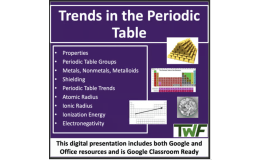
The topics include: The periodic table, periods, rows, energy levels, groups, columns, properties of the chemical families, the periodic law, atomic number, alkali metals, alkaline earth metals, halogens, noble gases, transitions metals, non-metals, metals and metalloids and noble gas electron configuration
Fun Way to Teach the Periodic Table
Ways to use this product
A. In small groups or pairs so that students can work together to learn the periodic table of elements
B. Assign this activity as a homework assignment to have individual practice using the table
C, Distribute this activity to students who need practice to learn the table
D. Classroom Activity Integrate the worksheet into your chemistry lesson to reinforce students’ understanding of the periodic table
Homework Assignment Take home quiz to help students learn and retain key concepts
*Exam Prep Use this quiz as a study guide for future exams and assessments
*Self-Study Allow students to independently test their knowledge and track their progress
Benefits
A. Reinforces Learning Aids students to solidify their understand of the tends of the periodic table
B. Convenient Just Print and go
C. Engaging Keep students motivated and interested
D. Comprehensive Covers a broad ranges
Related resources
More resources teachers may find useful
24 related resources were found using this product's title, contributor, categories and tags.


In the classroom
Teaching tips & learning objectives

Learning objectives
- Compare elements by ionization energy, electronegativity and atomic radius
- Determine the protons, neutrons and electrons in an atom or isotope
- Summarize periodic table structure and trends in original song lyrics

Teaching tips
- The lessons reference YouTube videos, so plan for internet access when showing them.

Skills covered
- Predicting periodic trends — answering questions on ionization energy, electronegativity and diagonal relationships

No reviews yet
Downloaded this resource? Tell other teachers how it went.
Resource details
Concepts & topics
Core concepts
 Core concepts
- Periodic trends
- Ionization energy
- Electronegativity
- Atomic radius
- Isotopes
 Topics
Explore more
Categories this resource belongs to
Explore related searches
More to explore
You may also like