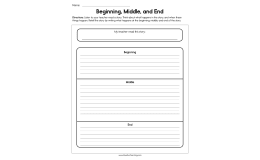
Beginning, Middle, End Story Sequencing Organizer


- Grades
- Grades 2–6, Elementary, Middle School
- Pages
- 1
- File type
- Preparation
- Print ready


- Subject
- ELA, Reading
- Topic
- Sequencing, sequencing chart graphic organizer
- Resource types
- Teacher Tools, Graphic Organizers, Worksheets & Printables, Worksheets
- Preparation
- Print ready
- Standards
- CCSS.RI.1.2 CCSS.RI.2.5 +1
About this resource
What's inside this resource
This graphic organizer can help your students to better understand the events that occur in the beginning, middle, and end of a story. This can be a helpful tool for students who are struggling to understand the sequence of events in a story.
Related resources
More resources teachers may find useful
24 related resources were found using this product's title, contributor, categories and tags.


In the classroom
Teaching tips & learning objectives

Learning objectives
Identify major events from the beginning, middle, and end of a text.
Retell a story using clear sequence words.
Organize ideas visually to support comprehension and written responses.

Teaching tips
Model sequencing using a class read-aloud, then complete the organizer together.
Encourage students to sketch small visuals in each box before writing.
Use the organizer as a planning sheet for narrative writing.

Skills covered
Retelling with sequence
Identifying key story events
Basic narrative comprehension
Good to know
Questions teachers ask about this resource
Is this organizer suitable for early readers?
Yes, the simple layout and clear labels support young learners.
Can it be used with any text?
Yes, it works with picture books, chapter books, and short stories.
Is this helpful for writing instruction?
Yes, students can use it to outline their own narratives.

No reviews yet
Downloaded this resource? Tell other teachers how it went.
Curriculum
Standards, concepts & topics
Standards
 Standards
- CCSS.RI.1.2 — Identify the main topic and retell key details of a text.
- CCSS.RI.2.5 — Know and use various text features (e.g., captions, bold print, subheadings, glossaries, indexes, electronic menus, icons) to locate key facts or information in a text efficiently.
- CCSS.W.3.3 — Write narratives to develop real or imagined experiences or events using effective technique, descriptive details, and clear event sequences. a. Establish a situation and introduce a narrator and/or characters; organize an event sequence that unfolds naturally. b. Use dialogue and descriptions of actions, thoughts, and feelings to develop experiences and events or show the response of characters to situations. c. Use temporal words and phrases to signal event order. d. Provide a sense of closure.
Core concepts
 Core concepts
Story sequencing
Narrative structure
Identifying key events
 Topics
Explore more
Categories this resource belongs to
Explore related searches
More to explore
You may also like