


Character Trait Web Graphic Organizer for Any Book
Second to fifth graders map one character’s traits on a six-spoke web, prove each with something the character says or does, then use the web to write about two of those traits.


- Grades
- Grades 2–4, Elementary
- Pages
- 2
- File type
- Preparation
- Print ready


- Subject
- ELA, Reading, Reading Comprehension, Literature
- Topic
- charlotte's web, charlotte's web activities
- Resource types
- Activities
- Preparation
- Print ready
About this resource
What's inside this resource
One character sits in a center circle and six trait boxes branch out from it on page 1 of this character trait web, which works with a picture book, a chapter book or a class novel. Students write the book title and the character’s name, then fill each box with a trait word and two lines of evidence: something the character says or does that proves it.
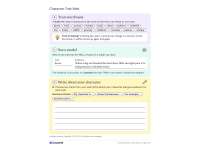
Page 2 supports the thinking. A 16-word bank offers traits from brave and honest to bossy and sneaky, and a short note explains that a feeling like sad or excited can change in a minute, while a trait shows up again and again. A model box for Milo, a mouse in a made-up story, pairs the trait brave with an action and explains why that action proves the trait when a sentence such as Milo is very brave would only repeat it.
Students finish by choosing two traits from their web and writing about the character with evidence for each, using four sentence starters and five writing lines.
Related resources
More resources teachers may find useful
5 related resources were found using this product's title, contributor, categories and tags.



In the classroom
Teaching tips & learning objectives

Learning objectives
- Name up to six traits that describe a story character.
- Support each trait with something the character says or does in the story.
- Tell the difference between a lasting character trait and a passing feeling.

Teaching tips
- Read the Milo model together before students start, pointing out that the evidence is an action, not a second way of saying the trait.
- Ask students to test each trait against the trait-or-feeling note; a word like excited describes a moment, not the character.
- Younger readers can start with three or four boxes and add the rest as the story goes on.

Skills covered
- Describing characters — students pick six trait words, from the bank or their own, for one character.
- Using story evidence — students record what the character says or does that proves each trait.
- Trait versus feeling — students learn that a trait shows up again and again, while a feeling can change quickly.
Good to know
Questions teachers ask about this resource
Which books can the web be used with?
Any story with a character students know well. The page has a blank book-title line and center circle, and the only example is Milo, a mouse invented for the model, so nothing ties the web to one title.
Do students have to fill all six trait boxes?
Six boxes give room for a well-known main character. For a minor character or a short picture book, students can fill the boxes they can prove and leave the rest; the writing task on page 2 needs only two traits.
How does the web connect to the writing task on page 2?
Students choose two of the traits they wrote on the web and reuse the evidence from those boxes, so the web works as the plan for the writing.

No reviews yet
Downloaded this resource? Tell other teachers how it went.
Resource details
Concepts & topics
Core concepts
 Core concepts
- Character traits
- Text evidence
- Story elements
- Graphic organizers
 Topics
Explore more