Compound Sentences Grammar Worksheet in Spanish - Oraciones Compuestas




- Grades
- Grades 1–5, Elementary
- Pages
- 10
- File type
- Preparation
- Print ready


- Subject
- Grammar, ELA, Spanish, Foreign Languages
- Topic
- spanish grammar, sentence structure
- Resource types
- Worksheets, Worksheets & Printables
- Preparation
- Print ready
About this resource
What's inside this resource
Product description
From the author
Introduction
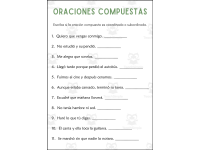
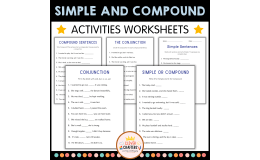
This set of 10 Spanish grammar worksheets helps students learn and practice oraciones compuestas step by step. The activities include identifying and classifying sentence types (coordinadas, subordinadas, yuxtapuestas), completing sentences with connectors, transforming simple sentences into compound ones, and creating new examples.
Students will better understand how connectors and clauses work together to form more complex ideas. The exercises reinforce grammar, sentence structure, and writing fluency in Spanish while supporting reading comprehension and language awareness.
What’s Included:
10 printable Spanish grammar worksheets
Identification, classification, and transformation activities
Connector completion and sentence creation tasks
Practice with coordinadas, subordinadas, and yuxtapuestas
Grades / Ages:
Ideal for Grades 1–6
Implementation Format:
Perfect for grammar lessons, literacy centres, test review, or Spanish language practice.
Answer Key:
Not included
File Type:
PDF (Non-editable)
Number of Pages:
10 pages total
License:
Paid product for personal or single-classroom use only
Tags to Use:
Compound sentences in Spanish, oraciones compuestas, Spanish grammar worksheets, ELE grammar, Spanish sentence structure, Spanish conjunctions, coordinadas subordinadas yuxtapuestas, Spanish writing practice
Related resources
More resources teachers may find useful
24 related resources were found using this product's title, contributor, categories and tags.


In the classroom
Teaching tips & learning objectives

Learning objectives
Distinguish simple sentences from compound sentences in Spanish.
Join two simple Spanish sentences into one compound sentence using an appropriate connector (nexo).
Classify compound sentences as coordinadas, subordinadas, or yuxtapuestas.

Teaching tips
Work through the pages in order, since the classification pages (coordinada/subordinada, page 13; yuxtapuesta, page 17) assume students can already tell simple from compound sentences (page 11).
Use the connector-underlining page (page 15) as a quick warm-up before the fill-in-the-connector page (page 20), since both draw on the same set of Spanish connecting words.
Have students compare answers in pairs on the open sentence-combining pages (14, 18), since more than one correct connector or wording is often possible.

Skills covered
Sentence-type identification — students label 10 Spanish sentences as simple or compound (page 11).
Connector use — students join simple sentences with an appropriate nexo across two separate pages (12, 19) and fill blanks with y, o, pero, porque (page 20).
Grammatical classification — students sort compound sentences as coordinadas, subordinadas, or yuxtapuestas (pages 13, 17).
Good to know
Questions teachers ask about this resource
Do the sentence-combining pages have one fixed correct answer?
Not always — pages that ask students to join two simple sentences or build one from a word list, such as 'María / estudiar / Pedro / jugar,' can be completed with more than one valid connector or wording, since no single connector is specified.

No reviews yet
Downloaded this resource? Tell other teachers how it went.
Resource details
Concepts & topics
Core concepts
 Core concepts
compound sentences
Spanish connectors
coordinada and subordinada clauses
 Topics
Explore more
Categories this resource belongs to
Explore related searches
More to explore
You may also like