Compound Sentences Worksheets with Conjunctions and Commas


- Grades
- Grades 1–2, Elementary
- Pages
- 9
- File type
- Preparation
- Print ready


- Subject
- ELA, Language Development, Grammar, Writing
- Topic
- Compound Sentences, Conjunctions
- Resource types
- Worksheets & Printables, Worksheets
- Preparation
- Print ready
- Standards
- CCSS.L.2.1
Product description
From the author
Introduction
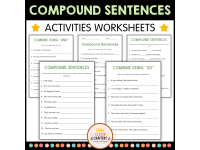
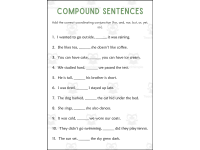
This set of 9 grammar worksheets helps students learn, practice, and master compound sentences in a step-by-step approach. The activities move from identifying compound sentences to combining simple ones using coordinating conjunctions (and, but, or, so).
Learners also practice selecting the correct conjunction, correcting punctuation, expanding sentences, and revising for clarity. The varied formats—identification, conjunction selection, editing, and short writing — make grammar practice engaging and effective. By the end, students confidently use commas and conjunctions to create smoother, more complex writing.
What’s Included:
9 printable worksheets
Practice with commas and coordinating conjunctions
Sentence identification, combining, and correction tasks
Identification, conjunction selection, and sentence-writing activities
Grades / Ages:
Ideal for Grades 1–6
Implementation Format:
Perfect for grammar lessons, writing workshops, literacy centres, or homework.
Answer Key:
Not included
File Type:
PDF (Non-editable)
Number of Pages:
9 pages total
License:
Paid product for personal or single-classroom use only
Tags to Use:
compound sentences, commas and conjunctions, coordinating conjunctions, grammar worksheets, sentence combining, punctuation practice, and but or so, grammar for elementary, ESL writing practice
Related resources
More resources teachers may find useful
24 related resources were found using this product's title, contributor, categories and tags.


In the classroom
Teaching tips & learning objectives

Learning objectives
Distinguish simple sentences from compound sentences
Combine two short sentences into one compound sentence using a specified conjunction
Punctuate a compound sentence correctly with a comma and coordinating conjunction

Teaching tips
Use the identification task to check understanding before combining sentences.
Practice one conjunction at a time before assigning mixed choices.
Ask students to read a completed sentence aloud and explain how its two ideas connect.

Skills covered
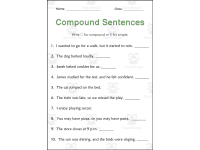
Simple vs. compound sentence identification — students label ten sentences as C for compound or S for simple.
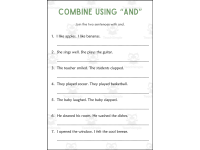
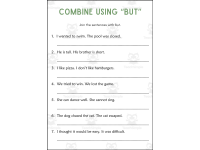
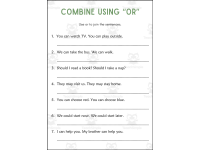
Sentence combining — students join short sentence pairs using and, but, or, and so across four dedicated pages.
Compound sentence punctuation — students rewrite sentence pairs with a correctly placed comma and conjunction.

No reviews yet
Downloaded this resource? Tell other teachers how it went.
Curriculum
Standards, concepts & topics
Standards
 Standards
- CCSS.L.2.1 — Demonstrate command of the conventions of standard English grammar and usage when writing or speaking. a. Use collective nouns (e.g., group). b. Form and use frequently occurring irregular plural nouns (e.g., feet, children, teeth, mice, fish). c. Use reflexive pronouns (e.g., myself, ourselves). d. Form and use the past tense of frequently occurring irregular verbs (e.g., sat, hid, told). e. Use adjectives and adverbs, and choose between them depending on what is to be modified. f. Produce, expand, and rearrange complete simple and compound sentences (e.g., The boy watched the movie; The little boy watched the movie; The action movie was watched by the little boy).
Core concepts
 Core concepts
Compound sentences
Coordinating conjunctions
Sentence combining
 Topics
More to explore
You may also like